Turnip greens - Tatsoi

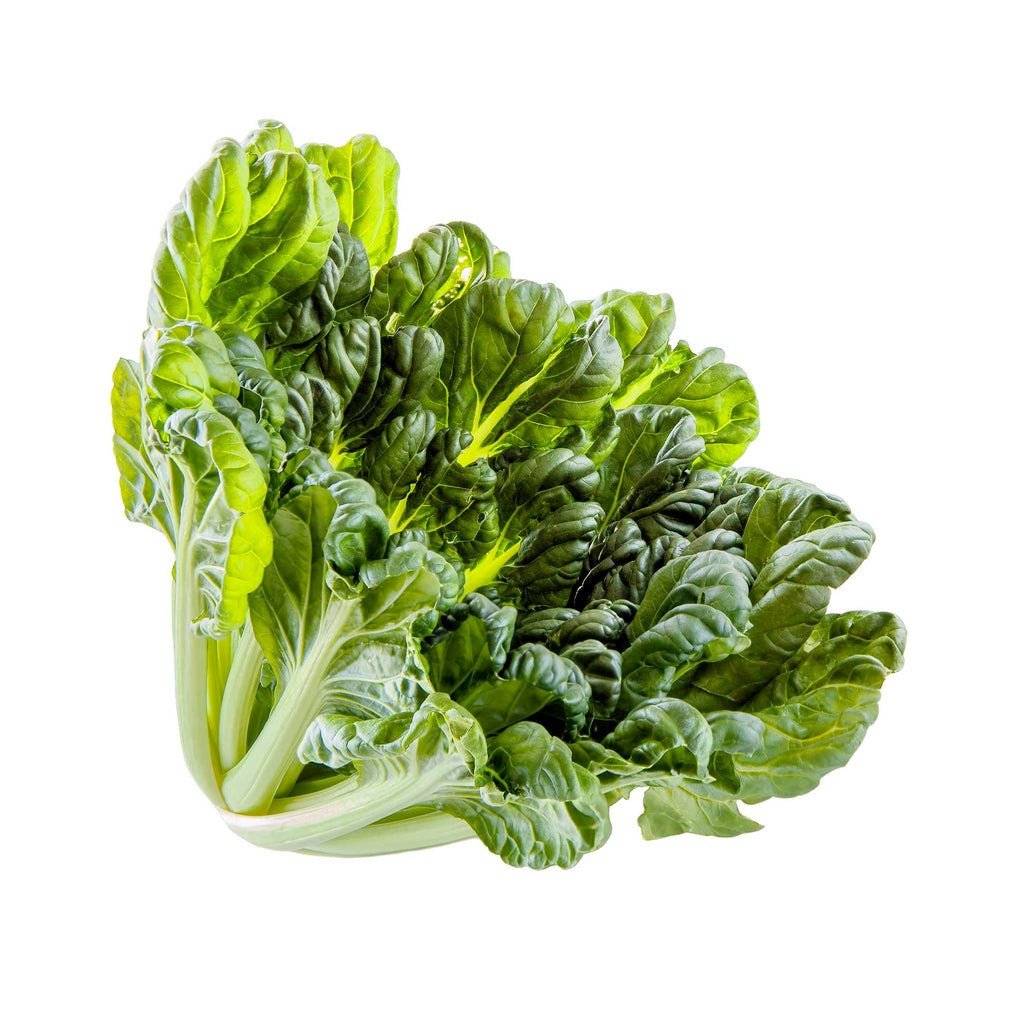
Turnip greens - Tatsoi
Brassica rapa subsp. narinosa / Brassica campestris subsp. chinensis var. rosularis
Plant family
Crucifers (Brassicaceae)
Cultivation Break
4 Years
Season Overview
Propagating
Planting
Harvest
Harvest
J
F
M
A
M
J
J
A
S
O
N
D
1ST YEAR
2ND YEAR
Details


Light requirement
Sunny

Water requirement
Moist

Soil
Medium (loamy)

Nutrient requirement
Medium

Dark germinator

Germination temperature
10 - 20 °C (Degrees Celsius)

Plant distance
25 cm

Row spacing
30 cm

Seeding depth
1.5 cm
Instructions
Description
Tatsoi (Brassica rapa subsp. narinosa, syn. Brassica narinosa or Brassica rapa subsp. Chinensis var. rosularis) is a close relative of pak choi, Chinese cabbage, kai-lan and turnip, from the cabbage genus (Brassica). It has also been given the name rosette pak choi or rosette bok choi because of the rosette-like arrangement of the leaves. Tatsoi is also known as spoon mustard or leaf mustard because of its small, spoon-shaped leaves. Tatsoi is a biennial herbaceous plant. It forms a taproot. The leaves are densely arranged in a basal rosette about 20 centimeters high. The spoon-shaped leaf blade is dark green and ribbed white. The four-petaled yellow flowers are about 1.5 cm in diameter. In the second year, an inflorescence up to 1 meter high develops. The oil from the seeds can be poisonous in some subspecies, as it can contain high levels of erucic acid. However, modern cultivars are usually free of it. Tatsoi was originally cultivated as an annual plant from the warm-temperate regions of China to the tropics. However, Tatsoi still grows in regions with cold seasons at temperatures down to -10 degrees. Due to its cold tolerance, Tatsoi is also suitable for cultivation in winter in unheated greenhouses. The plant requires a sunny or semi-shady location protected from the wind and loose soil. The harvest time in the temperate zones of China is usually in January and February, while the flowering time is in March. When grown in a greenhouse, the plant can also be harvested all year round. If the sowing period for greenhouse cultivation is between April and August, harvesting can take place between August and October. The harvest period usually lasts between 40 and 50 days. With so-called dwarf tatsoi, it takes around 20-25 days until the vegetables are ready to harvest.
Origin:
China, Japan
Growing tips
Tatsoi can be sown directly or grown on the windowsill. If you want to make the work a little easier, you can use pre-grown young plants from the garden center. The right time for sowing is crucial: Tatsoi sprouts if it is grown too late in spring or too early in fall. Tatsoi loves cool periods. There are two proven time windows: spring (from March/April, depending on the region) and late summer to fall (August to October). Late sowing produces particularly uniform rosettes with short days. On the balcony, you can start earlier if you pre-grow on the windowsill and put them out after the first milder days. Location Tatsoi grows quickly and is ready to harvest after around 45 days, as a baby leaf even just four weeks after planting. As it doesn't mind cooler temperatures, it can be sown in the fall for a second harvest. Although Tatsoi is undemanding in terms of temperature, it requires a sheltered location and well-drained, loose and humus-rich soil. The plant prefers full sun if it is watered sufficiently. Tatsoi's water requirement is generally low - however, it must not be allowed to dry out in order to avoid premature flowering. Direct sowing Place the seeds 1-1.5 cm deep and cover them thinly. Germination begins at around 10 °C, and is fastest at 15-20 °C. In the bed, sow in rows 25-30 cm apart; later in the row, you can space them out to 20-25 cm per plant. Stagger the plants in the balcony box so that each rosette gets its own light window. Make a shallow groove, pre-water it once, sow loosely and cover the seeds thinly with soil. Press the surface lightly so that the seeds have contact with the soil. Keep the top 2-3 cm of soil evenly moist for the first 10-14 days. Use a fine spray so that seedlings are not washed away. A thin layer of mulch made from dried grass clippings helps to retain moisture without weighing down the seedlings. Plan a small reseeding every 2-3 weeks to ensure a continuous harvest. For babyleaf, sow more densely and cut very young, as soon as the leaves are palm-sized. For full rosettes, give more space and harvest leaf by leaf or the entire plant. Pre-cultivation Pre-cultivation is worthwhile if there is still a threat of cold spells outside or if you want to harvest earlier. Use multi-pot trays, small pots or spring pots and fill them with loose, nutrient-poor potting compost. Plant 1-2 seeds per pot at a depth of 0.5-1 cm. Place in a bright spot, but not in full midday sun. 18-20 °C is ideal. The seedlings usually appear after 5-12 days. When two plants emerge, pinch off the weaker one just above the soil - this way you won't disturb the roots of the stronger one. As soon as 2-3 true leaves appear and the root ball holds well, transplant into larger pots or plant in a bed. Prick out as soon as the seedlings show 2-3 true leaves. Lift them with a pricking-out stick or spoon, grasp the leaf (not the stem), place them in fresh soil a little deeper, press down gently and water. In the bed, separate them early to 20-25 cm; you can use the small, removed plants as baby leaves in the kitchen. Planting Soil that is poor in nutrients should be supplemented with a little compost or manure before planting. Alternatively, fresh, high-quality soil can be worked into the soil. An increased potassium content meets the needs of cruciferous plants such as Tatsoi. Plant on a mild, overcast day or in the late afternoon. Pre-water the planting hole, set the plant straight in, fill in, press down just enough to secure it and water well. In full sun, provide light shade for the first 1-2 days to prevent the leaves from getting sunburnt. In windy conditions, a low-tensioned fleece will act as a wind break. Care The Tatsoi requires some care during growth - above all it needs to be watered and fertilized. It is important to provide the plants with an even supply of water, as otherwise they will quickly suffer from drought damage. You should also be aware of some diseases and pests. These points are important when caring for Tatsoi. Watering Make sure that the Tatsoi plants do not dry out. During hot days, regular watering is essential for the health of the plants. A mulch layer of grass clippings, straw or bark mulch also reduces evaporation and suppresses the growth of wild herbs. In hot and dry conditions, the tatsoi may bolt and flower. Flowering is then unavoidable, but to prevent a bitter taste, the flowering heads are cut off just below the first leaf base. However, the right time for sowing and the right care can prevent sprouting at an early stage. As with pak choi, all parts of the plant are edible. The flowering heads can be eaten in a salad, for example, but taste more intense and somewhat bitter. As tatsoi - like many cruciferous plants - is susceptible to mildew, water should only be distributed at the base of the plant. A soaker hose or drip irrigation is particularly suitable for this, or you can water carefully with a watering can or garden hose. Avoid wetting the leaves. Fertilizing Fertilizing Tatsoi is necessary during the short growing period. A nitrogen-rich fertilizer is suitable for this, as it optimally covers the nutrient requirements during the intensive growth phase. A slow-release fertilizer in granular form releases nutrients into the soil over a longer period of time. The plants absorb these, which supports healthy leaf growth. Diseases and pests As already mentioned, powdery mildew can become a problem on Tatsoi due to incorrect watering. However, the fungal disease cabbage hernia is also a danger that should not be underestimated. Pests such as earth fleas, but also aphids, cabbage white butterflies and cabbage flies can occur on Tatsoi. Harvest Tatsoi is ready to harvest after 40 to 50 days, baby leaf plants even after 30 to 35 days. Tatsoi should not be harvested during frost, as damage occurs at the points where the sensitive leaves touch. To harvest, the heads are cut off about 1 cm above the ground with a sharp, clean knife. In mild weather, the Tatsoi can sprout again if cut a little higher up, so that another harvest is possible. The second rosettes are smaller than the first, but just as aromatic. Storage Tatsoi can be stored in the same way as pak choi - in a cling bag or wrapped in a damp towel, the cabbage will keep in the fridge for up to a week. Due to its fine tissue, Tatsoi does not freeze as well as other plants in the Brassica family, such as kale or Brussels sprouts. Uses Tatsoi can be used in many ways. As a pesto, salad, steamed, stir-fry, Tatsoi vegetables and for garnishing soups, the cabbage is wonderful. It is a very versatile leafy vegetable that can be served both raw and cooked. Tatsoi can be used wherever you would use spinach or pak choi. Today, the vegetable is also used as an ingredient in smoothies.

Companion Plants
Bean (Dwarf bean)
Carrots
Celery (Celeriac / Celery root)
Celery (Celery)
Celery (Leaf celery / Chinese celery)
Chives
Coriander / Cilantro
Dill
Garlic
Lettuce (Common chicory)
Lettuce (Endive / Escarole / Erisée)
Lettuce (Lamb's lettuce)
Lettuce (Lettuce)
Lettuce (Radicchio / Italian chicory)
Lettuce (Sugar loaf)
Nasturtium
Onion
Onion (Spring onion)
Parsley
Spinach (Summer)
Spinach (Winter)
Tagetes / Marigolds
Thyme

Antagonistic Plants
Abyssinian cabbage / Ethiopian mustard
Arugula / Rocket
Aubergine / Eggplant
Broccoli
Broccoli raab / Stem cabbage / Cima di rapa
Brussels sprouts
Brussels sprouts
Cabbage (Cabbage)
Cabbage (Pointed cabbage)
Cabbage (red cabbage)
Cabbage (Savoy cabbage)
Cauliflower
Chinese kale - Kai-lan / Chinese broccoli
Collard greens
Collard greens (Kale)
Collard greens (Tuscan kale / Dinosaur kale / Palm tree kale)
Corn / Maize
Kohlrabi / German turnip / Turnip cabbage
Mustard
Napa cabbage / Chinese cabbage
Okra
Pak Choi
Pepper / Paprika
Potato
Radishes
Rapeseed
Rapeseed - Sheer cabbage / Siberian cabbage
Rapini / Broccoli rabe
Rutabaga / Swedish turnip
Sea coal
Tomato (Bush tomato)
Tomato (Cocktail bush tomato)
Tomato (Cocktail Stake Tomato)
Tomato (Stake tomato)
Turnip
Turnips - Oilseed turnips
Turnips - Wild turnips
Vegetable cabbage - Forage cabbage
Vegetable cabbage - Ribbed cabbage / Portuguese cabbage
Vegetable cabbage - wild cabbage / ancient cabbage

Diseases
Black spot of roses
Grey mold
Root Rot
Club root of cabbage
Downy mildew

Pests
Land snails
Thrips
Cabbage white
Cabbage fly
Cabbage heart midge
Flea beetles
Aphids
Voles