Herbst-Säulenapfel 'Black McIntosh'

Variety
Herbst-Säulenapfel 'Black McIntosh'
Approved Data
created by Alex&Sempi at 02.04.2026
Features
Taste
aromatic
Location
light: sunny to semi-shady
Growth habit
growth habit: columnar
columnar fruit trees
insect pollination
Resistances
woolly apple aphid resistant
Color
Frucht: dunkelrot
Frucht: rotviolett/violettrot
Fruchtfleisch: cremeweiß
Fruit shape
Kernfrucht
Season Overview
Planting
Harvest
Harvest
J
F
M
A
M
J
J
A
S
O
N
D
1ST YEAR
FOLLOWING YEARS
Description
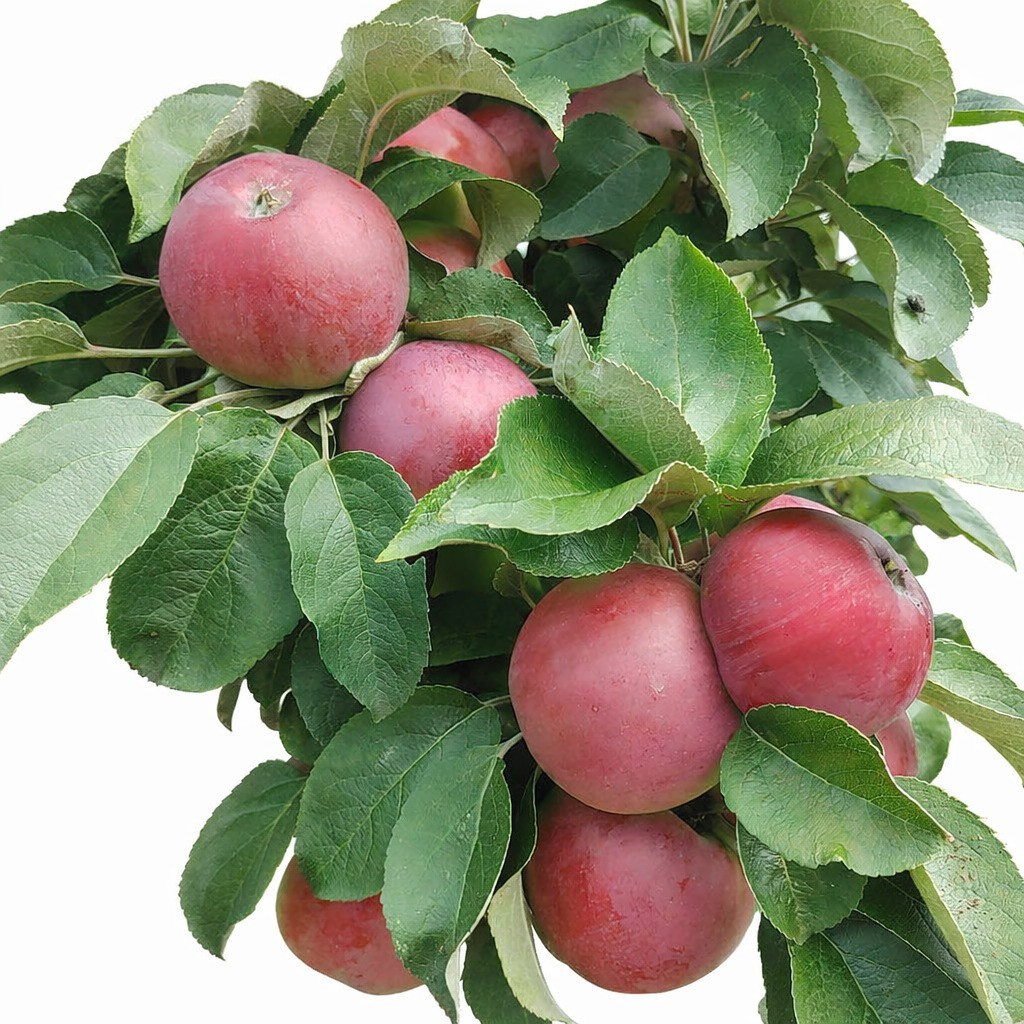
The 'Black McIntosh' columnar apple tree is a variety of the popular American 'McIntosh' apple known for its particularly dark-colored fruit. It is characterized by very narrow and slow growth, reaching a height of only about 1.5 to a maximum of 3 meters. Especially when grown in a container, it rarely exceeds 2 m in height and 40 cm in width, making it an ideal apple tree for small gardens, balconies, and patios. As a typical winter apple, it bears fruit very late in the year. The harvest season begins around mid-September and extends into October. The juicy apples are medium to large in size and, when ripe, display a beautiful dark red to bluish-frosted color with only occasional green spots. Nevertheless, the fine-textured and firm flesh of Malus domestica 'Black McIntosh' apples is greenish-white, and its sweet and juicy flavor has a refreshing, mildly tart note. The fruit is usually eaten fresh, but is also well-suited for baking and for making compote, juice, or applesauce. They are considered easy to store and can be kept unprocessed until November. The tree’s short stature and columnar shape make harvesting easier and make the columnar apple ‘Black McIntosh’ particularly popular with children and older people, who can comfortably pick and eat the fruit without having to climb. However, for the tree to produce apples, a second apple tree is required nearby to act as a pollinator. Among the best varieties for this purpose are 'Glockenapfel', 'Goldparmäne', 'James Grieve', and 'Klarapfel'. As an early-bearing variety, the 'Black McIntosh' columnar apple tree often bears fruit for the first time as early as its second year. In addition to its value as a fruit-bearing tree, it is also very decorative. It attracts a lot of attention as early as the blooming season in April and May. The blossoms display a wide color spectrum ranging from striking dark red to delicate pink to innocent creamy white. After they fade, the lush green of the leaves remains until the apples, with their deep red, and the autumn foliage, with its bright yellow, add new splashes of color toward the end of the year. It is very frost-hardy and is considered winter-hardy throughout Germany. Origin The cultivated apple (Malus domestica), which belongs to the rose family (Rosaceae), is one of the most popular and most widely cultivated fruit trees worldwide. Like its relatives the pear, quince, and medlar, the apple is also a so-called pome fruit. Today’s cultivated varieties can be traced primarily to the wild forms, the crabapple (Malus pumila) and the wild apple (Malus sylvestris), whose original range is Asia Minor. The apple tree was already of great importance in ancient times. Apple cultivation came to Germania with the Romans and took root there. In Western Europe, Charlemagne (742–814) and many monasteries contributed to its spread. The apple is, not least because of its appearance as the fruit of knowledge in the Bible, a symbol of the feminine principle, temptation, and the earth. Thus, the legend of the tree of paradise and its fruits appears in a wide variety of cultures. For about a hundred years, the breeding of new apple varieties has been carried out systematically. There are currently over 100,000 varieties worldwide, of which about 1,500 are cultivated in Central Europe. Many of them, however, play no role in commercial trade and are more of a niche for enthusiasts. Appearance and Growth The apple tree is a tree growing up to ten meters tall with ascending or spreading branches, a deep taproot, and scaly, irregularly flaking bark. The alternate leaves are oval, finely serrated, and either felt-like on the underside or smooth. When the apple tree opens its flowers in terminal clusters in late spring—usually in the weeks from late April to mid-May—five to ten flowers and a rosette of leaves emerge from the thick buds on the fruiting wood. The five petals of the flowers vary in shape and color depending on the variety. In most cases, they first appear pinkish-red, then pure white. In warm regions, flowering begins much earlier than in harsh areas or cool northern locations. The fruits of the apple tree are divided internally by parchment-like walls into five compartments, each containing two seeds. Depending on the variety, the apples range from spherical to flat, and are green, yellow, or reddish.
F1 Hybrid
Frostproof
Growing tips
Typical uses for the columnar apple 'Black McIntosh' are as a container plant on balconies and terraces or as a space-saving fruit tree in small gardens. The attractive little apple tree is also well suited as a tempting vitamin supplier in children's play areas, as a pollinator plant for other apple trees that takes up little space and as an insect pasture that attracts valuable pollinators such as bees and bumblebees to the garden with its nectar and pollen. As a plant native to Central Europe, Malus domestica 'Black McIntosh' is undemanding and grows in almost any normal garden soil. However, it feels most at home in moist, well-drained soil with a high nutrient content. Dry soils can be well compensated for by watering and substrates that tend to become waterlogged can be prevented by planting and draining with a 10 cm thick layer of crushed stone or gravel underneath. The ideal spot for the crab apple is sunny to semi-shady, with slightly higher yields and sweeter fruit to be expected in the sun. However, good and consistent yields require a little patience and regular thinning pruning. In addition, any side shoots that have become too long should be cut back to a length of around 10 to 20 cm in spring or summer in order to maintain the space-saving column shape. Otherwise, 'Black McIntosh' hardly needs any care. However, it responds gratefully to an annual fertilization with a commercially available organic slow-release fertilizer in March or April, especially if the substrate is not very rich in nutrients. Location and soil Apple trees thrive best in deep, nutrient-rich soils supplied with humus. Cold, wet locations lead to poor tree and fruit development and increased disease infestation. It is important to choose a location that is not susceptible to late frost, as the open apple blossom can only tolerate temperatures of around minus one degree Celsius. How do you plant an apple tree? The rootstock is decisive for the growth height of an apple tree. Ask a tree nursery for advice on which apple variety and which tree shape - half-stem, standard, spindle, espalier or bush - is suitable for your chosen location. They will also recommend the necessary pollen-producing variety, as apple trees cannot usually fertilize themselves, so they need a second tree to produce fruit. Find out in advance about the disease tolerance, taste and shelf life of the variety you want. Modern, resistant varieties are usually the better choice. At some tree nurseries, you can sample the fruit of different apple varieties at planting time in the fall. Apple trees are mainly available as bare-rooted trees - i.e. without a root ball. They are easier to care for and harvest. They are uprooted in the nursery in the fall when they have shed their leaves. Apple trees are best planted in the desired location in the garden from the end of October to the end of March. Dig a hole twice the size of the root ball with a spade and loosen the base with a digging fork. Drive a support stake into the ground with a hammer on the side of the main wind direction. Before placing the root ball in the pit, fill the planting hole with a mixture of loose garden soil and compost so that the trunk is level with the soil surface. Compost has also proven to be a good additive for filling the sides of the pit. When placing the excavated soil, you should gently shake the tree trunk from time to time so that the soil can be well distributed between the roots. Take care not to bend the roots. It is also important that the apple tree is not planted deeper than it was previously in the ground. Once the tree has been planted, the soil must be well tamped down and watered in at the watering edge. The apple tree then needs a pruning cut, in which the top and all side shoots of the tree are shortened by no more than half. The tree is secured to the stake with a coconut rope in the shape of a figure of eight. If you want to be on the safe side and ensure that the young crown is not immediately infested by insect pests, you can attach glue rings to both the stake and the trunk. If you need to replant an apple tree, it is best to do this within the first four years after planting. Fall is the best time to move the tree in the garden. How do you care for an apple tree? During dry periods, the apple tree should be watered from time to time and a balanced supply of nutrients is also necessary for healthy growth. Fertilize your apple tree for the first time in early spring (mid-March at the latest), preferably with a natural fertilizer such as horn shavings. In addition, cover the area around the trunk once or twice a year with well-rotted compost. This compost treatment stimulates the tree to produce new shoots and ensures that it bears more fruit. In summer, you can supplement the treatment by pouring an apple infusion over the entire eaves area several times a year. To do this, scald two handfuls of coarsely chopped apple leaves and chopped apples with two liters of boiling water. Allow to cool, pour the mixture through a sieve and dilute the infusion to 15 liters. If the tree bears a lot of fruit in one year, you should thin out the fruit clusters on your apple tree. This applies in particular to varieties that are prone to so-called alternance: A high fruit set leads to the apple trees not flowering or hardly flowering at all the following year, as they produce too few flower buds for the following year. The fruit set is then all the more sparse. Training and pruning Regular pruning of the apple tree helps to keep it healthy, strong and fruitful. The crown should always be light - old and inward-growing wood should therefore be cut away. Winter pruning is preferable for regular fruit yields and low shoot growth. This stimulates wood growth. The situation is different with very strong growth and abundant fruit growth. In this case, it is advisable to prune the apple tree in August and thin it out as soon as the fruits are the size of walnuts. You can leave one or two fruits on each fruit stand. The remaining apples will be larger and more intense in color and taste as a result of the pruning. And: the tree can produce enough fruit buds again for the next year. Fertilization Apples are cross-pollinated, which means that pollination with pollen of the same variety is not possible. This requires so-called pollen donors, i.e. at least one other apple variety in the vicinity that opens its flowers during the same period. Bees are also needed to ensure that the trees produce lots of fruit. In cool spring weather and also due to the declining number of bee colonies, bumblebees and wild bees are increasingly having to take over pollination. Tip: Attract beneficial insects to the garden with nesting aids and food plants. Unfertilized or insufficiently fertilized flowers are rejected one to four weeks after flowering ("post-flowering fall"). If pollination has been successful, only the petals fall off. The sepals dry up and remain as a small crown. Initially, growth is slow: at the end of May, the young apples are about the size of a walnut. When the fruit falls in June, the tree sheds all the fruit that cannot be nourished or develops poorly. The remaining apples continue to grow all the faster. The first cool nights promote picking ripeness and the typical coloring of the skin. This explains why the harvest hardly starts later in less favorable locations than in warmer climates. Harvesting and using apples The apple harvest begins as soon as the fruit can be easily removed from the stem, has the color typical of the variety and the flesh is no longer too green. You can then pick the apples. Storage varieties are harvested before this time - this increases their shelf life. Make sure that storage varieties do not have any damage or rot. You should store the harvested apples in a frost-free room at a constant temperature - for example in a cellar with a natural floor. Alternatively, you can line the crates thickly with corrugated cardboard and store them on a sheltered balcony. Special attention should also be paid to the glassiness of the apples: If more than a third of the flesh is glassy, the apples cannot be stored. A popular method of preserving pomaceous fruit is to preserve apples, for example as apple sauce. Homemade apple cider vinegar, which is said to help with weight loss and also balances the acid-base balance, or homemade apple liqueur also keep for a long time. If you don't have a suitable place to store the fruit, you can also freeze apples. Apples have 52 calories per 100 grams and are good for the body: for example, they contain important vitamins, minerals and phytochemicals. The fiber they contain also ensures that apples are healthy. Propagating apple trees Apples are propagated by grafting. You can either graft the apple tree by copulation onto bare-root apple rootstocks or, in summer, by oculation, in which only one eye with a strip of bark of the premium variety is pushed behind the t-shaped cut bark of the grafting rootstock. Diseases and pests The most common diseases and pests on apple trees include codling moths and apple web moths as well as fungal diseases such as powdery mildew and apple scab. To combat the scab fungus, you need to know its annual cycle: The fungus overwinters in the fallen leaves on the ground and forms microscopically small fruiting bodies there in spring. The spores they contain are transferred to the young leaves by wind and water splashes and infect them. As a result, slightly oily scab spots form on the leaves at the beginning. The pear-shaped spores that develop here infect leaves and fruit during the summer, including those of apple trees in the immediate vicinity and further afield. Dark, jagged spots appear on the fruit, with small cracks forming in the center. The cycle is completed when the leaves fall off again in the fall. Important: Collect the fallen leaves as completely as possible in the fall and dispose of them in the organic waste garbage can. Spraying with suitable agents should always be carried out in early spring from the budding stage in order to prevent the first infections. For new plantings, opt for less susceptible varieties such as 'Retina', 'Rewena', 'Rebella', 'Topaz' or 'Florina'.
Details


Light requirement
Sunny

Water requirement
Moist

Soil
Medium (loamy)
Nutrient requirement
Medium

Dark germinator

Plant distance
60 cm

Row spacing
60 cm

Seeding depth
1 cm

Companion Plants

Antagonistic Plants
No antagonistic plants
Diseases
Powdery mildews
Pests
Schildläuse
Caterpillars
Aphids