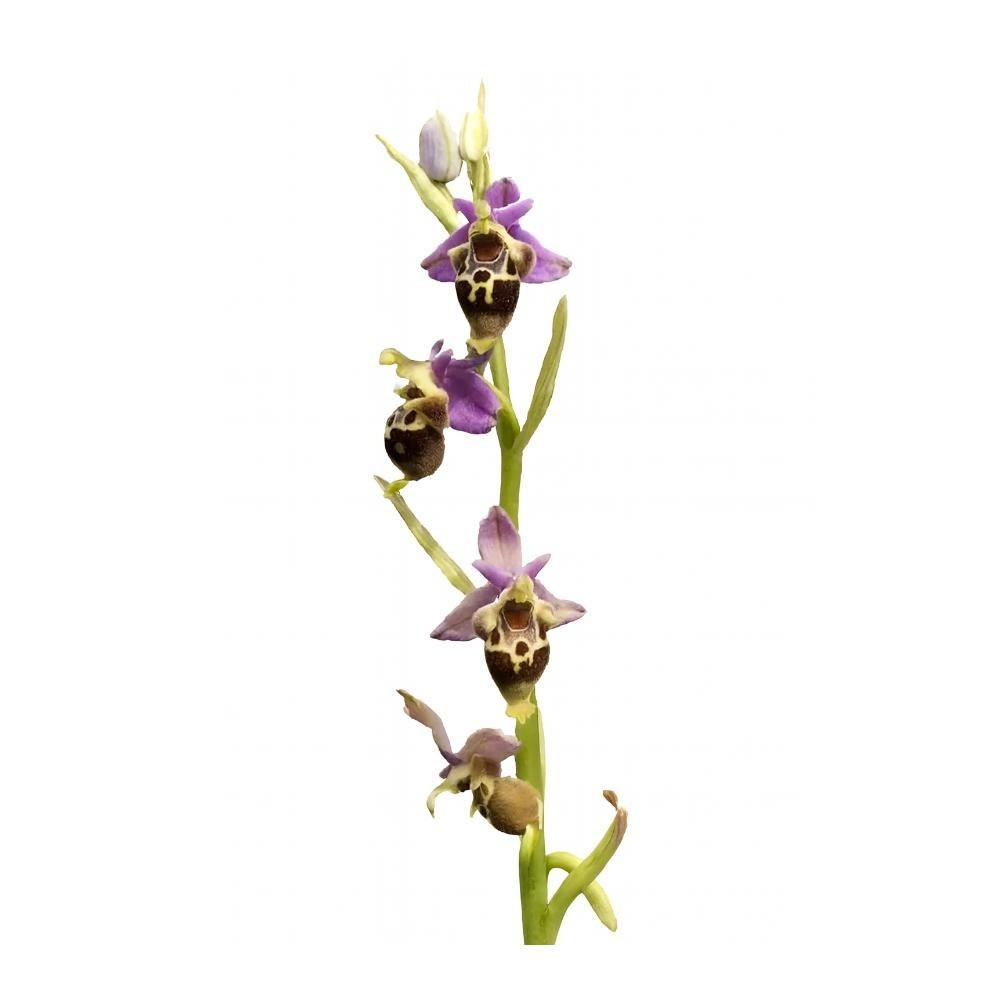
Schnepfen - Ragwurz (Wildform)

Variety
Schnepfen - Ragwurz (Wildform)
Approved Data
created by Alex&Sempi at 21.02.2026
Features
Resistances
robust
resistant
drought tolerant
Pest-resistant
Little susceptible
frost-sensitive
hardy with protection
hardy down to -10°C
Color
pink-red
Flower: pink
Flower yellow
Blüte: kastanienbraun
green
brown
glossy
Blätter: silbergrau
Frucht: braungrün/grünbraun
Oberfläche: schimmernd
Wurzel: weiß
Wurzel: gelb
Blattrippen: grün
Samen: braun
Wurzel: beige
Behaarung: silbergrau
Samen: beige
Oberfläche: samtig
Stamm, Stiel: hellgrün
Taste
not edible
Toxizität: ungiftig
Growth habit
cross-pollination
insect pollination
lifespan: perennial
leaves: rosulate
growth habit: rosette-shaped
height: 50 - 60 cm
root type: bulb, tuber
propagation by offsets
Wuchsform: krautig
Blüte: Täuschblüte
Game Variety
growth habit: upright leaf position
growth habit: upright slender
ornamental plant
hermaphroditic
growth habit: upright flower stems
entire leaves
small flowers
spicate flowers
Scentless flowers
weak to medium growth
non-woody
slow growth
no lateral shoot development
Spear shaped leaves
propagation by seeds
leaves slim
perennial
Blätter: zugespitzt
Blätter: mittelgroß
Geschlechtertyp: einhäusig
Keimung: Lichtkeimer
Blätter: weich/zart
Blätter: einfach
Schnitt: nicht erforderlich
Blätter: länglich
Blütenstand: einzeln, kleine Gruppen
Blütenform: zygomorph (spiegelbildlich)
Wuchsform: terrestrisch
Lifespan: moves in early summer
Vermehrung: samenfest
Stamm, Stiel: behaart
Blüte: behaart
Stamm, Stiel: rund
Stamm, Stiel: fleischig
Blätter: wintergrün
Stamm, Stiel: gerillt
Lebenszyklus: treibt im Spätsommer aus
Fruit shape
capsule
grooved
slim
Thin
small
Form: langoval, zylindrisch
Oberfläche: trocken
Form: aufrecht wachsend
Location
Soil moisture: moderately dry to fresh
biotope: mountain area
biotope: forest
Biotop: Magerrasen, Trockenwiese
Biotop: Savanne / Buschland
planting: bed
planting: outdoor
light: sunny to semi-shady
Soil: permeable soil
soil moisture: no waterlogging
Fertilization: nutrient-poor
soil moisture: well-drained
Soil: light
Soil: gravelly to sandy
fertilization: low-humus
Soil: sandy
planting: heat protected
Wind: windverträglich
fertilization: low-nitrogen
Soil: rocky, stony
Soil: loosened
Water: Adequate
Water: sparingly
pH value: neutral to alkaline (7-8)
Planting: rock garden / alpine garden
Planting: edge of wooded areas or beneath trees
Soil: mineral
fertilization: no peat
Heat requirement: moderate
Boden: kalkhaltig
Licht: vor Mittagssonne geschützt
Nachbarn gute: trockenheitsliebende
Nachbarn schlecht: feuchtigkeitsliebend
Good companions: calcium-loving
Nachbarn schlechte: stark wuchernd
Nachbarn schlechte: hoher nährstoffbedarf
Nachbarn gute: mit niedrigen Nährstoffbedarf
Nachbarn schlechte: hochwachsend
Nachbarn gute: niedrigwachsend
Gartenstil: Naturgarten
Herkunft: einheimisch, indigen
Boden: flachgründig (0-30)
Boden: karg
Düngung: nicht erforderlich
Soil moisture: not too moist
Pflanzung: Wiese
Season Overview
Sowing
Harvest
Harvest
J
F
M
A
M
J
J
A
S
O
N
D
1ST YEAR
FOLLOWING YEARS
Description
The snipe orchid (Ophrys scolopax) is a plant species belonging to the genus Ophrys within the orchid family (Orchidaceae). This plant species is found in sparse forests and scrubland, garrigue, nutrient-poor meadows and grasslands with moderately dry to fresh, but always alkaline soils up to an altitude of 2000 meters above sea level. Growth This perennial herbaceous plant reaches heights of between 10 and 65 cm and has two egg-shaped to spherical tubers as survival organs. One to two scale leaves are found at the base of the stem. Three to seven leaves are grouped together in a basal rosette, and one to two, sometimes four, additional leaves are found further up. The elongated inflorescence consists of two to twelve, in rare cases even 20 flowers. The narrow elliptical to ovate sepals are pink to red and rarely whitish green to green in color. The hairy petals appear pink to red. The deeply three-lobed and short-haired lip, on the other hand, is chestnut brown. Sometimes it has a faint violet tone. The narrow bare edge is yellowish in color. The spot is very extensive in the lower half of the lip. It uses Peckham's mimicry, imitating the appearance of long-horned bee females in order to attract males for pollination. This species flowers between March and June. Early and late flowering variants are often found in the same area. Subspecies This group is one of the most diverse and difficult to classify among the ragworts. This also leads to many different types of classification. Eight subspecies are presented below. However, it remains to be clarified whether this is correct, as the different variants cannot be clearly distinguished from one another. - Ophrys scolopax subsp. scolopax (snipe orchid) - Ophrys scolopax subsp. cornuta (small-flowered horned orchid) - Ophrys scolopax subsp. heldreichii (small-flowered Heldreich's orchid) - Ophrys scolopax subsp. apiformis (Tunisian Ragwort) - Ophrys scolopax subsp. conradiae (Conrad's Ragwort) - Ophrys scolopax subsp. philippi (Philippe's Ragwort) - Ophrys scolopax subsp. sardoa (Sardinian Ragwort) - Ophrys scolopax subsp. vetula (Seealpen Ragwort) Ragworts (Ophrys), also known as Kerfstendel, form a genus of plants in the orchid family (Orchidaceae). They are mainly found around the Mediterranean and survive the dry summer with the help of an underground tuber. For pollination, the flowers attract male insects by producing fragrances and resembling insects in appearance. The insects transfer pollen when they attempt to copulate with the flowers. Depending on the interpretation, the genus comprises 10 to 350 species. The botanical genus name Ophrys is derived from the Greek word ophrys for "eyebrows." The "term" Ophrys was first mentioned by Pliny the Elder in his work Naturalis historia. Growth Ophrys species are relatively small, perennial, herbaceous plants. They usually reach heights of 10 to 40 centimeters, but there are also flowering specimens that are only 5 centimeters tall, while other species reach up to 90 centimeters. They survive the unfavorable season with an underground tuber. During the growing season, this tuber is replaced by one, rarely two new ones. The tubers are round to slightly oval and are formed partly from root tissue and partly from shoot tissue. They contain living cells that store starch and dead cells that store water. Above the tubers, fibrous roots emerge from the shoot. The leaves form a basal rosette, and additional smaller leaves may be arranged on the stem; or the leaf rosette is loosely distributed with leaves scattered along the stem. A few flowers are loosely arranged in a terminal, racemose inflorescence. The ovary is sessile, not hairy, and not or only slightly twisted. The flowers are resupinate, relatively large, conspicuous, and resemble an insect. The hermaphroditic flowers are zygomorphic and trifoliate. The tepals are not fused together. The three outer tepals (sepals) are white, pink, or greenish, usually glabrous. The lateral petals are smaller than the outer petals and hairy. The lip is entire to three-lobed, often with an appendage or a superimposed tip at the end. The lip is usually convexly curved, with the tip sometimes curved upwards in the opposite direction. Unlike related genera, the lip of ragwort does not have a spur. At the base of the lip there is a conspicuously colored area in the center, often with two elevations on either side. In the center of the lip there is a smooth, often shiny area, while the lip is hairy towards the edge. The column combines the stigma and the stamen; between the two is the poorly developed separating tissue (rostellum), which often has two small, colored lateral outgrowths. The two pollinia are connected by stalks, each with a separate adhesive disc (viscium). Pollination Orchids of the genus Ophrys are known for their special pollination mechanism. The lip of an Ophrys flower mimics a female insect. Male insects are deceived and transfer pollen during a process known as pseudocopulation. This phenomenon is called sexual deception and is a form of mimicry (deceptive mimicry). The sensory components of sexual deception consist of olfactory (scent), visual (color, shape), and tactile (hairiness) stimuli. The scent of the flowers, which in many species is a mixture of low-volatility hydrocarbons that is imperceptible to the human nose, is the most important stimulus for specifically attracting male pollinators. It is an "almost" exact copy of the sexual pheromones of female insects and therefore triggers the same search and copulation behavior as the corresponding female scents. Tactile stimuli are particularly important. Depending on the orientation of the hairs, a male insect can recognize where the "front" and "back" of a female are. The orientation of the hairs on Ophrys flowers therefore determines whether the pollinator attempts to copulate with the flowers "head first" or "abdomen first." The pollinia are accordingly removed and transported with the head or the rear body (abdomen). The consequence of the sexual deception mechanism is a certain specificity in pollination, because attraction via sex pheromones is relatively specific, but in the heat of the moment it becomes non-specific. The result is therefore countless hybrids. In most cases, the pollinators are solitary bees, for example of the genera Andrena, Eucera, Anthophora, etc. A few Ophrys species are pollinated by digger wasps (Ophrys insectifera), dagger wasps (Ophrys speculum), beetles, flies (Ophrys fuciflora) or plant wasps (Ophrys insectifera var. subinsectifera). Due to this dependence of Ophrys species on their respective pollinators, the protection of orchids should therefore always take into account the protection of the corresponding pollinating insects.
Non hybrid
Frostproof
Growing tips
Location Light: Sunny to semi-shady, warm spots are ideal. Soil: Lime-rich, well-drained, nutrient-poor, rather dry. Suitable for: Nutrient-poor grassland, dry meadows, rock gardens, semi-natural areas. Planting Time: Fall or spring. Tubers: Plant shallow, soil not too nutrient-rich. Spacing: 15-20 cm, as they form small clumps. Care Watering: Only water lightly during longer dry periods. Avoid waterlogging at all costs. Fertilization: No fertilization - they prefer lean soils. Hardiness: Fully hardy down to -20 °C. Propagation: By seed (slow, requires mycorrhizal fungi). Vegetatively by tuber formation. Special features Flowering time: April to June, depending on species. Flowers: Decoy flowers - imitate insects (e.g. bee, fly, bumblebee orchid). Height: 15-40 cm. Species diversity: Over 200 species and subspecies in Europe and the Mediterranean region. Ecological importance: Highly specialized pollination strategies, important for biodiversity.
Details


Light requirement
Sunny

Water requirement
Dry

Soil
Light (sandy)
Nutrient requirement
Low

Light germinator

Plant distance
10 cm

Row spacing
15 cm

Seeding depth
3 cm


Antagonistic Plants
Diseases
Root Rot
Grey mold
Fusarium
Pests
Land snails
Voles