Bocks-Riemenzunge (Wildform)

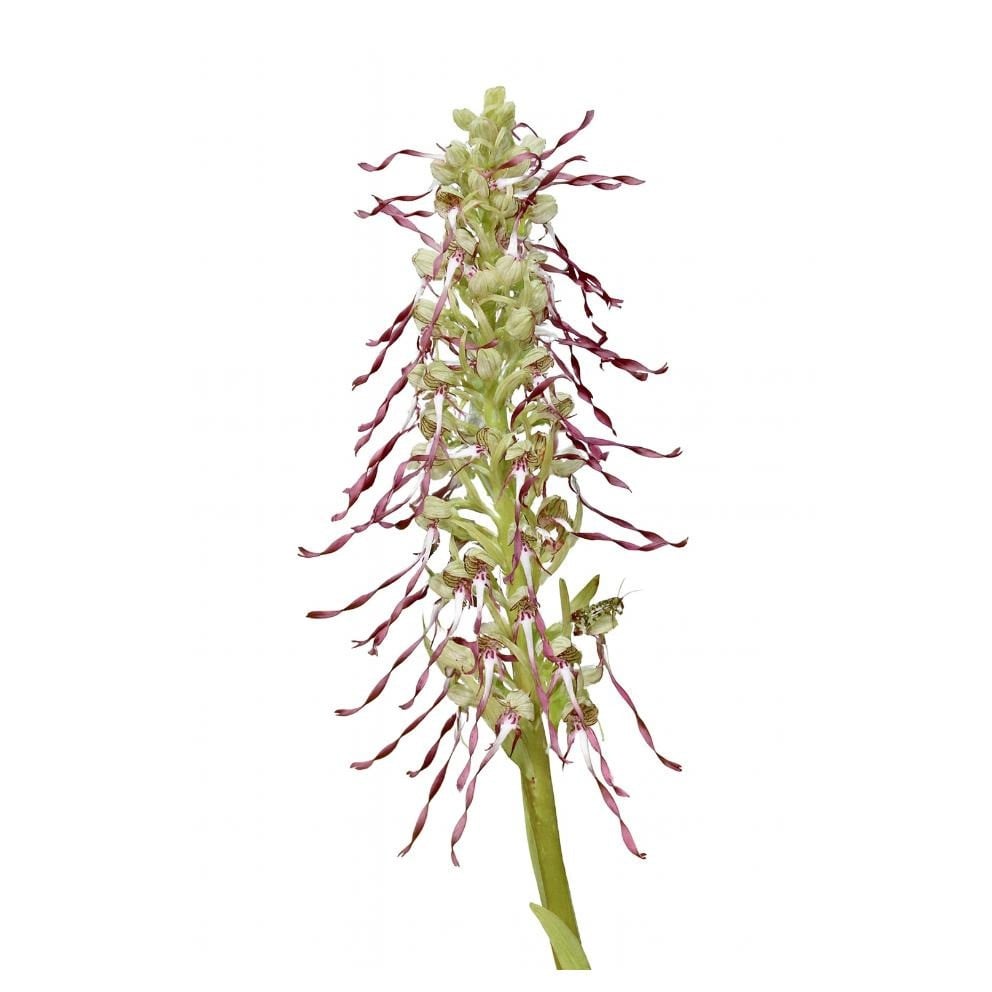
Variety
Bocks-Riemenzunge (Wildform)
Approved Data
created by Alex&Sempi at 21.02.2026
Features
Growth habit
lifespan: perennial
growth habit: high
Game Variety
growth habit: upright leaf position
leaves: rosulate
leaves: loosely leafed
leaves: Deciduous
Cold germination
fast growth
growth habit: rosette-shaped
cross-pollination
growth habit: upright slender
lifespan: short-lived
ornamental plant
Fragrant flowers
panicle-shaped flower
height: 50 - 60 cm
height: 80 - 100 cm
wide: 20 - 30 cm
height: 60 - 80 cm
hermaphroditic
height: 70 - 90 cm
growth habit: upright flower stems
root type: bulb, tuber
entire leaves
spicate flowers
strong growth
no lateral shoot development
Spear shaped leaves
propagation by seeds
leaves slim
perennial
insect pollination
Blüte: mittelgroß
Blätter: zugespitzt
Blätter: mittelgroß
Geschlechtertyp: einhäusig
Keimung: Lichtkeimer
Wuchsform: krautig
Blätter: einfach
Schnitt: nicht erforderlich
Blätter: länglich
Blütenform: zygomorph (spiegelbildlich)
Wuchsform: terrestrisch
Lifespan: moves in early summer
Vermehrung: samenfest
Stamm, Stiel: rund
Stamm, Stiel: fleischig
Stamm, Stiel: kahl
Lebenszyklus: treibt im Spätsommer aus
Fruit shape
elongated
triangular
smooth, sleek
capsule
Oberfläche: trocken
Color
grey-green
light brown
glossy
Flower: white
Flower: red
Blüte: braun
Blüte: grün
Frucht: grün
Stem, trunk: greenish-grey
Wurzel: weiß
Wurzel: cremeweiß
Blattrippen: grün
Samen: braun
Samen: beige
Musterung: gepunktet
Resistances
resistant
robust
drought tolerant
Little susceptible
susceptible to late frost
hardy down to -20°C
Location
planting: outdoor
planting: house wall / wall
Soil: permeable soil
soil moisture: no waterlogging
biotope: mountain area
Planting: mounds / ridges
Fertilization: nutrient-poor
light: light shade.
light: Full sun
soil moisture: well-drained
fertilization: low-humus
Soil: light to medium-heavy
Soil: sandy to loamy
Wind: windverträglich
fertilization: low-nitrogen
Soil: rocky, stony
Soil: loosened
Water: sparingly
pH value: neutral to alkaline (7-8)
Soil moisture: moderately dry to fresh
Planting: rock garden / alpine garden
Light: Sun
Soil: mineral
Soil moisture: dry
fertilization: no peat
Heat requirement: moderate
Boden: kalkhaltig
Pflanzung: Trockenmauer
Biotop: Feld
Nachbarn gute: trockenheitsliebende
Nachbarn schlecht: feuchtigkeitsliebend
Nachbarn schlechte: Schattenpflanzen
Good companions: calcium-loving
Good companions: sun-loving
Nachbarn schlechte: stark wuchernd
Nachbarn schlechte: hoher nährstoffbedarf
Nachbarn gute: mit niedrigen Nährstoffbedarf
Nachbarn schlechte: hochwachsend
Nachbarn gute: niedrigwachsend
Gartenstil: Naturgarten
Biotop: Magerrasen, Trockenwiese
Herkunft: einheimisch, indigen
Pflanzung: Hügelbeet
Boden: flachgründig (0-30)
Boden: karg
Düngung: nicht erforderlich
Gartenstil: Duftgarten
Soil moisture: not too moist
Biotop: Ruderalflächen
Pflanzung: Wiese
Taste
not edible
Toxizität: ungiftig
Season Overview
Sowing
Harvest
Harvest
J
F
M
A
M
J
J
A
S
O
N
D
1ST YEAR
FOLLOWING YEARS
Description
The genus of lizard tongues (Himantoglossum) in the orchid family (Orchidaceae) contains only a few species. They are mainly native to southern Europe and the Mediterranean region, with only the Bocks lizard tongue also occurring in warmer areas of Central Europe. Lizard tongues are widespread throughout the Mediterranean region. In Western Europe, their range extends north to England, and in the southwest, they are found as far as North Africa. To the east, they are found in Turkey and Iran. They are always found on dry, calcareous soils in sunny to semi-shaded locations. In addition to grasslands, abandoned fields, and various Mediterranean shrub communities, they also colonize sparse forests. Growth These are vigorous, perennial herbaceous plants with two elongated oval tubers as survival organs. The leaf rosette sprouts in autumn and is largely complete by winter. The leaves are elongated to strap-shaped. The leaves begin to wilt or are already wilted during the flowering period. Depending on the location, the flowering period extends from April to August. The terminal, racemose inflorescence is covered with numerous flowers. The bracts are long and tower above the ovary. This is twisted so that the flowers are resupinate. The petals are greenish to purple. The three outer petals and the lateral petals adhere to each other and form a hood. The three-lobed lip is strongly elongated, especially the middle lobe. This is linear in shape and twisted to the left; it often ends in a deep incision. The side lobes are shorter and have a wavy edge. The base of the lip forms a spur. The column is short, and the stamen contains two pollinia, which hang via pedicels (caudiculae) on a common adhesive disc (visidium) surrounded by a hemispherical membrane (bursicula). The stigma is round to rounded-square. The separating tissue between the stigma and stamen (rostellum) is clearly developed. The flowers are pollinated by various bees from the genera Andrena, Apis, and Colletes. The spur contains small amounts of sugary nectar.
Non hybrid
Frostproof
Growing tips
Location Light: Sunny to semi-shady, prefers warm, dry places. Soil: Lime-rich, well-drained, rather dry to moderately fresh. Suitable for: Nutrient-poor grassland, dry meadows, rock gardens, semi-natural areas. Planting Time: Spring or fall. Tubers: Plant flat, soil not too rich in nutrients. Spacing: 30-40 cm, as the plants can grow very large. Care Watering: Only water lightly during longer dry periods. Avoid waterlogging at all costs. Fertilization: No fertilization - they prefer lean soils. Hardiness: Fully hardy down to -20 °C. Propagation: By seed (slow, requires mycorrhizal fungi). Vegetatively by tuber formation. Special features Flowering time: June to July. Flowers: Very showy, with long, ribbon-like lips ("strap tongues"), often twisted or coiled. Height: 50-100 cm, sometimes up to 120 cm. Species diversity: In Europe, e.g. Himantoglossum hircinum (buck's strap), H. robertianum (giant strap). Scent: Some species exude an intense, sometimes goat-like scent.
Details


Light requirement
Sunny

Water requirement
Dry

Soil
Medium (loamy)

Nutrient requirement
Low

Light germinator

Plant distance
20 cm

Row spacing
30 cm

Seeding depth
3 cm

Companion Plants

Antagonistic Plants

Diseases
Root Rot
Grey mold
Pests
Land snails
Aphids
Voles