Evergreen

Evergreen
Vinca
Plant family
- others -
Season Overview
Sowing
Harvest
Harvest
J
F
M
A
M
J
J
A
S
O
N
D
1ST YEAR
FOLLOWING YEARS
Details


Light requirement
Semi-shaded

Water requirement
Moist

Soil
Medium (loamy)

Nutrient requirement
Medium

Light germinator

Germination temperature
15 – 20 °C (Degrees Celsius)

Plant distance
30 cm

Row spacing
30 cm

Seeding depth
0.5 cm
Instructions
Description
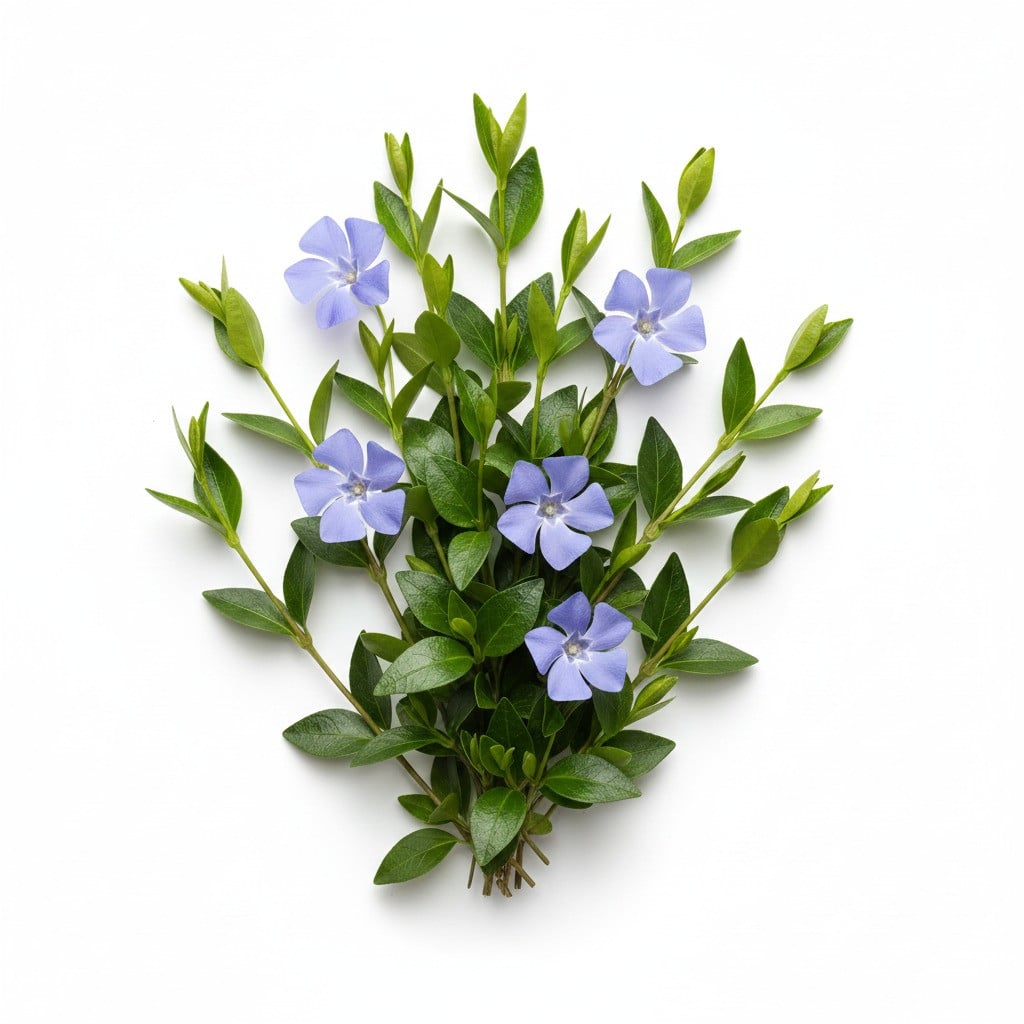
Origin and appearance Periwinkle (Vinca) is a genus of the dogbane family (Apocynaceae), which is distributed from Europe to western Asia and includes around a dozen species. Two of them occur in our native deciduous forests: the large periwinkle and the small periwinkle (Vinca major and Vinca minor). As its name suggests, periwinkle retains its dark green, shiny, ovate to lanceolate leaves all year round. Both the large and the small periwinkle form long runners and quickly conquer larger areas. As its shoots are woody, periwinkle is actually a woody plant. However, both species are used as perennials due to their small size - the small periwinkle grows to a height of 10 to 15 cm, the large periwinkle 20 to 30 cm. As a dog poison plant, all parts of the periwinkle are poisonous. The flowers of both species open from April to May, although those of the large periwinkle are somewhat larger with a diameter of up to five centimetres. The flowers are usually single, rarely in pairs, in the leaf axils. Their five blue, purple or white petals are tubular and fused together. After fertilization, bell-shaped fruits up to four centimetres long are formed, each containing four to eight seeds. Cultivated forms of both species are available in nurseries. The large periwinkle of the 'Variegata' variety is adorned with white and yellow leaves. 'Alba' flowers white, 'Reticulata' light blue and has yellow-veined foliage. The small periwinkle 'Alba' has very large, white, 'Rubra' red-violet flowers. 'Azurea Plena' flowers in blue and 'Multiplex' in purple-red. Periwinkle feels most at home in loose, nutrient-rich soil in the light shade of deciduous trees and shrubs. The large periwinkle prefers somewhat warmer and drier woodland edges, while the small periwinkle also thrives in cool, damp places.
Origin:
Europe, West Asia
Growing tips
Use The large and small periwinkle are very pretty and robust ground covers for shady areas and for planting under shrubs, even in public green spaces. They look best in combination with tall shade perennials such as astilbe, foxglove (digitalis) or cranesbill (geranium). The blue-flowering ground covers with their dark green, shiny foliage form a beautiful backdrop for yellow daffodils in spring. The small periwinkle is also suitable for planting under low-competition shrubs such as witch hazel (Hamamelis) or flowering dogwood (Cornus kousa), as it does not cause strong root pressure. The large periwinkle should be used with caution in the garden - the wild species in particular tends to proliferate in suitable locations and can completely overgrow smaller shrubs and trees. Planting Large and small evergreens are best planted in spring, as the evergreen foliage of plants that have not yet taken root is susceptible to frost damage. Before planting, the soil should be cleared of all root weeds such as ground elder and couch grass. Nutrient-poor soil can be improved with compost. Pruning the shoots when planting encourages branching and thus ensures better ground cover. Pruning Periwinkle does not need to be pruned regularly. However, if it spreads too much, it can be shortened considerably - preferably in spring, to just above the ground. Sufficient branches and dormant buds should remain. Winter protection In harsh locations and in areas exposed to wind and sun, the evergreen should be given winter protection with foliage. Further care tips Both large and small periwinkles develop better if a thin layer of mature compost is spread between the plants each spring. Propagation Periwinkle is very easy to propagate by cuttings - simply remove the rooted side shoots in spring. Both species can also be divided in spring. Propagation by cuttings is also very easy - all you need to do is remove the leaves from the bottom of the shoots when pruning and place them in a shady spot in moist, humus-rich soil. Diseases and pests Fungi in particular can cause problems for the evergreen. Rust fungi, leaf spot diseases or root neck and stem rot occur in high humidity and wet soil. As a preventative measure, periwinkle should be planted in such a way that the air can circulate well.

Companion Plants

Antagonistic Plants

Diseases
Dry rot of crucifers
Septoria
Angular leaf spot of cucumber
Pests
Spider mites
Aphids