Schönorche 'Takane'

Variety
Schönorche 'Takane'
created by Alex&Sempi at 17.02.2026
Features
Resistances
robust
hardy down to -10°C
Location
Light: Semi-Shade
Taste
not edible
Toxizität: ungiftig
Color
orange yellow
apricot
Blüte: hellbraun
Fruit shape
capsule
Growth habit
insect pollination
Season Overview
Propagating
Planting
Harvest
Harvest
J
F
M
A
M
J
J
A
S
O
N
D
1ST YEAR
FOLLOWING YEARS
Description
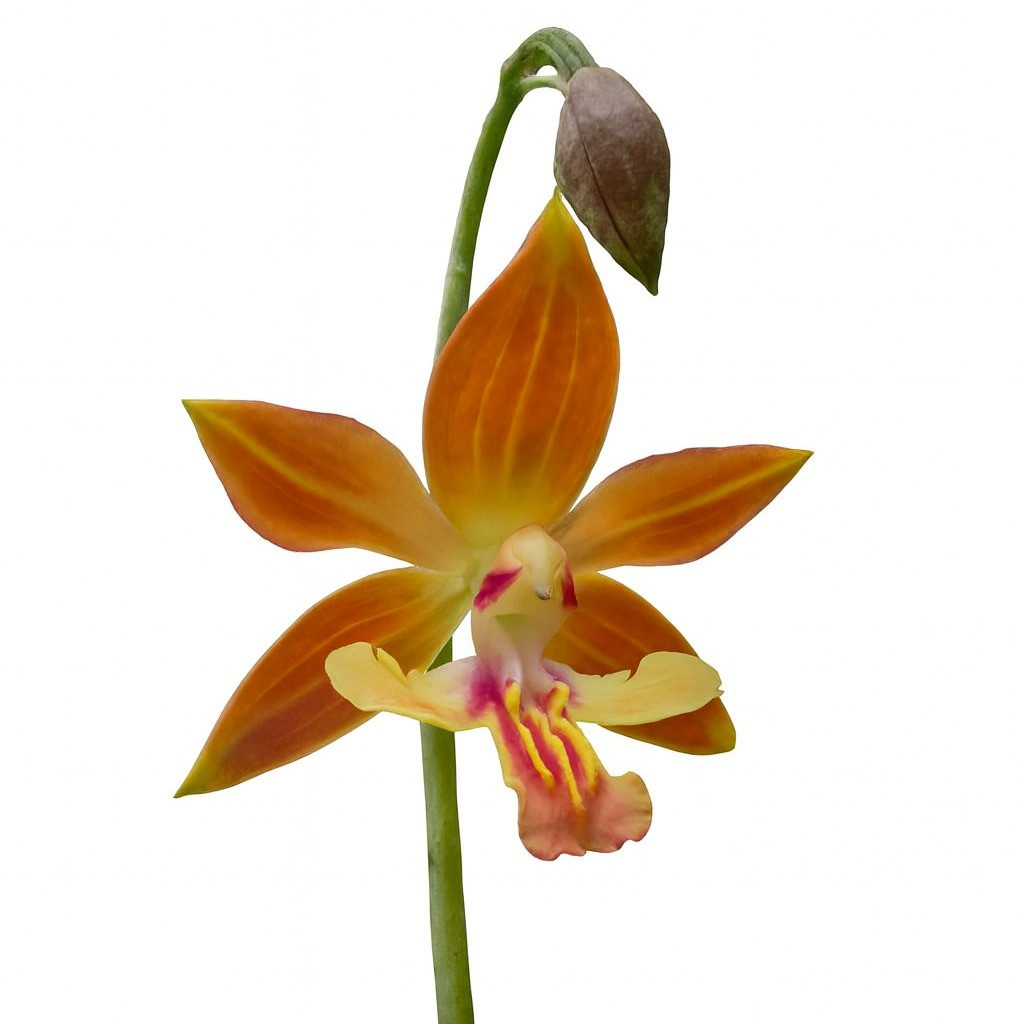
Calanthe 'Takane' is a beautiful terrestrial orchid created by crossing two botanical species. This prolific hybrid produces inflorescences with small flowers whose colors vary depending on the specimen, ranging from orange-yellow to light brown or apricot tones. The flowering period lasts for two months and exudes a distinctive clove scent. It is somewhat demanding to grow and requires acidic soil that is moist in summer and well-drained in winter, as well as a semi-shaded location. In addition, its winter hardiness is limited, to around -10°C in dry soil and protected by mulch. Fortunately, it is easier to cultivate in pots, which allows its beauty to be enjoyed even in regions with harsh winters. Calanthe belongs to the orchid family, which comprises over 25,000 species, 160 of which are found in France alone! This highly diverse family includes epiphytic species that use trees as host plants, as well as terrestrial species that grow in the ground. The Calanthe genus belongs to the latter group and comprises over 150 species, mainly native to the tropical and subtropical regions of Asia. Calanthe 'Takane' is a hybrid created by crossing two botanical species: Calanthe discolor (from Japan, China, and Korea) with two-toned flowers in light brown and pale pink, and Calanthe sieboldii from Japan, which has a long, slightly fragrant lemon-yellow flower. This deciduous plant forms pseudobulbs (a type of rhizome) that enable it to survive the winter and sprout again in spring. In March-April, it sprouts beautiful, bright green leaves that are about 15-18 cm long and 6-8 cm wide and have a slightly shiny surface. The slightly folded leaves with visible veins have an enveloping base that surrounds the inflorescence, which appears about a month later. This inflorescence is about 20-25 cm long and bears about 15 small flowers with a diameter of about 3 cm, which have the typical pattern of orchids. Three sepals and two lateral, pointed petals are apricot to light brown in color, while the lip, the lower petal, is sometimes orange-yellow in color. The lip is very different from the other parts of the flower and is divided into three artistically designed lobes. The central lobe is deeply veined and has a variable number of linear bulges. As with many hybrids, the colors can vary depending on the specimen, but the pastel shades are always harmoniously combined and the tropical appearance of the flower always makes a big impression in the garden. The lightly scented flowers exude a carnation fragrance and bloom for several weeks, occasionally until July. This hybrid is considered one of the longest-lived of the terrestrial orchids. In favorable climates with mild winters, plant your Calanthe 'Takane' in partial shade, sheltered from the wind and in light, humus-rich soil that is neutral to slightly acidic. Thanks to its tropical appearance, it is the star of exotic beds, along with other distinctive plants such as the arum (Zanthedeschia aethiopica). Arisaema, with its surprising snakehead flowers in many varieties, will also fit well into an exotic scene. Cyrtomium falcatum, a fern with shiny dark green fronds, also fits well into the picture, as does the toad lily (Tricyrtis hirta), which blooms late in the season. Calanthe is a genus in the orchid family (Orchidaceae). It is widespread in the tropics of Asia, Africa, and Central America. Most species grow terrestrially on forest floors, while some are epiphytes. Due to its beautiful flowers, it is also called the beautiful orchid. The genus Calanthe can be divided into two subgenera. The subgenus Calanthe, with the type species Calanthe veratrifolia, comprises evergreen plants without pseudobulbs. In the subgenus Preptanthe, on the other hand, the plants have storage organs and survive dry periods by shedding their leaves. Description All species of this genus form densely packed shoots with limited growth. The shoot axis can be long and cylindrical or compressed and thickened into pseudobulbs. These consist of several internodes and are covered with leaves along their entire length. The leaves are elongated-oval, thin, and folded along the numerous prominent leaf veins. The species with pseudobulbs are deciduous, while those without storage organs are evergreen. The upright inflorescence appears laterally from the shoot axis or from its base. It is racemose and bears many resupinate flowers. These are usually conspicuously pink, white, or yellow in color. Bracts, ovaries, and petals may be hairy. The three sepals and the lateral petals are free and not fused into a tube. The lip is two- or four-lobed, with a spur at the base. In the middle of the lip there is often a warty, fleshy callus consisting of several keels. The column is fused with the lip at least at the base, but often along its entire length. The stamen is terminal and contains eight waxy pollinia. Distribution The species of the genus Calanthe are pantropical. The center of diversity is Southeast Asia, but several species also occur in Africa and Madagascar. One species, Calanthe calanthoides, is widespread in Central America. Many species grow terrestrially in the shade of forests, often at higher altitudes up to 3200 meters. Cultivation Due to their relatively large, colorful flowers, some species are found in cultivation. Depending on the origin of the species, different requirements apply. For example, evergreen species need to be watered all year round, while deciduous species need a dry dormant period. Calanthe species are often infested with spider mites, especially in dry heated air. When the flowers freeze, they turn blue because indigo is formed.
F1 Hybrid
Frostproof
Growing tips
Calanthe 'Takane' prefers sheltered environments, partial shade, thick and aerated humus in the undergrowth, light and moderately moist soils from spring to the end of summer and drier soils in winter. The rhizome will rot in winter moisture, especially if there is frost. Place it in partial shade at the edge of large trees, with the west being the best orientation. In heavy soils, add 1/3 potting soil and 1/3 non-calcareous pebbles and mix this with your garden soil to a depth and width of 40 cm. In regions with cold winters, winter protection against cold and moisture is essential. To do this, place a 20 cm thick layer of leaves or shredded bark on the stump and, if necessary, a waterproof cover over it. Cultivation in pots or window boxes is perfectly possible and even necessary in regions where it can freeze below -8/-10°C. In this case, the pot should be placed in an unheated room. Use a mixture of 60% heather soil, 20% potting soil and 20% coarse sand. Terrestrial Calanthes need a lot of nutrients during the vegetation period: a weekly fertilizer application as for geraniums in half the dosage range from mid-May to mid-September is very beneficial. Location Light: Partial shade to shade, no direct midday sun. Soil: Rich in humus, loose, well-drained; special orchid soil or enriched with compost/bark mulch. Humidity: High, especially in summer; spray occasionally. Planting Time: Spring or fall, container plants possible all year round (except in frost or extreme heat). Depth: Plant rhizomes flat, root ball flush with soil surface. Pot culture: Pot with good drainage, at least 30-40 cm in diameter. Care Watering: Growth phase (spring-autumn): regular, keep soil slightly moist. Winter dormancy: water considerably less, but do not allow to dry out completely. Fertilization: During the growing season 2-3 times a week with orchid fertilizer at half the recommended dose. Do not fertilize in winter. Overwintering: Many species are hardy down to -10 to -15 °C. Protection from winter dampness with mulch or brushwood is more important than frost protection. Keep potted plants frost-free or protected. Special features Flowering time: spring to summer, depending on the species; flower panicles with many individual flowers. Deciduous or winter-green: some species retain leaves, others retract in winter. Propagation: Division of the rhizomes in spring or fall.
Details


Light requirement
Semi-shaded

Water requirement
Moist

Soil
Light (sandy)

Nutrient requirement
Medium

Light germinator

Germination temperature
20 - 25 °C (Degrees Celsius)

Plant distance
40 cm

Row spacing
40 cm

Seeding depth
0.2 cm

Companion Plants

Antagonistic Plants

Diseases
Root Rot
Powdery mildews

Pests
Aphids
Spider mites