Orchids - Japanese orchids (Bletilla)

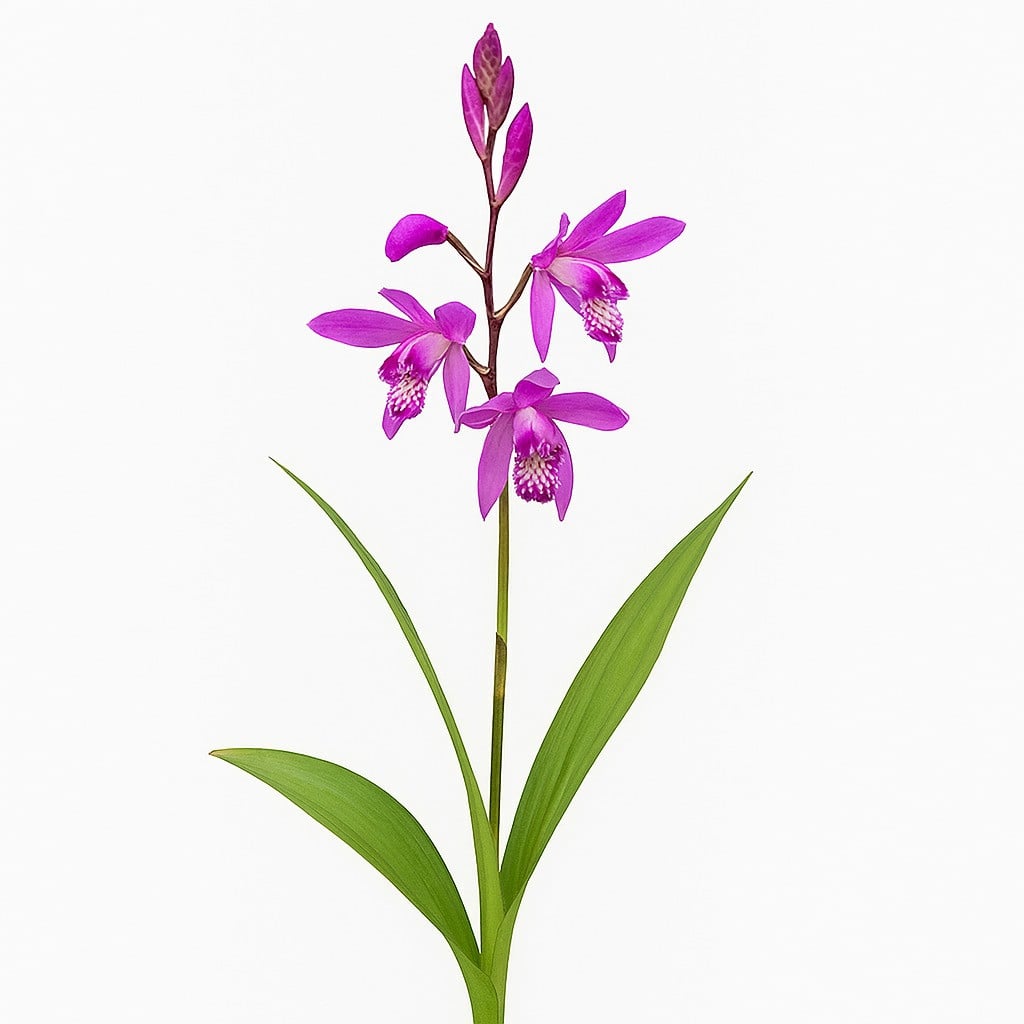
Orchids - Japanese orchids (Bletilla)
Bletilla
Plant family
Orchid family (Orchidaceae)
Season Overview
Sowing
Harvest
J
F
M
A
M
J
J
A
S
O
N
D
1ST YEAR
FOLLOWING YEARS
Details


Light requirement
Semi-shaded

Water requirement
Moist

Soil
Medium (loamy)

Nutrient requirement
Medium

Light germinator

Germination temperature
15 - 25 °C (Degrees Celsius)

Plant distance
30 cm

Row spacing
30 cm

Seeding depth
0.2 cm
Instructions
Description
The plant genus Bletilla belongs to the orchid family (bot. Orchidaceae). These are so-called outdoor orchids, which are known as Japanese orchids or hyacinth orchids. The genus consists of five to nine known species. These are found in East Asia. The best-known species are Bletilla striata and Bletilla formosana. They also adorn domestic gardens as ornamental plants. Other Bletilla species are Bletilla yunnanensis, Bletilla ochracea and Bletilla szetschuanica. Bletilla orchids have been known since the 18th century. The first scientific description dates back to 1784, when Carl Peter Thunberg, a Swedish naturalist and botanist, described the species Bletilla striata. The botanist Heinrich Gustav Reichbach classified the then known species into the new genus in 1853. The name Bletilla means small Bletia. Even though Bletilla and Bletia orchids are similar, they are not related to each other. The special feature of the genus Bletilla is its terrestrial growth. Leaf Each shoot has between two and six leaves. They are lanceolate to linear and folded along the leaf vein. The leaves develop after the flowering period. They wither and die in the fall. The orchid withdraws completely for winter dormancy. The plant only sprouts again in spring. Flower Bletilla have racemose terminal inflorescences. These grow in a zigzag pattern and bear few flowers. They are very attractive and are white, pink or yellow in color. The petals are single. Apart from the three-lobed lip, the petals are identical. The flowers do not produce nectar. Fruit An upright capsule fruit forms after flowering. Growth Unlike many other orchids, Bletilla orchids do not grow epiphytically, i.e. as a perching plant on other plants, but terrestrially, on the ground. They have a tuberous rhizome as a survival organ from which roots and shoots grow. In spring, the Bletilla sprouts shoots from the bare underground rhizomes. The first flowers appear in late spring. They last between two and four weeks. With the exception of Bletilla ochracea, all species are hardy. The orchid goes completely dormant in winter. The plant only sprouts again in spring. Habitat In the wild, the plants can be found in sunny or, more frequently, semi-shady locations. They thrive in scrubland, on stony or grassy terrain and at the edge of woodland. The Bletilla species prefer medium-moist soils. They grow here on loamy garden soil. Distribution The Bletilla genus originally occurs mainly in East Asia. The individual species are distributed from Yunnan to the southern regions of China. They are found in Taiwan, Korea, Japan, Myanmar, Vietnam and Thailand. The various species colonize locations between 500 and 2,000 meters above sea level. They mostly grow in savannahs, rarely at the edges of water bodies. Utilization Some species are used as ornamental plants in domestic gardens due to their large decorative flowers. The species Bletilla striata in particular can cope with the climate in Central Europe and is cultivated here. This species is hardy in sheltered places. They thrive in semi-shady locations and on a loamy soil. The stems, leaves and rhizomes of some Bletilla species are used in East Asian medicine. Care/pruning No special pruning measures are required for Bletilla plants. Sawdust over the rhizome is suitable for frost protection. The plants do not tolerate moisture well in winter. It makes sense to protect the rhizome from moisture. The gardener can also remove the plants from the soil and store them in substrate in a dry, dark room during the winter.
Origin:
East Asia, Yunnan, southern China, Taiwan, Korea, Japan, Myanmar, Vietnam, Thailand
Growing tips
Location Light: Partial shade to sunny, avoid direct midday sun. Soil: Loose, humus-rich, slightly acidic to neutral, good drainage, no lime. Pot culture: Possible, with a sufficiently large pot and drainage layer. Planting Time: Spring (March-May). Depth: Plant rhizomes shallowly, cover only lightly with soil. Spacing: 20-30 cm, as clumps form. Care Watering: Keep evenly moist during the growth phase (soft water). No waterlogging - allow excess water to run off. Keep drier in winter. Fertilization: From May to September monthly with a weak orchid fertilizer. Mulching: Protects against drying out and keeps the soil evenly moist. Winter hardiness In the fall, the leaves turn yellow and the plant retreats into the soil. A cold period is required for Bletilla to grow and flower again the following season. Hardy to -15 °C in Central Europe. Protection with leaves or brushwood is recommended. Keep container plants frost-free over winter. Propagation Rhizome division possible in spring or fall. After a few years, dense clumps with many flower stems will form. Bletilla orchids can be propagated by seed, but this is very demanding. As the seeds germinate without the help of mycorrhiza or special nutrient media, sowing is not too difficult. The seeds are sprinkled onto moist sphagnum that has been sterilized in a pressure cooker, for example. The sowing pot is tightly sealed with a plastic bag and placed in a bright place at temperatures of 15 °C to 20 °C, but not exposed to the sun. Germination will begin after a few weeks or months. Then it should be aired more often. It takes four to five years until flowering. Diseases and pests Rhizome and root rot: caused by overwatering or waterlogging of the substrate. Soil fungi and mildew: develop in high humidity and poor ventilation. Fungal spots on leaves: favored by excessive moisture and poor ventilation. Aphid or mealybug pests: can occur occasionally, especially in warm, dry environments.


Antagonistic Plants

Diseases
Powdery mildews
Root Rot
Pests
Aphids