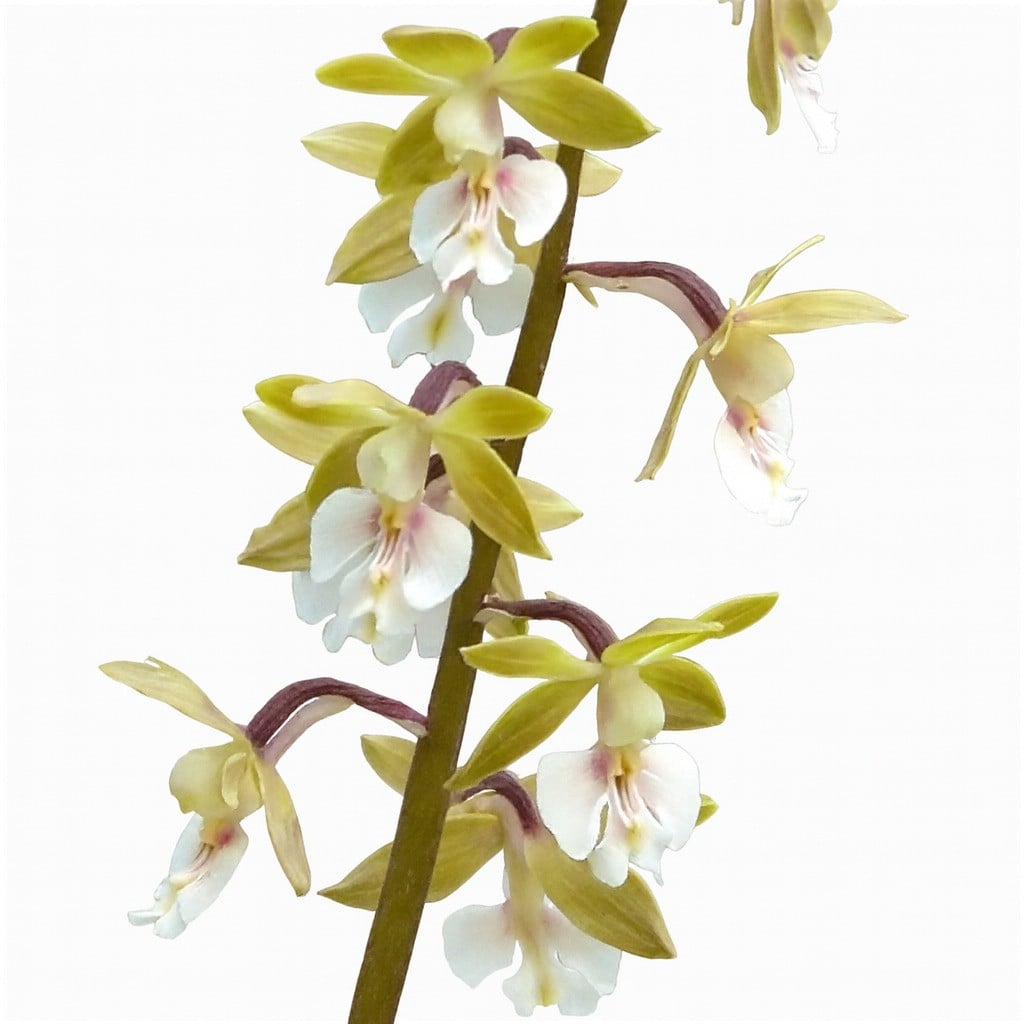
Schönorche 'Olive Green'

Variety
Schönorche 'Olive Green'
created by Alex&Sempi at 17.02.2026
Features
Resistances
robust
hardy down to -10°C
Location
Light: Semi-Shade
Taste
not edible
Toxizität: ungiftig
Fruit shape
capsule
Growth habit
insect pollination
Color
Blüte: grün
Season Overview
Propagating
Planting
Harvest
Harvest
J
F
M
A
M
J
J
A
S
O
N
D
1ST YEAR
FOLLOWING YEARS
Description
Schönorche Olive Green is a rare hybrid terrestrial orchid species. In spring, Olive Green produces a flower stalk with elegant olive-green petals decorated with brown stripes. The lip is white-pink, with light to dark pink coloring, creating a contrasting two-tone effect. This perennial plant is deciduous and floriferous and is grown in mild and humid climates. It prefers thick, well-drained humus soil that is kept moist in spring and rather dry in winter. Cultivation in pots allows for better control of soil composition and moisture. In winter, it can be protected with a layer of mulch if the soil or substrate is dry and can withstand temperatures down to -10 °C. Olive Green Calanthe is a hybrid of wild species, mainly from the Far East. It sprouts from the ground in spring and dries up in autumn. The plant forms a clump of leaves about 40 cm in size in all directions. This orchid forms a pseudobulb from which large light green leaves sprout in spring, ranging from 15 to 40 cm in length and 8 to 15 cm in width. The leaves are folded, oval-shaped, and strongly veined with parallel ribs. The leaves are somewhat similar to those of the Veratrum species. In spring, in April and May, the plant develops impressive 40 cm high inflorescences with beautiful two-colored flowers. An orchid flower consists of 3 sepals and 3 petals, one of which, the lip, is often particularly impressive in orchids. The lip of the Olive Green is broad, folded, and pinkish-white in color with light pink and dark pink markings, while the other parts of the flower are olive green and brown. The plant forms only a few runners. In winter, it enters a dormant phase when the foliage has turned completely yellow. In favorable climates, Olive Green Calanthe should be planted in partial shade and sheltered from the wind in light, humus-rich soil with a neutral to slightly acidic tendency. It thrives in the shade in a cool rock garden between rocks or at the edge of fresh undergrowth, in the company of Arisaema, Cypripedium, Paris, Bletilla, and ferns. Due to its moderate winter hardiness, the plant should be protected from severe frost and moisture. It thrives well in large pots that overwinter in a cold greenhouse. Calanthe is a genus in the orchid family (Orchidaceae). It is widespread in the tropics of Asia, Africa, and Central America. Most species grow terrestrially on forest floors, while some are epiphytes. Due to its beautiful flowers, it is also called the beautiful orchid. The genus Calanthe can be divided into two subgenera. The subgenus Calanthe, with the type species Calanthe veratrifolia, comprises evergreen plants without pseudobulbs. In the subgenus Preptanthe, on the other hand, the plants have storage organs and survive dry periods by shedding their leaves. Description All species of this genus form densely packed shoots with limited growth. The shoot axis can be long and cylindrical or compressed and thickened into pseudobulbs. These consist of several internodes and are covered with leaves along their entire length. The leaves are elongated-oval, thin, and folded along the numerous prominent leaf veins. The species with pseudobulbs are deciduous, while those without storage organs are evergreen. The upright inflorescence appears laterally from the shoot axis or from its base. It is racemose and bears many resupinate flowers. These are usually conspicuously pink, white, or yellow in color. Bracts, ovaries, and petals may be hairy. The three sepals and the lateral petals are free and not fused into a tube. The lip is two- or four-lobed, with a spur at the base. In the middle of the lip there is often a warty, fleshy callus consisting of several keels. The column is fused with the lip at least at the base, but often along its entire length. The stamen is terminal and contains eight waxy pollinia. Distribution The species of the genus Calanthe are pantropical. The center of diversity is Southeast Asia, but several species also occur in Africa and Madagascar. One species, Calanthe calanthoides, is widespread in Central America. Many species grow terrestrially in the shade of forests, often at higher altitudes up to 3200 meters. Cultivation Due to their relatively large, colorful flowers, some species are found in cultivation. Depending on the origin of the species, different requirements apply. For example, evergreen species need to be watered all year round, while deciduous species need a dry dormant period. Calanthe species are often infested with spider mites, especially in dry heated air. When the flowers freeze, they turn blue because indigo is formed.
F1 Hybrid
Frostproof
Growing tips
Calanthe Olive Green prefers sheltered environments, partial shade, thick and well-aerated humus in the undergrowth, slightly moist soils from spring to the end of summer and drier soils in winter. Winter moisture will rot the rhizome, especially if there is frost. Place it in partial shade at the edge of large trees, with the west being the best orientation. For heavy soils, add 1/3 leaf soil and 1/3 non-calcareous pebbles mixed with your garden soil to a depth and width of 40 cm. In regions with cold winters, winter protection against cold and damp is essential. To do this, place a 20 cm thick layer of leaves or shredded bark over the roots and, if necessary, a waterproof cover over it. Growing in pots or window boxes is perfectly possible in a mixture of 60% heather soil, 20% potting soil and 20% coarse sand. Terrestrial Calanthes are quite demanding plants during the growing season: A weekly fertilization with geranium fertilizer in half dosage from mid-May to mid-September will be very beneficial. Location Light: Partial shade to shade, no direct midday sun. Soil: Rich in humus, loose, well-drained; special orchid soil or enriched with compost/bark mulch. Humidity: High, especially in summer; spray occasionally. Planting Time: Spring or fall, container plants possible all year round (except in frost or extreme heat). Depth: Plant rhizomes flat, root ball flush with soil surface. Pot culture: Pot with good drainage, at least 30-40 cm in diameter. Care Watering: Growth phase (spring-autumn): regular, keep soil slightly moist. Winter dormancy: water considerably less, but do not allow to dry out completely. Fertilization: During the growing season 2-3 times a week with orchid fertilizer at half the recommended dose. Do not fertilize in winter. Overwintering: Many species are hardy down to -10 to -15 °C. Protection from winter dampness with mulch or brushwood is more important than frost protection. Keep potted plants frost-free or protected. Special features Flowering time: spring to summer, depending on the species; flower panicles with many individual flowers. Deciduous or wintergreen: some species retain leaves, others retract in winter. Propagation: Division of the rhizomes in spring or fall.
Details


Light requirement
Semi-shaded

Water requirement
Moist

Soil
Light (sandy)

Nutrient requirement
Medium

Light germinator

Germination temperature
20 - 25 °C (Degrees Celsius)

Plant distance
40 cm

Row spacing
40 cm

Seeding depth
0.2 cm

Companion Plants

Antagonistic Plants

Diseases
Root Rot
Powdery mildews

Pests
Aphids
Spider mites