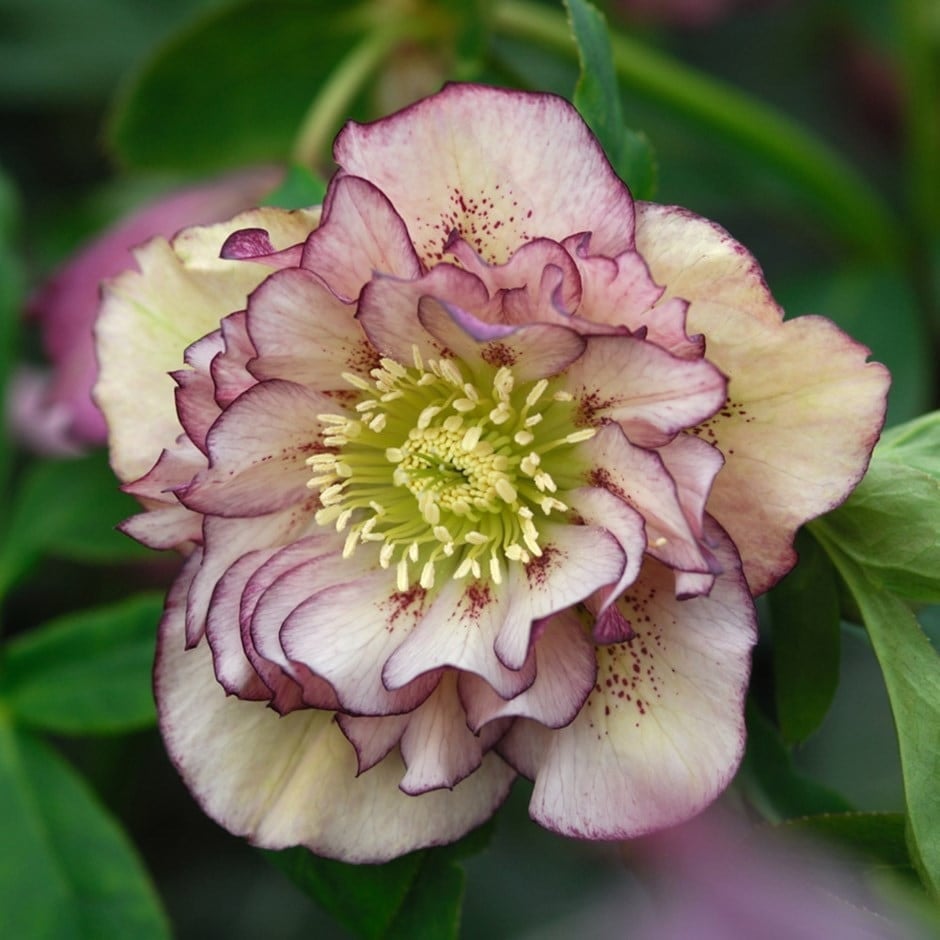
Gefüllte Lenzrose 'Double Ellen Picotee'

Variety
Gefüllte Lenzrose 'Double Ellen Picotee'
Approved Data
created by Alex&Sempi at 12.11.2025
Features
Growth habit
lifespan: perennial
growth habit: compact
growth habit: herbaceous
flower: flowering
Cold germination
strong leaves
growth habit: rosette-shaped
cross-pollination
early flowering
ornamental plant
root type: rhizome
growth habit: bushy clump-forming
leaves: evermoist
seed-fixed: no
wide: 30 - 40 cm
hermaphroditic
growth habit: upright flower stems
finger-shaped leaves
weak to medium growth
non-woody
slow growth
propagation by division
perennial
insect pollination
Blütenform: schalenförmig
leaves: leathery, tough
Blüte: mittelgroß
Blätter: mittelgroß
Geschlechtertyp: einhäusig
Keimung: Lichtkeimer
Blätter: gesägt
Blüte: duftend schwach
Wuchs: nicht invasiv
Schnitt: nach Blüte
Schnitt: Spätwinter
Blüte: halbgefüllt
Blütenstand: einzeln, kleine Gruppen
root type: deep-rooted
Resistances
resistant
robust
Pest-resistant
Little susceptible
fully hardy
hardy down to -30°C
Standorttolerant
Location
planting: outdoor
sheltered from the wind
Soil: permeable soil
soil moisture: no waterlogging
Fertilization: nutrient-rich
fertilization: humus-enriched
Soil: Well fertilized
soil moisture: fresh to moist
Light: Semi-Shade
soil moisture: well-drained
biotope: forest
Soil: good garden soil
Water: regularly
planting: heat protected
Fertilization: phosphate-rich
Soil: light to medium-heavy
Heat requirement: low
Soil: sandy to loamy
fertilization: low-nitrogen
pH value: acidic to neutral (5,5-7)
planting: covered balcony or terrace
fertilization: lime-free
fertilization: potassium-rich
Planting: rock garden / alpine garden
Planting: edge of wooded areas or beneath trees
Planting: pots, tubs, or boxes
Fertilization: moderate
Water: moderately
Fertilization: organic
Licht: vor Mittagssonne geschützt
Pflanzung: Bauerngarten
Düngemittel: zweimalig Kompost
Düngemittel: Hornspäne
Good companions: moisture-loving
Nachbarn schlecht: trockenheitsliebend
Good companions: shade tolerant
Nachbarn schlechte: kalkliebend
Nachbarn schlechte: sonnenliebend
Nachbarn schlechte: stark wuchernd
Nachbarn schlechte: hoher nährstoffbedarf
Nachbarn gute: mit niedrigen Nährstoffbedarf
Nachbarn gute: hochwachsend
Nachbarn gute: niedrigwachsend
Düngung: NPK 5/7/10
Pflanztechnik: Mulchen
Gießen: Olla
Pflanzung: Staudenbeet
Boden: mittelgründig (30-60)
Herkunft: Züchtung
Color
inked
glossy
Black seeded
creamy-yellow
Flower: red
Blätter: dunkelgrün
Frucht: braungrün/grünbraun
Musterung: verlaufend
Stamm, Stiel: grün
Wurzel: braun
Wurzel: schwarz
Herbstfärbung: keine
Oberfläche: glatt
Musterung: gepunktet
Taste
not edible
Toxizität: giftig
Fruit shape
small
follicle
Season Overview
Propagating
Planting
Harvest
J
F
M
A
M
J
J
A
S
O
N
D
1ST YEAR
FOLLOWING YEARS
Description
The 'Double Ellen ® Picotee' rose tolerates frost and snow and bears colorful flowers in winter. A snow-covered garden full of flowers looks like a picture from a winter fairy tale. In reality, every gardener is able to create their own winter fairy tale. The botanical name of this wonderful variety is Helleborus x orientalis 'Double Ellen ® Picotee' and it belongs to the buttercup family. It is an absolute eye-catcher in the dark season and its cupped flowers work wonders on frosty, icy winter days. If the gardener decides to plant Helleborus x orientalis 'Double Ellen ® Picotee' in his bed, he will enjoy a garden that is already in bloom in February. The flowers sit on slightly branched stems. They adorn themselves with a lovely color. Creamy yellow with a reddish tinge and a red edge adorns the flower. The cupped, semi-double flowers can be seen from February to April. At the end of April, the outer petals lose their color and bell-shaped fruits form in the middle of the flower. Yet another ornamental in the garden. The baroque-like flowers shine in warm shades and bloom while other plants overwinter. Double Ellen ® Picotee' can withstand temperatures down to minus 28° C and defies frost, snow and ice. It adapts exceptionally well to winter. They are more uncomplicated and flower from February until spring. Lenz is an old word for spring, hence the name Lenz rose. If the location is ideal, the Lenz rose 'Double Ellen ® Picotee' will live for decades. The Helleborus x orientalis 'Double Ellen ® Picotee' grows slowly, 10 centimeters per year and reaches a height of 40 centimeters. Its growth is bushy, clumpy and stretches up to 60 centimeters in width.
F1 Hybrid
Frostproof
Growing tips
Location
Details


Light requirement
Semi-shaded

Water requirement
Moist

Soil
Medium (loamy)

Nutrient requirement
Medium

Light germinator

Germination temperature
7 - 10 °C (Degrees Celsius)

Plant distance
40 cm

Row spacing
40 cm

Seeding depth
0.5 cm

Companion Plants

Antagonistic Plants
Aubergine / Eggplant
Broccoli
Broccoli raab / Stem cabbage / Cima di rapa
Brussels sprouts
Brussels sprouts
Cabbage (Cabbage)
Cabbage (Pointed cabbage)
Cabbage (red cabbage)
Cabbage (Savoy cabbage)
Carrots
Cauliflower
Celery (Celeriac / Celery root)
Celery (Celery)
Celery (Leaf celery / Chinese celery)
Chili
Chinese kale - Kai-lan / Chinese broccoli
Collard greens
Collard greens (Kale)
Collard greens (Tuscan kale / Dinosaur kale / Palm tree kale)
Coriander / Cilantro
Corn / Maize
Cucumber / Gherkin
Dahlia
Grasses - Bamboos
Grasses - feather-bristled grasses, lamp-cleaning grasses
Grasses - Fescue
Grasses - Pampas grass
Ivy
Kohlrabi / German turnip / Turnip cabbage
Larkspur
Lavender
Napa cabbage / Chinese cabbage
Okra
Parsnip
Pepper / Paprika
Potato
Radish
Radishes
Rose
Rosemary
Sage
Stem herbs
Succulents - Agave family
Succulents - Cacti
Succulents - Crassulaceae
Sweet potato
Sweet woodruff / Sweetscented bedstraw
Thyme
Tomato (Bush tomato)
Tomato (Cocktail bush tomato)
Tomato (Cocktail Stake Tomato)
Tomato (Stake tomato)
Vegetable cabbage - wild cabbage / ancient cabbage

Diseases
Root Rot
Black spot of roses
Powdery mildews

Pests
Land snails
Aphids