Knotted flowers

Knotted flowers
Leucojum
Plant family
Amaryllis family (Amaryllidaceae)
Season Overview
Sowing
Harvest
J
F
M
A
M
J
J
A
S
O
N
D
1ST YEAR
FOLLOWING YEARS
Details


Light requirement
Semi-shaded

Water requirement
Moist

Soil
Medium (loamy)
Nutrient requirement
Medium

Dark germinator

Germination temperature
10 – 15 °C (Degrees Celsius)

Plant distance
15 cm

Row spacing
15 cm

Seeding depth
10 cm
Instructions
Description
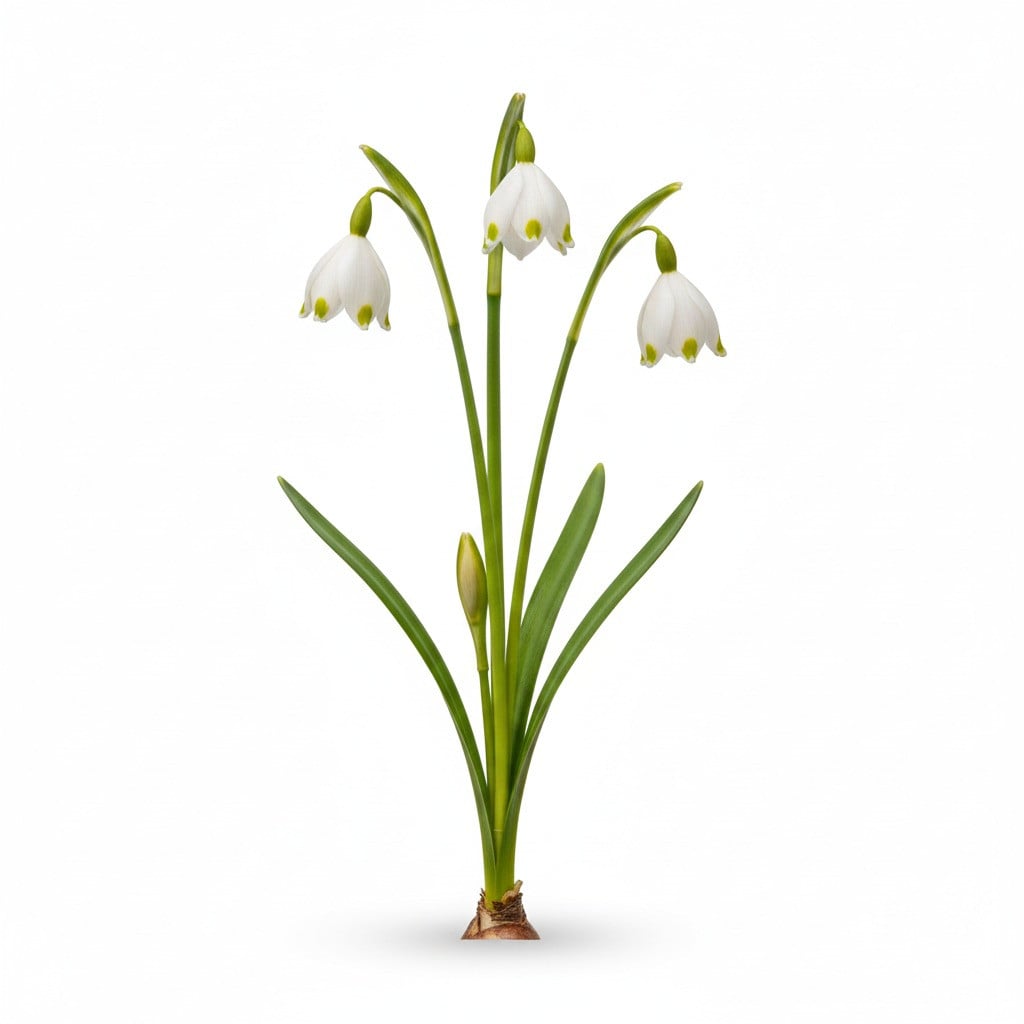
Knot flowers are perennial, herbaceous plants that form bulbs as survival organs. These are four to five centimeters in size, egg-shaped and have a brown-red outer skin. In spring, basal, linear leaves and individual flower stalks sprout from the bulb. While the spring knot flower usually produces only one, or more rarely two, bell-shaped flowers, the summer knot flower produces three to five, sometimes up to eight, flowers per flower stalk. They also hang down in a bell shape. The petals are white with green spots at the tips. The plants grow to a height of 10 to 50 centimetres and flower from February or April. After fertilization, capsule fruits with numerous seeds are formed. Once the seeds are ripe, the leaves and flower stem die back and the plant enters its dormant phase, typical of bulbous plants, until the following spring. Like the snowdrop, all parts of the knot flower are poisonous.
Origin:
Europe
Growing tips
Location and soil While the spring knot flower needs semi-shady to shady locations to thrive, the summer knot flower is much more light-hungry. It develops best in sunny to semi-shady corners of the garden. The soil should be rich in humus and nutrients for both species. In the case of the summer knotweed, it should be clay-loamy and moist, while the spring knotweed should be fresh and sandy-loamy to prevent waterlogging. Planting Planting takes place in the fall, from September to October. Plant the bulbs about ten centimetres deep in the soil and keep the same distance from neighboring plants. Please note: Depending on the variety, the required planting distance may be slightly greater - check this when purchasing. Care tips Knot flowers generally require little care. However, you should be aware that it can take a good two years before the knot flower blooms. If the soil was mixed with compost during planting, you can wait with the first fertilization until the vitality and joy of flowering diminishes. Then knot flowers will be happy with some organic fertilizer applied every few years in spring. Pruning is not necessary. However, if you want to prevent the plants from going to seed, you should remove the inflorescences in good time. When the knot flowers move in in the fall, the upper parts of the plant dry out first. However, wait until the foliage has completely withered before cutting it off. Only then will the nutrients have been fully transported to the bulbs. During long dry periods, water occasionally by hand - knot flowers do not like their bulbs to dry out completely. Overwintering Leucojum is hardy and generally does not need winter protection. The species can withstand temperatures of -28 to -34 degrees Celsius. Use The spring knot flower is a popular early spring bloomer that combines well with other early flowering bulbs such as snowdrops (Galanthus), winter aconites (Eranthis) and crocuses (Crocus). They are preferably planted in small groups in the border so that the low plant is shown to its best advantage. The summer knotweed, together with the checkerboard flower (Fritillaria meleagris), is ideal for planting near-natural pond banks. If sufficient space is available, knot flowers can also be used to grow wild - they quickly conquer larger areas in suitable locations. Or they can be cultivated in pots on balconies or terraces, where they are often the first bloomers of the season. Propagation For propagation, the daughter bulbs that have formed on the original bulb are removed in the fall and planted elsewhere in the garden. However, knot flowers can also be propagated by seed. However, because the plants then need several years to flower, this method is rarely used in the garden.


Antagonistic Plants
Diseases
Grey mold
Pests
Aphids
Voles