Kapuzinererbse Blauwschokker

Variety
Kapuzinererbse Blauwschokker
Approved Data
created by Regina R. at 14.01.2022
Features
Growth habit
lifespan: annual
growth habit: rank
growth habit: compact
growth habit: high ranking
growth habit: high
Climbing plant
harvest: continuously pickable
flower: flowering
root type: taproot
self-fruiting
fast growth
Nutzungsart: Ur-/Alte Sorte
No pruning necessary
root type: heart-shaped root system
growth habit: upright slender
growth habit: needs climbing support
medium to strong growth
height: 180 - 200 cm
leaves: leafy
wide: 50 - 60 cm
round leaves
hermaphroditic
wide: 40 - 50 cm
lobed leaves
entire leaves
Scentless flowers
non-woody
weak lateral shoot development
propagation by seeds
insect pollination
Nutzungsart: Mischkultur
Summer variety
Blätter: eiförmig
Blüte: mittelgroß
Blätter: mittelgroß
Geschlechtertyp: einhäusig
Ernte: mittelreifend
Keimung: Dunkelkeimer
Blätter: weich/zart
Blätter: einfach
Blätter: oval
Ernteertrag: mittel
Blätter: gewellt
Blütenform: schmetterlingsförmig
Blütenstand: einzeln, kleine Gruppen
Blütenform: zygomorph (spiegelbildlich)
Vermehrung: samenfest
Taste
mild
aromatic
sweet
crunchy
Pea aroma
raw edible
Edible
tender
Earthy
A little floury
edible skin
Essbarkeit: Frucht
Essbarkeit: Samen
Toxizität: ungiftig
Konsistenz: fest
Location
planting: bed
planting: outdoor
planting: house wall / wall
Soil: permeable soil
soil moisture: no waterlogging
Fertilization: single dose of compost
Fertilization: nutrient-poor
fertilization: minimal
Soil: regular garden soil
soil moisture: moist
light: Full sun
soil moisture: well-drained
fertilization: low-humus
Water: regularly
planting: heat protected
Soil: deep
Fertilization: phosphate-rich
Soil: light to medium-heavy
planting: open balcony or terrace
Soil: sandy to loamy
Wind: windverträglich
fertilization: low-nitrogen
planting: covered balcony or terrace
Soil: loosened
fertilization: potassium-rich
Water: sparingly
pH value: neutral to alkaline (7-8)
Planting: pots, tubs, or boxes
Light: Sun
Planting: frost-free
pH value: neutral (7)
Water: moderately
Heat requirement: moderate
Heat requirement: cool
Düngung: kalktolerant
Pflanzung: Bauerngarten
Good companions: moisture-loving
Nachbarn schlecht: trockenheitsliebend
Nachbarn schlechte: Schattenpflanzen
Nachbarn schlechte: kalkliebend
Good companions: sun-loving
Nachbarn schlechte: stark wuchernd
Nachbarn schlechte: hoher nährstoffbedarf
Nachbarn gute: mit niedrigen Nährstoffbedarf
Nachbarn schlechte: mit niedrigen Nährstoffbedarf
Nachbarn schlechte: hochwachsend
Nachbarn gute: niedrigwachsend
Pflanztechnik: Milpa
Gießen: Olla
Boden: karg
Herkunft: Züchtung
Düngemittel: Holzasche
Düngemittel: Gesteinsmehl
Fruit shape
elongated
flat
smooth, sleek
slim
medium-sized
slightly curved
Hülsenfrucht
Resistances
cold tolerant
resistant
robust
drought tolerant
krankheitstolerant
Color
light green / pale green
purple
medium green
Blüte: pink
Oberfläche: matt
Blätter: blaugrün
Stem, trunk: grey
Frucht: schwarzviolett/violettschwarz
Stamm, Stiel: grün
Stamm, Stiel: violett
Wurzel: weiß
Wurzel: cremeweiß
Blattrippen: grün
Wurzel: beige
Oberfläche: glatt
Blattrippen: hellgrün
Samen: graugrün
Wurzel: rosa
Season Overview
Propagating
Planting
Harvest
J
F
M
A
M
J
J
A
S
O
N
D
Description
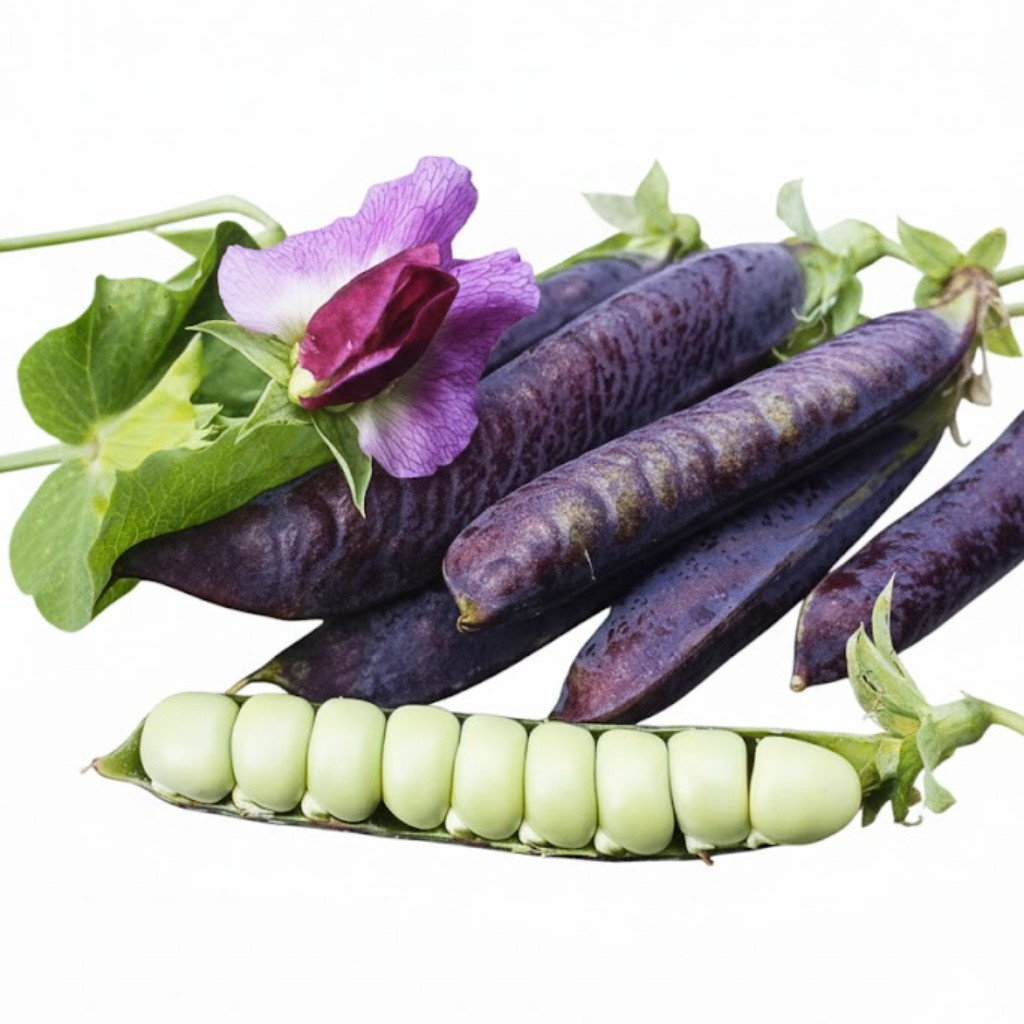
Shell pea 'Blauwschokker' is an old, very decorative variety from the Netherlands. It blooms early and produces beautiful purple-purple flowers. This then subsequently gives rise to the dark purple pods, 5-6 cm long, with the gray-green peas inside. The plant fits perfectly in any cottage garden in mixed beds planted with herbs, vegetables and ornamental plants alike, as the sight of it in all stages of life is really beautiful. This variety is very suitable for fresh consumption immediately after harvest. Sweet taste. Harvested young, they can also be consumed again sugar peas. Of course, the peas can also be dried and stored. Sturdy and robust. Grows up to 2 m tall.
Non hybrid
Not frost resistant
Growing tips
Germination in 10-20 days at 5-20°C. Stabilize the young plants, which are about 10 cm high, by mounding them and provide them with rices (climbing aid). Harvesting of the young pods possible from June. Trellis recommended. Place trellis at a distance of 1.5 m. Place pea seeds every 3 cm along the trellis. Protect seeds from birds.
Details


Light requirement
Sunny

Water requirement
Moist

Soil
Medium (loamy)
Nutrient requirement
Low

Dark germinator

Germination temperature
8 - 18 °C (Degrees Celsius)

Plant distance
5 cm

Row spacing
45 cm

Seeding depth
3 cm

Companion Plants
Borage
Broccoli
Brussels sprouts
Cabbage (Cabbage)
Cabbage (Savoy cabbage)
Caraway / Meridian fennel / Persian cumin
Carrots
Cauliflower
Collard greens (Kale)
Collard greens (Tuscan kale / Dinosaur kale / Palm tree kale)
Common marigold
Corn / Maize
Cucumber / Gherkin
Dill
Fennel
Florence fennel / Finocchio
Kohlrabi / German turnip / Turnip cabbage
Lentils
Lettuce (Lettuce)
Lettuce (Radicchio / Italian chicory)
Melissa
Napa cabbage / Chinese cabbage
Nasturtium
Okra
Oregano
Pak Choi
Pumpkin / Squash
Radish
Radishes
Rhubarb
Root parsley
Rutabaga / Swedish turnip
Sage
Spinach (Summer)
Sunflower
Turnip

Antagonistic Plants
Diseases
Rust of pea
Powdery mildews
Pests
Pea weevils
Olive Brown Pea Moth