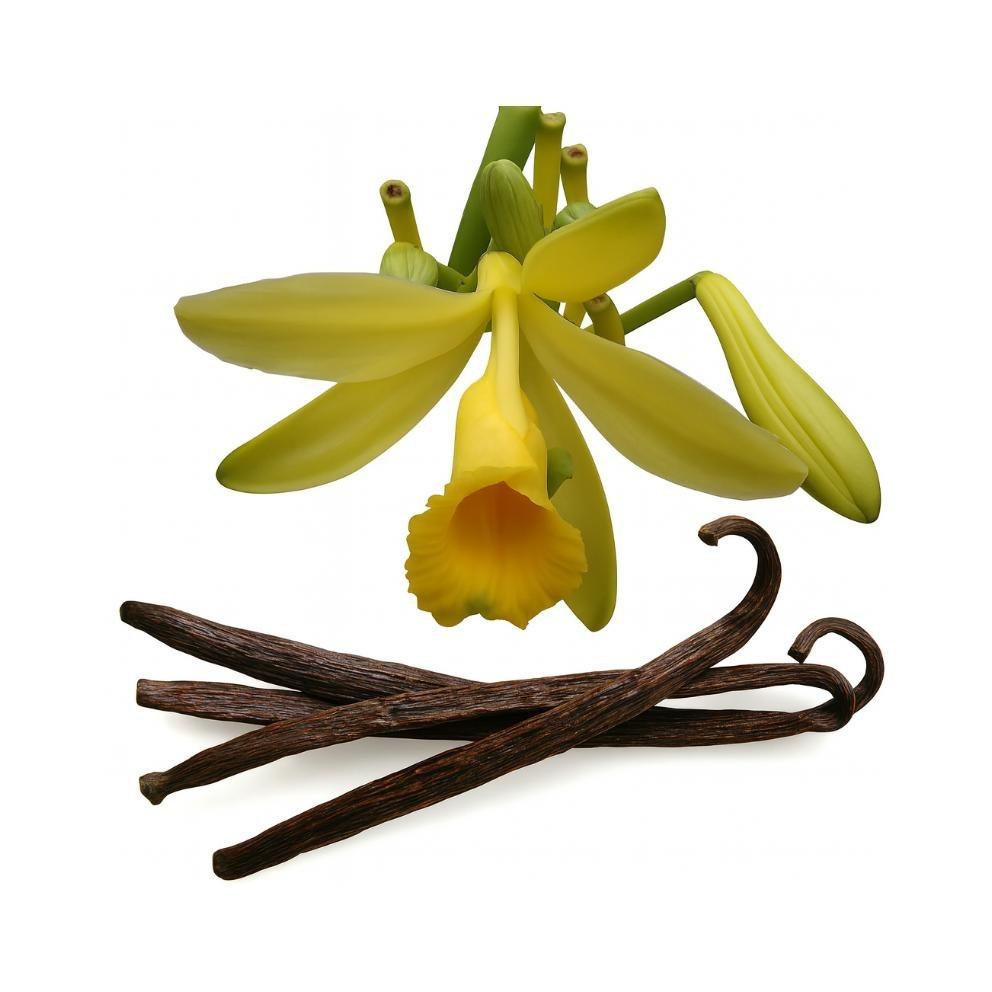
Echte Vanille / Gewürzvanille (Wildform)

Variety
Echte Vanille / Gewürzvanille (Wildform)
Approved Data
created by Alex&Sempi at 22.02.2026
Features
Growth habit
lifespan: perennial
growth habit: climbing
growth habit: high
Climbing plant
Game Variety
harvest: continuously pickable
leaves: loosely leafed
root type: shallow-rooted
strong leaves
fast growth
normal growth
warm germination
cross-pollination
growth habit: needs climbing support
medium to strong growth
Fragrant flowers
leaves: evermoist
growth habit: twining, vining
propagation by cuttings
growth habit: becoming woody
wide: 50 - 60 cm
hermaphroditic
height: over 400 cm
height: 300 - 400 cm
wide: 40 - 50 cm
height: 200 - 250 cm
sukkulent
entire leaves
large flowers
large leaves
root type: aerial root
weak lateral shoot development
insect pollination
hand pollination
leaves: leathery, tough
harvest: late-ripening
Blütenstand: traubenförmig
Blätter: zugespitzt
Blätter: mittelgroß
Geschlechtertyp: einhäusig
Keimung: Lichtkeimer
Schnitt: Auslichtung
Schnitt: Verjüngung
Schnitt: Form
Schnitt: Erhaltung
Schnitt: zeitiges Frühjahr
Schnitt: möglich
Wuchsform: verzweigt
Blätter: oval
Blätter: länglich
Ernteertrag: mittel
Blüte: kurzlebig
Blütenstand: einzeln, kleine Gruppen
Blütenform: zygomorph (spiegelbildlich)
Vermehrung: samenfest
Blüte: behaart
Stamm, Stiel: rund
Stamm, Stiel: fleischig
Blätter: fleischig
Pruning: before flowering
Stamm, Stiel: kahl
Wuchsform: semiepiphytisch
Taste
aromatic
sweet
intensive
floral
mildly toxic
Essbarkeit: Frucht
Essbarkeit: Samen
Aroma: Vanille
Essbarkeit: roh nicht essbar
Location
planting: greenhouse
Heat requirement: high
Soil: permeable soil
soil moisture: no waterlogging
Planting: windowsill / indoor space
Fertilization: nutrient-poor
fertilization: minimal
light: light shade.
Light: Semi-Shade
soil moisture: well-drained
Soil: light
fertilization: low-humus
Water: regularly
soil moisture: not too dry
wind: airy
Planting: winter garden
pH value: acidic to neutral (5,5-7)
Soil moisture: moderately dry to fresh
Planting: pots, tubs, or boxes
Planting: frost-free
Water: moderately
Water: Let the substrate dry in between
biotope: rainforest
Licht: vor Mittagssonne geschützt
Düngung: flüssig
Good companions: moisture-loving
Nachbarn schlecht: trockenheitsliebend
Nachbarn schlechte: kalkliebend
Nachbarn schlechte: stark wuchernd
Nachbarn schlechte: hoher nährstoffbedarf
Nachbarn gute: mit niedrigen Nährstoffbedarf
Nachbarn gute: hochwachsend
Nachbarn gute: niedrigwachsend
Boden: flachgründig (0-30)
Pflanzung: Gewächshaus
Luftfeuchte: hoch
Boden: organisch
Color
light yellow
glossy
dark green
yellow-green
Black seeded
Fruit: yellow-green
Blätter: dunkelgrün
Stamm, Stiel: grün
Oberfläche: wachsig
Oberfläche: schimmernd
Wurzel: weiß
Wurzel: gelb
Wurzel: grünlich
Blattrippen: grün
Samen: braun
Wurzel: beige
Wurzel: grau
Resistances
drought tolerant
frost-sensitive
Fruit shape
smooth, sleek
large
slim
capsule
Form: langoval, zylindrisch
Season Overview
Sowing
Harvest
J
F
M
A
M
J
J
A
S
O
N
D
1ST YEAR
FOLLOWING YEARS
Description
Vanilla (botanical name Vanilla) is a genus of plants in the orchid family (Orchidaceae). The 106 to 126 species are found in subtropical to tropical regions. The first species belonging to the genus Vanilla were named before Carl von Linne established the binomial system of nomenclature in 1753. The genus Vanilla is distributed across the tropical and subtropical regions of various continents. There are areas in southern North America, the Caribbean islands, Central America, South America, Central Africa, Madagascar, Southeast Asia, and the western Pacific islands. Most species are native to South America, although a few species, such as Vanilla imperialis and Vanilla roscheri, are native to the African continent. In many Vanilla species, the vegetative characteristics vary greatly and are therefore poorly suited as identifying features. The species of the genus Vanilla are evergreen, perennial herbaceous plants. These climbing plants grow directly in the ground, rooting (terrestrial) or semi-epiphytic. The thick, bare, green, monopodial shoot axis sometimes branches and is succulent. The gray-green roots emerge from each node of the shoot axis. Their leaves are leathery, thick, and fleshy; they can be large and elongated or scale-like. The racemose inflorescence is short and contains densely arranged resupinate flowers. The relatively short-lived flowers are conspicuous. The hermaphroditic flowers are zygomorphic and trifoliate. The sepals are free. Botanically speaking, the fruits are elongated capsules or cylindrical, leathery berries that do not open. The fruits are also called "vanilla pods" when they are fermented and used as a spice. As with all orchid species, the fruits contain many very small seeds. The seed coat (testa) is hard. Use The best known and most economically important representative is the spice vanilla or true vanilla (Vanilla planifolia). The spice vanilla is obtained from the fermented capsules ("vanilla pods") of this plant. About 15 species bear aromatic fruits. Some other vanilla species, such as Tahitian vanilla (Vanilla tahitensis and Vanilla pompona), are used commercially. These vanilla species can also be used in cooking. However, as their composition is slightly different from that of true vanilla, their aroma is not quite as fruity. Tahitian vanilla is mainly used in cosmetics.
Non hybrid
Growing tips
Location Light: Bright, but no blazing midday sun. Temperature: Warm all year round, at least 18 °C; ideally 20-30 °C. Humidity: High (60-80 %), imitate a tropical climate. Climbing support: Climbing plant, requires supports or trees to grow upwards (semi-epiphyte). Substrate Loose and permeable: Mixture of bark, peat, coconut fibers or orchid soil. Drainage: Important, as waterlogging causes root damage. Planting Time: Possible all year round indoors as it is a tropical plant. Pot culture: Large, deep pots or tubs with climbing support. Outdoors: Only in tropical regions; in Central Europe only in a heated greenhouse or conservatory. Care Watering: Keep evenly moist, but not wet. Water a little less in winter. Fertilizing: Weak orchid fertilizer every 2 weeks during the growth phase. Flowering & pollination: Flowers only appear when the tendrils are approx. 2 m long. Each flower only lasts one day. Manual pollination is necessary for pods, as the natural pollinators (certain bee species) are absent here. Special features Flowering time: Usually spring to summer. Fruiting: After 8-9 months, only after successful pollination; pods approx. 15 cm long. Vanillin production: The typical aroma is only produced by drying and fermenting the pods. Life span: Perennial, evergreen climbing plant.
Details


Light requirement
Semi-shaded

Water requirement
Moist

Soil
Light (sandy)
Nutrient requirement
Medium

Light germinator

Plant distance
60 cm

Row spacing
80 cm

Seeding depth
0.5 cm

Companion Plants

Antagonistic Plants
Diseases
Root Rot
Dry rot of crucifers
Grey mold
Pests
Mealybugs
Thrips
Spider mites
Land snails
Schildläuse