Thimbles

Thimbles
Digitalis
Plant family
Plantain family (Plantaginaceae)
Season Overview
Propagating
Planting
Harvest
J
F
M
A
M
J
J
A
S
O
N
D
1ST YEAR
2ND YEAR
Details


Light requirement
Semi-shaded

Water requirement
Moist

Soil
Medium (loamy)
Nutrient requirement
Medium

Light germinator

Germination temperature
18 - 20 °C (Degrees Celsius)

Plant distance
35 cm

Row spacing
45 cm

Seeding depth
0.2 cm
Instructions
Description
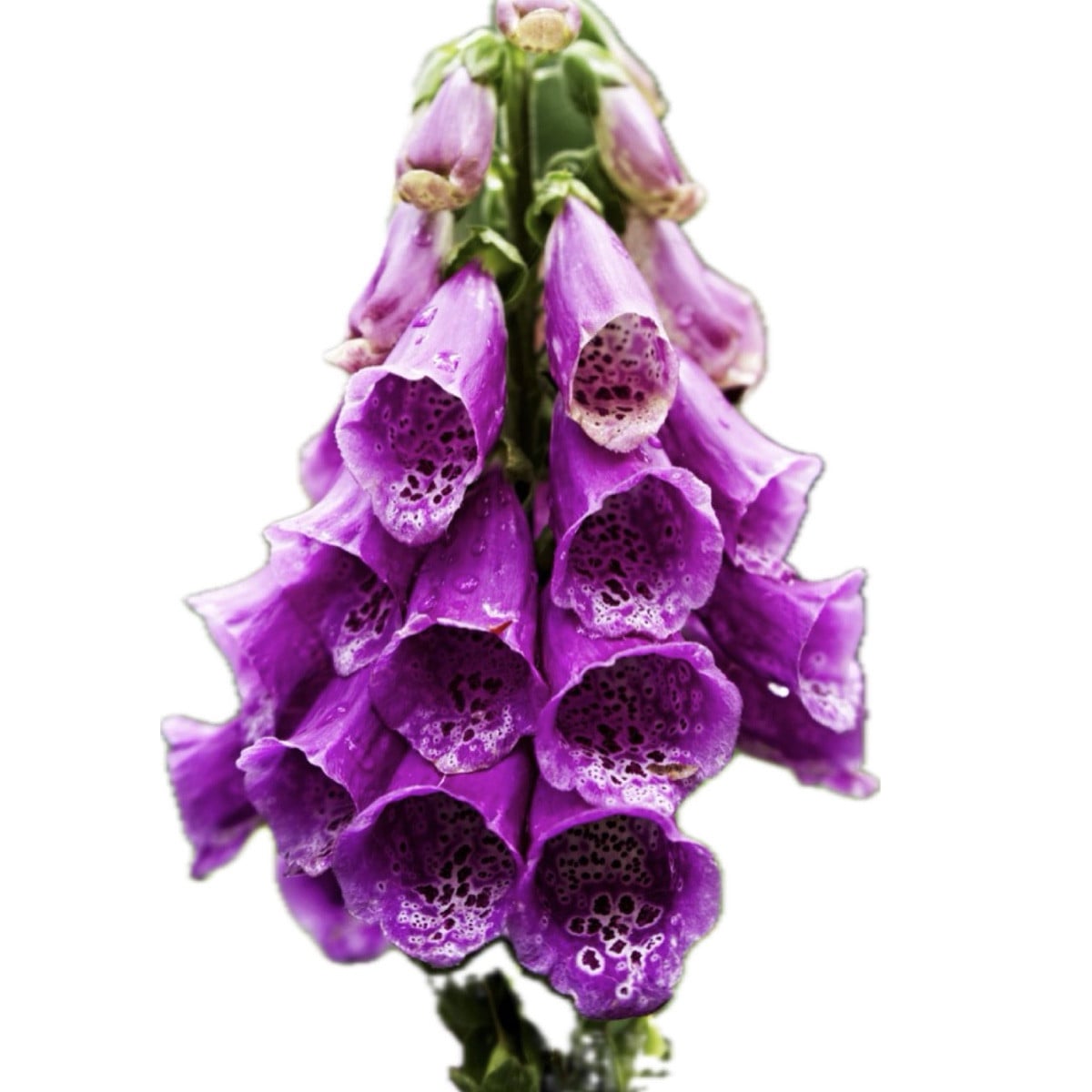
The foxgloves (Digitalis) are a plant genus within the plantain family (Plantaginaceae). The approximately 25 species are widespread in Europe, North Africa and West Asia. Digitalis species grow as biennial or perennial herbaceous plants that rarely become somewhat woody at the base. The stems are branched at most at their base. The alternate, sometimes basal leaves are simple. The leaf margin is smooth or toothed. The flowers are arranged in terminal, sometimes branched, racemose inflorescences. The hermaphrodite flowers are zygomorphic and five-petaled. The five sepals are fused, with short calyx tips. The five petals are tubular to bell-shaped. The corolla is two-lipped; the lower lip is three-lobed, the upper lip has either barely recognizable lobes (e.g. in Digitalis grandiflora) or they are clearly two-lobed (e.g. in Digitalis lutea). There are only four stamens; they do not protrude from the corolla tube. The anthers touch each other in pairs. The style ends in a two-lobed stigma. The septate, ovoid capsule fruit contains many small, ribbed seeds. The plant constituents digitalis glycosides are used therapeutically for the symptomatic treatment of heart failure, as they have a positive inotropic effect on the heart. In high doses they act as a poison, which leads to death through various cardiac arrhythmias. Foxglove, especially red foxglove, has been used internally and externally in medicine. The genus Digitalis is widespread in Europe, North Africa and Western Asia, with its main distribution area being Southern Europe. Three species occur in Germany: the large-flowered foxglove, the yellow foxglove and the red foxglove; the woolly foxglove is also found as a neophyte.
Origin:
Europe, North Africa, West Asia
Growing tips
Pruning after flowering promotes new shoots. ☀️ 1. Choose the right location Partial shade is ideal Sun is fine if the soil remains fresh and humus-rich Full shade → fewer flowers 🌱 2. prepare the soil Humus, loose, slightly moist No waterlogging (foxglove reacts sensitively) Work in some compost, but do not overfertilize 🌾 3. sowing Light germinator → Do NOT cover seeds Sowing depth: 0 mm Germination temperature: 18-20 °C Pre-cultivation: February-April Direct sowing: May-June 🌼 4th planting Planting time: May-June or September Spacing: 30-40 cm Water well after planting 💧 5. care Keep evenly moist No waterlogging Mulch helps to retain moisture Do not fertilize like vegetables - foxglove likes it lean 🌸 6. flowering & life cycle Biennial: Year → Rosette Year → Flowering (June-August) The plant dies after flowering If seed heads are left standing, it will reliably reproduce 🐛 7. diseases & pests Robust due to toxins Possible problems: Powdery mildew, leaf spots, snails on young plants Airy position prevents fungi 🌿 8. good neighbors Ferns, hosta, columbine, heuchera, astilbe 9. bad neighbors Lavender, thyme, sedum (too dry/lean)

Companion Plants

Antagonistic Plants
Coneflower (Echinacea)
Evergreen
Garlic
Grasses - Bamboos
Hydrangea / Hortensia
Ivy
Lavender
Onion
Onion (Spring onion)
Rose
Rosemary
Rudbeckia (Coneflower / Black-eyed-susans)
Sage
Stem herbs
Strawberry
Succulents
Succulents - Agave family
Succulents - Cacti
Succulents - Crassulaceae
Succulents - Euphorbiaceae
Sunflower
Thyme
Diseases
Root Rot
Black spot of roses
Downy mildew
Powdery mildews
Grey mold
Pests
Land snails
Leaf-miner flies
Aphids