Rapeseed

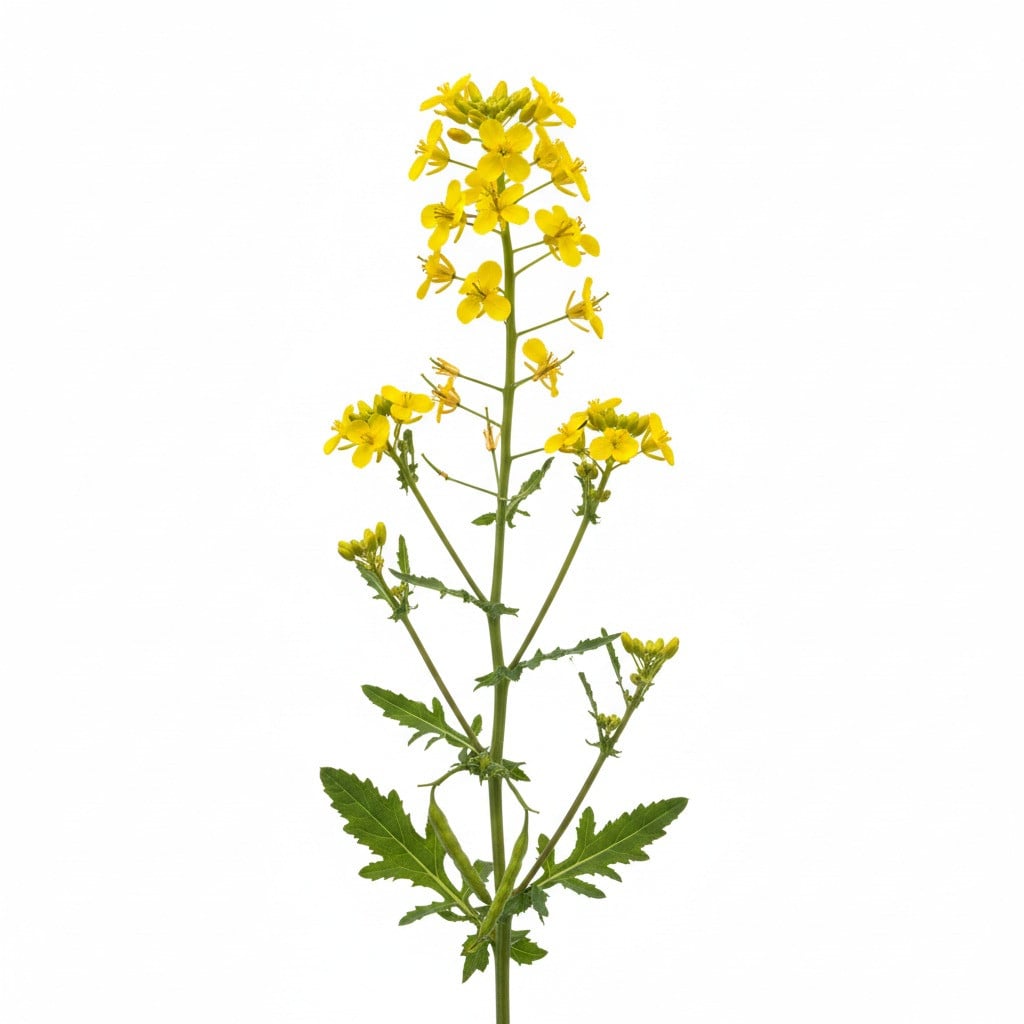
Rapeseed
Brassica napus
Plant family
Crucifers (Brassicaceae)
Cultivation Break
4 Years
Season Overview
Sowing
Harvest
Harvest
J
F
M
A
M
J
J
A
S
O
N
D
1ST YEAR
2ND YEAR
Details


Light requirement
Sunny

Water requirement
Moist

Soil
Medium (loamy)
Nutrient requirement
High

Dark germinator

Germination temperature
8 - 12 °C (Degrees Celsius)

Plant distance
20 cm

Row spacing
40 cm

Seeding depth
2 cm
Instructions
Description
Rapeseed (Brassica napus), also called oilseed rape or canola, is a species in the mustard family (Brassicaceae). It is an economically important oilseed crop. The seeds are primarily used to produce rapeseed oil and the co-product rapeseed meal. Brassica napus is an allopolyploid hybrid that originated from a hybridization of oilseed rape (Brassica rapa) and cabbage (Brassica oleracea). Rapeseed (from Low German rapsād, with the second word element, since the plant is cultivated for its oil-bearing seeds, from Low German Rapp, borrowed from the Latin word Rapa, meaning the same) has been cultivated for centuries for the high oil content of its seeds. The rapeseed plant was already known to the Romans. Rapeseed originally comes from the eastern Mediterranean region and was used to produce cooking oil and, above all, lamp oil. Rapeseed is an annual or biennial herbaceous plant and reaches heights of 30 to 150 centimeters. It can develop a fleshy taproot. The upright stem is branched at the upper part. The aboveground plant parts are occasionally very faintly gray-pubescent along the veins and leaf margins, but are usually completely glabrous or only weakly hairy at the base. Leaves: The basal leaves at the lower part of the stem consist of a petiole up to 15 centimeters long and a leaf blade that is 5 to 25 (rarely up to 40) centimeters in length and 2 to 7 (rarely up to 10) centimeters in width, with an outline that is ovate, oblong-rounded to lanceolate, pinnately lobed or cuneate, and sometimes undivided. The terminal lobe is ovate and the margin is toothed, wavy, or entire. On each side of the midrib, there are one to six lateral leaf lobes, which are noticeably smaller than the terminal lobe, occasionally absent, and also have toothed, wavy, or entire margins. The leaves higher up on the stem are sessile with a leaf blade that is lanceolate, ovate, or oblong, up to 8 centimeters long and 3.5 centimeters wide. Their auricle-like base encloses the stem, and the leaf margin is smooth or wavy. Inflorescence/Flower: Depending on the weather, an individual plant will bloom for about three to five weeks, but a single flower wilts after only one to two days. 20 to 60 flowers are arranged in an terminal, racemose inflorescence. The hermaphroditic flowers are four-parted. The four ascending or rarely nearly erect sepals are oblong, 5 to 10 millimeters long and 1.5 to 2.5 millimeters wide. The four bright- to pale-yellow petals are usually 1 to 1.6 (0.9 to 1.8) centimeters long and 6 to 9 (5 to 10) millimeters wide, broadly reverse-ovate with a rounded upper end and a 5 to 9 millimeter-long claw. There are six stamens. The filaments are usually 7 to 10 millimeters long (rarely up to 5), and the anthers, which are 1.5 to 2.5 millimeters long, are oblong. The ovary is elongated with a short to barely visible style and a capitate stigma. Both self-fertilization within the flower and cross-pollination by bees occur. Fruits/Seeds: The slender or ascending, straight pedicel is usually 1.2 to 2.3 (1 to 3) centimeters long. The sessile pod is linear to cylindrical to slightly quadrate, 5 to 9.5 (3.5 to 11) centimeters long and 3.5 to 5 millimeters in diameter, and contains twelve to twenty seeds. The dark brown to blackish round seeds are globular with a finely reticulate surface, measuring 1.5 to 2.5 (1.2 to 3) millimeters in diameter.
Origin:
Mediterranean region, India
Growing tips
Cultivation Winter oilseed rape is mainly grown in Central Europe. It is sown in the fall and harvested the following early summer. In Canada, the world's largest rapeseed producing country, spring rapeseed predominates. In Germany, the aim is to sow winter oilseed rape in the second half of August. Sowing into the first week of September is possible. The aim is for the plants to enter the winter in a strong rosette stage, but not yet to form an elongated shoot axis. Oilseed rape requires an optimum seedbed with a slightly consolidated seed placement horizon (the soil depth at which the seed is placed) and a flat, loose surface. 35-70 grains of winter oilseed rape per square meter are sown shallowly with a sowing depth of two to three centimeters. The sowing rate for hybrids is somewhat lower than for line varieties. Row spacings of around 13 to 26 cm are common. Both drill sowing and the more precise but more complex precision sowing are used. The rapeseed plant places high demands on the nutrient supply. Compared to cereals, the main nutrients required by oilseed rape are nitrogen, potassium and sulphur. Among the micronutrients, rapeseed requires particularly high levels of boron, manganese and molybdenum. Utilization Rapeseed, the commercially used part of the plant, is primarily used to produce rapeseed oil, which is used as an edible oil and animal feed, but also as a biofuel. Rapeseed oil is also used in the chemical and pharmaceutical industries and serves as a raw material for materials such as paints, bioplastics, cold foam, plasticizers, surfactants and biogenic lubricants. Depending on the processing method, around two thirds of the rapeseed mass is produced as by-products of rapeseed oil extraction in oil mills in the form of rapeseed cake, rapeseed expeller or rapeseed extraction meal. These products are mainly used as protein-rich animal feed and can partially replace imports of soy. Glycerine, which is a by-product of the further processing of rapeseed oil into biodiesel, is also used in the animal feed industry, but increasingly also in the chemical industry and as a bioenergy source. The rapeseed straw resulting from the harvest usually remains on the field as a source of humus and nutrients, but can also be used for energy. Rapeseed fields are very important for beekeeping. Rapeseed flowers are one of the most important and richest sources of nectar for honey bees in Germany, among other countries. A rapeseed flower produces nectar with a total sugar content of 0.4 to 2.1 mg in 24 hours. One hectare of rapeseed can yield a honey harvest of up to 494 kg in one flowering season. Due to the large-scale cultivation, the fine and lard-like candied rapeseed honey is also easy to harvest as pure honey. Rapeseed leaves and stems of some varieties are edible and are mainly used as a vegetable in Asian and African cuisine.

Companion Plants

Antagonistic Plants
Abyssinian cabbage / Ethiopian mustard
Beetroot
Broccoli
Broccoli raab / Stem cabbage / Cima di rapa
Brussels sprouts
Brussels sprouts
Cabbage (Cabbage)
Cabbage (Pointed cabbage)
Cabbage (red cabbage)
Cabbage (Savoy cabbage)
Cauliflower
Chinese kale - Kai-lan / Chinese broccoli
Collard greens
Collard greens (Kale)
Collard greens (Tuscan kale / Dinosaur kale / Palm tree kale)
Kohlrabi / German turnip / Turnip cabbage
Mustard
Napa cabbage / Chinese cabbage
Radish
Radishes
Rapeseed - Sheer cabbage / Siberian cabbage
Rutabaga / Swedish turnip
Sea coal
Sunflower
Turnip
Vegetable cabbage - Forage cabbage
Vegetable cabbage - Ribbed cabbage / Portuguese cabbage
Vegetable cabbage - wild cabbage / ancient cabbage
Diseases
Root Rot
Dry rot of crucifers
Black spot of roses
Club root of cabbage
Grey mold
Pests
Land snails
Cabbage fly
Flea beetles
Aphids
Voles