Forsythia

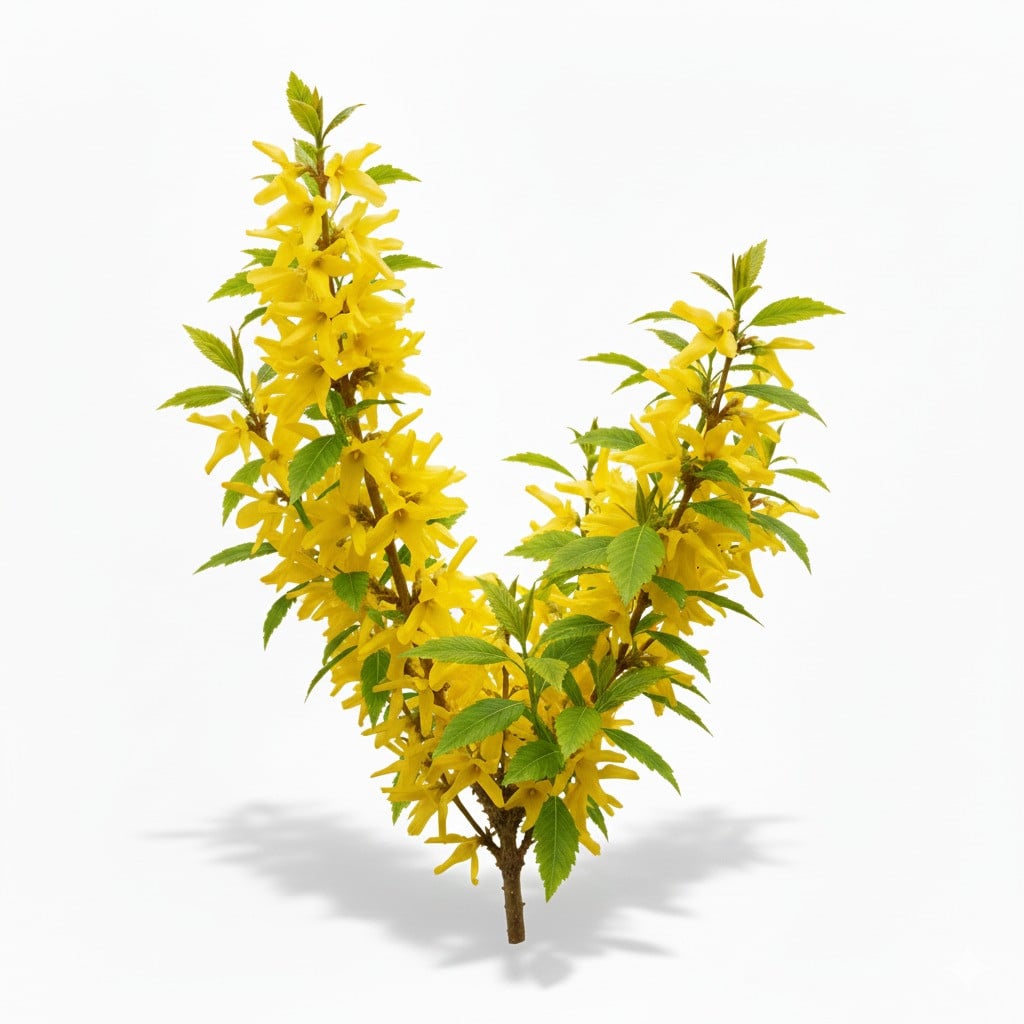
Forsythia
Forsythia
Plant family
Olive family (Oleaceae)
Season Overview
Planting
Harvest
Harvest
J
F
M
A
M
J
J
A
S
O
N
D
1ST YEAR
FOLLOWING YEARS
Details


Light requirement
Sunny

Water requirement
Moist

Soil
Medium (loamy)

Nutrient requirement
Medium

Light germinator

Germination temperature
20 – 25 °C (Degrees Celsius)

Plant distance
170 cm

Row spacing
170 cm

Seeding depth
0.5 cm
Instructions
Description
Origin There are seven different species of forsythia (Forsythia), also known as golden bells, worldwide, which are mainly found in East Asia. Only one species, Forsythia europaea, is native to southern Europe. Forsythia belongs to the olive tree family (Oleaceae) and is therefore related to the olive tree, among others. The genus Forsythia was named after the English master gardener William Forsyth. The forsythias cultivated in gardens (Forsythia x intermedia) are all hybrid varieties of the two East Asian species Forsythia suspensa and Forsythia viridissima. Growth habit Forsythias are usually two to three meter tall shrubs with an initially upright growth habit that becomes strongly overhanging with age. Their growth habit is basal and mesotonic, i.e. the dormant eyes also sprout from the older wood at the base and in the middle of the shoot until old age, usually forming long, thin, tightly upright shoots. The bark is olive-green on young shoots, ochre-yellow to grey-yellow on older ones and covered with strikingly large cork warts, so-called lenticels. Leaves Forsythia leaves are opposite, eight to twelve centimetres long and ovate with an elongated tip. The leaf edges are serrated and the leaf blade is usually light to fresh green in color. In sunny locations with rather dry and nutrient-poor soils, the deciduous leaves sometimes show a yellowish to purplish autumn color before they fall. Flowers Depending on the weather, the flowers usually appear in abundance from mid-March. The yellow bells usually have four petals and are around three centimetres in diameter. They appear along almost the entire length of the shoot on last year's and older wood as well as on its short side branches. The two to three-year-old shoots are the most floriferous. From an ecological point of view, forsythia is not the first choice for garden planting, as most insects cannot do much with the flowers. For example, they provide bees with neither nectar nor usable pollen. Fruits Most hybrid varieties of forsythia are sterile or produce very few fruits. The 'Beatrix Farrand' variety, on the other hand, is reliably fruitful: it produces brown, hard capsule fruits from its flowers.
Origin:
East Asia, Southern Europe
Growing tips
Location Forsythia blooms most magnificently in full sun locations. In semi-shade and shade, the flowering is significantly less magnificent and the crowns of the shrubs are not nearly as dense. Soil Forsythia has low demands on soil quality. They grow in all acidic to alkaline, well-drained and not too dry soils. If the lime content is very high, the leaves sometimes turn yellow. A high humus content has a positive effect on the vitality of the flowering shrubs. Planting Forsythia is usually offered in pots, less often as bare-rooted shrubs. As they are easy to propagate and grow quite quickly, they are classed as simple flowering shrubs and are relatively inexpensive. When planting, you should above all ensure that the soil has good water retention capacity. If the soil is poor, work in plenty of mature compost and leaf humus and cover the soil surface with bark humus after planting the shrubs. Care Although forsythia does not need regular feeding, it should be watered in good time during dry summers. They quickly drop their leaves in the heat on dry soil and the lack of water also has a negative effect on flower formation for the following year. Avoid tilling the soil in the root area and pluck out individual wild herbs that grow through the mulch layer by hand. As forsythia has few problems with strong root competition, it can also be well underplanted with ground cover plants to suppress weeds. Pruning Forsythia is a flowering shrub that senesces relatively quickly and becomes lazy to flower. In order to maintain the joy of flowering, it is best to prune your forsythia annually or at least every three years after flowering from mid to late April with pruning shears and thin it out. Remove all branches that are older than three years or cut them off above a younger, vital side shoot. Only leave as many of the new shoots from the previous year that have sprouted at the base of the shrub as you have removed older branches. If a forsythia has not been pruned for years and its crown has literally fallen apart, it can also be completely pruned in spring and the crown can then be rebuilt from the strong young shoots. Use In spring, forsythias produce an enormous abundance of yellow flowers. This makes them visually very dominant and they should be used sparingly and accentuated in the garden. A single forsythia planted with blue bulbs such as grape hyacinths, for example, is much more effective than a hedge of free-growing forsythia at the end of the plot. They should be planted in small groups of three plants at most. Another challenge is to bridge the rest of the garden season after the forsythia blooms with other suitable flowering shrubs or perennials. This is because the forsythias are then hardly noticed visually, as they do not stand out with their growth habit or special leaf decoration. The shrubs are therefore very suitable as background planting for perennial beds, which take over the flowering sceptre from mid-April. Low forsythia varieties such as 'Week-End' are sometimes also cultivated in planters due to their robust nature. However, their rather short flowering period in spring does not justify such use and the associated higher care requirements. Propagation Propagating forsythia is child's play, as all varieties reliably form roots as cuttings. The cuttings method is favored for the taller varieties, while the weaker growing varieties are usually propagated in early summer by slightly woody cuttings. Diseases and pests Forsythia is quite robust and not very susceptible to disease in sunny locations with sufficient soil moisture. Monilia tip blight, which otherwise mainly affects sour cherries and some ornamental cherries, sometimes occurs in spring. Cut infected branches out of the crown early and generously. Powdery mildew is also a common fungal parasite, but does not cause any serious damage. As far as animal pests are concerned, weevils and aphids are the most common.

Companion Plants

Antagonistic Plants

Diseases
Septoria
Angular leaf spot of cucumber
Powdery mildews

Pests
Spider mites
Aphids