Brunfelsia

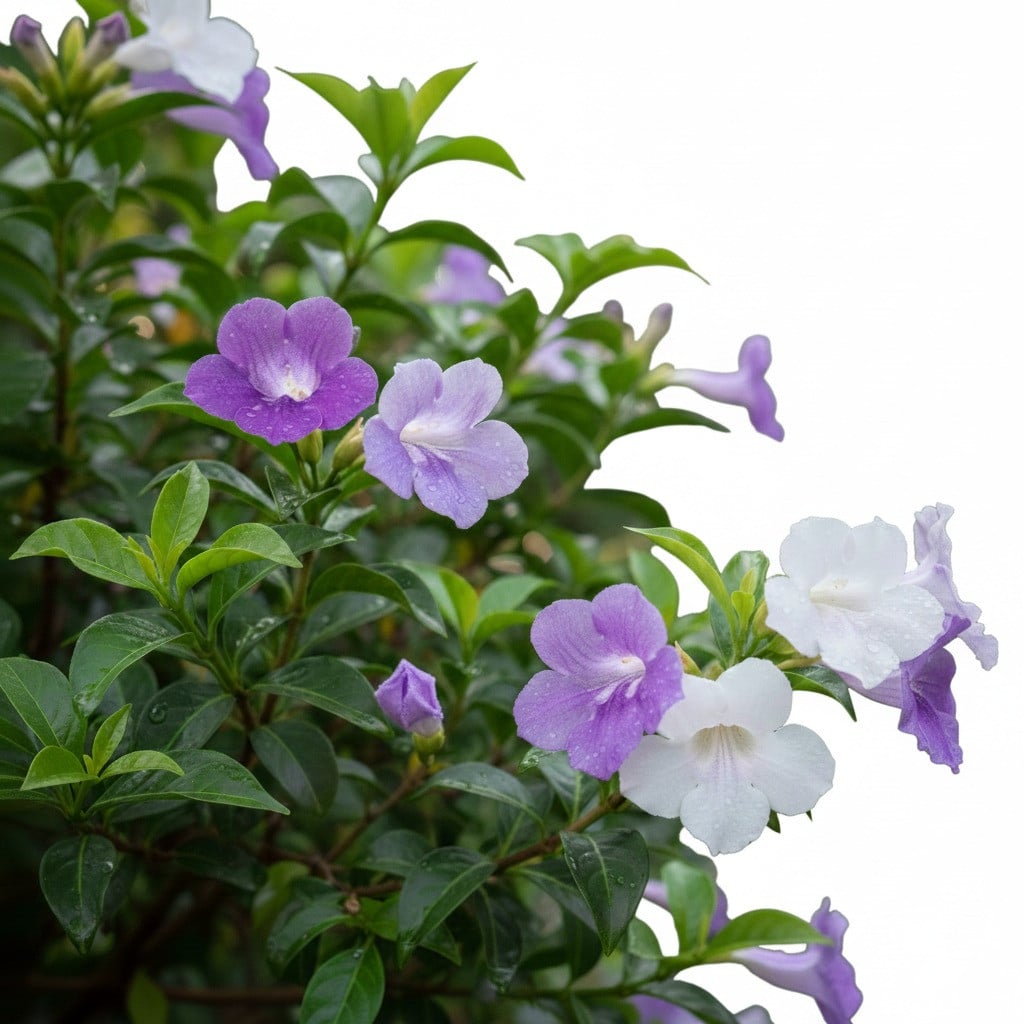
Brunfelsia
Brunfelsia
Plant family
Solanums (Solanaceae)
Season Overview
Planting
Harvest
J
F
M
A
M
J
J
A
S
O
N
D
1ST YEAR
FOLLOWING YEARS
Details


Light requirement
Semi-shaded

Water requirement
Moist

Soil
Medium (loamy)

Nutrient requirement
Medium

Light germinator

Germination temperature
25 – 30 °C (Degrees Celsius)

Plant distance
70 cm

Row spacing
70 cm

Seeding depth
0.5 cm
Instructions
Description
Brunfelsia is a genus of plants in the nightshade family (Solanaceae). The 46 species are divided into the three sections Brunfelsia (22 species), Franciscea (18 species) and Guianenses (6 species), which differ significantly in terms of both distribution and characteristics. Growth Most Brunfelsia grow as shrubs, only some species also grow as small trees. Within the Brunfelsia section, the species typically grow to heights of 2 to 3 m, although Brunfelsia jamaicensis, Brunfelsia americana and Brunfelsia lactea can also reach 10 to 12 m in height. The species in the Franciscea and Guianenses sections usually grow to a height of 1 to 3 m, but there are also larger species here. Brunfelsia grandiflora, for example, grows to an average height of 4 to 5 m as a tree, but some collections are said to come from trees up to 10 m high or liana-like plants of the same length. The species with the lowest growth height is Brunfelsia latifolia, which flowers at a height of 30 cm and only rarely reaches a height of 1 m. The species either form a main stem or are more or less strongly branched near the base. Occasionally, the species Brunfelsia australis, Brunfelsia grandiflora and Brunfelsia brasiliensis, among others, can develop two or three main stems. In the cultivated forms of Brunfelsia nitida, Brunfelsia undulata and Brunfelsia australis, root suckers often form around the main stem, resulting in a large number of clones. Leaves The size of the leaves varies between 1 and 30 cm in length and 0.1 and 1 cm in width. The leaf size can also vary greatly within a species depending on environmental conditions such as light and humidity. The leaves of Brunfelsia grandiflora, for example, can be between 6 and 23 cm long. The texture of the leaves is usually firm-skinned to almost leathery, they feel soft and rubbery. Some species and varieties also have thicker, leathery and shiny leaves, such as Brunfelsia splendida, Brunfelsia dwyeri, Brunfelsia obovata var. coriaceae or Brunfelsia rupestris. Some stands of Brunfelsia uniflora and Brunfelsia brasiliensis, which grow in unusually dry or unprotected locations, also develop leathery leaves. The leaves are light to dark green on the upper side, the underside is somewhat lighter. Brunfelsia pilosa, Brunfelsia plicata and Brunfelsia undulata have a dark purple pigmentation on young shoots, which is due to anthocyanins. The veins are barely visible on the upper side of the leaf, but are clearly visible on the underside. On each half of the leaf, three to twelve secondary veins branch off pinnately from the main vein, with neighboring secondary veins rejoining near the edge. The intermediate veins are finely reticulated and can be indistinct or slightly prominent. A special feature is Brunfelsia hydrangeiformis, in which the midrib, the secondary veins and the larger intermediate veins are embedded in weak furrows on the upper side, thus forming a very irregular surface structure. Roots Seedlings and young plants have diffusely branched roots, but older plants often develop a strong taproot. Flowers The hermaphrodite flowers of Brunfelsia species are stalked. They are slightly zygomorphic, which can be seen in the calyx, the curved corolla tube, the irregular corolla edge or the two differently shaped pairs of stamens, depending on the species. The largest flowers are found in the Brunfelsia section and are particularly fragrant in the evening. The Franciscea section has somewhat smaller and less fragrant flowers. The smallest flowers are found in the Guianenses section, which are again fragrant. Fruits The fruits are capsules.
Origin:
South America, West Indies
Growing tips
Location / light Brunfelsia should be grown in a bright location. Slight sunlight, but only during the early morning hours, is conducive to flower formation. The humidity should not be too low. Watering / Watering Water a Brunfelsia evenly so that the soil ball always remains slightly moist. Waterlogging and excessive waterlogging of the substrate should always be avoided. Spray the Brunfelsia with soft water from time to time. Between November and February, the plants should be watered more sparingly, but the root ball should not be allowed to dry out. Temperature During the main growing season, normal room temperatures of up to approx. 22°C are fine for the growth of Brunfelsia. However, the ideal temperature is between 15 and 18°C. Temperatures must not rise too high, otherwise the Brunfelsia will shed its buds. If you are looking for vigorous flower formation, give the Brunfelsia a 6-week rest period at temperatures around 12 °C in November. Major temperature fluctuations must be avoided during the dormant period. Propagating the plant To propagate Brunfelsia, cut 8 to 15 cm long head cuttings in spring. Place these in small pots with a moist mixture of equal parts peat moss and sharp sand. Then put plastic bags over them and place the Brunfelsia cuttings in a bright, sunny spot. After four to six weeks, the cuttings should show signs of rooting by sprouting. Now uncover the cuttings, water them evenly and fertilize them every two weeks with a weak concentration of liquid fertilizer. Approximately four months after propagation, the young plants are placed in uniform soil. To achieve bushy growth, the tips of the shoots are removed. For Brunfelsia plants from the previous year, shorten the previous year's growth by about half in spring. Soil / substrate Normal potting soil or potting compost is well suited for the care of Brunfelsia. In early spring, repot the plants in fresh soil. Fertilizing / nutrient requirements The nutrient requirements of Brunfelsia are low to moderate. Well-growing plants are given a commercially available liquid fertilizer in a low concentration every 14 days. The plants are not fertilized between November and February. Pests, diseases The leaves will fade in overly sunny locations. Waterlogging can cause chlorosis with yellow leaves. Brunfelsia is quickly attacked by spider mites in low humidity.


Antagonistic Plants

Diseases
Septoria
Angular leaf spot of cucumber
Powdery mildews
Root Rot
Pests
Spider mites
Schildläuse
Aphids
White fly