Sweet chestnut, edible chestnut, marron

Sweet chestnut, edible chestnut, marron
Castanea sativa
Plant family
- others -
Season Overview
Planting
Harvest
Harvest
J
F
M
A
M
J
J
A
S
O
N
D
1ST YEAR
FOLLOWING YEARS
Details


Light requirement
Sunny

Water requirement
Dry

Soil
Medium (loamy)

Nutrient requirement
Medium

Dark germinator

Germination temperature
20 – 25 °C (Degrees Celsius)

Plant distance
2000 cm

Row spacing
2000 cm

Seeding depth
3 cm
Instructions
Description
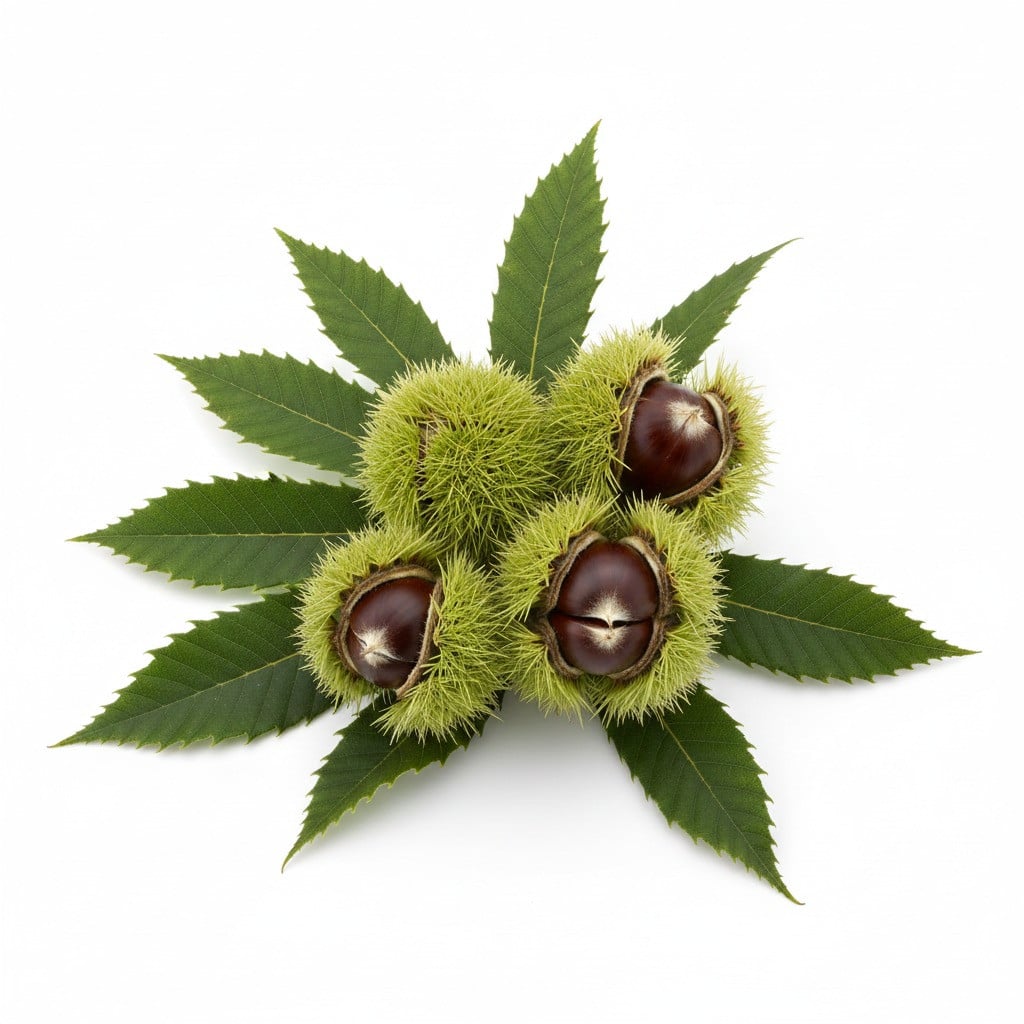
Growth The sweet chestnut is a deciduous, upright-growing deciduous tree that develops a spreading crown with age and can grow up to 30 meters high. Its trunk has an average diameter of one to two meters. When young, its bark is smooth and brown; as it ages, it turns gray and becomes rough and cracked. Leaves Castanea sativa does not sprout its leaves until the end of April to the beginning of May. Initially they are still slightly hairy, later smooth, shiny and clearly veined. The leathery, elongated leaves grow up to 20 centimetres long and around 6 centimetres wide. They turn yellow-brown in the fall and brown just before the leaves drop. Blossoms The sweet chestnut tree begins to flower for the first time after 20 years at the earliest. Its flowers are monoecious, i.e. they grow together from the leaf axis. At the end of May to mid-July, the male flowers appear first as yellowish, 15 to 20 centimeter long catkins. The female flowers, which are much less conspicuous, then develop at their base. Fruits After pollination by bees and other insects, the seeds develop from the female flowers of the sweet chestnut in October. The fruits are shiny, dark brown nuts that are encased in a spiky fruit cup. The spines are green at first and turn yellow-brown when ripe. In the wild form, the fruit cups are significantly smaller (around 5 to 6 centimetres) than in most cultivated forms of the sweet chestnut (up to 10 centimetres). When fully ripe, the fruit cup opens and the one to three chestnuts fall to the ground. Animals such as squirrels, dormice, jays and crows hide them in the ground as a food supply and new trees sprout from the forgotten fruit.
Origin:
Caucasus and Armenia, Asia Minor, Greece, Italy, Canary Islands mild wine-growing regions in Germany
Growing tips
Location The sweet chestnut is very fond of warmth and needs plenty of light to thrive. It is best to give it plenty of space so that it can develop into a stately tree. It does not tolerate late frosts and a rainy flowering period well. Soil Castanea sativa feels most at home in fresh, loose and deep soil. Acidic soils are preferred and the lime content must not be too high. Waterlogging should also be avoided. The sweet chestnut is best planted in spring so that the young tree can grow in well. The planting hole should be deep enough so that the root ball is not higher than before in the planting container. Loosen the soil thoroughly and cover with bark mulch after planting. Don't forget to water thoroughly! Care Once rooted, the sweet chestnut requires no major care. It is grateful for an annual dose of compost, as this covers its high potassium requirement. Pruning The sweet chestnut develops its stately crown most beautifully if it is left to grow unpruned. With increasing age, old, diseased or troublesome branches can of course be thinned out. Use Due to its stately growth habit and height, the sweet chestnut is only suitable for larger gardens. As a solitary plant, it is a beautiful eye-catcher. If you value fruit, you should plant at least a second sweet chestnut nearby as a pollinator. Varieties There are countless varieties of sweet chestnut that have been optimized for larger fruits and yields. Propagation Castanea sativa is relatively easy to propagate from seed, but it takes at least 20 years until the first blossom. Those who value flower and fruit decoration should plant a grafted tree. Diseases and pests One dreaded disease of the sweet chestnut is chestnut blight. The causative agent, a fungus, was introduced via America and China at the beginning of the 20th century and decimated large parts of the chestnut population in southern Europe. Today, however, it is kept well in check by biological control and hardly ever occurs. Ink disease is also caused by a fungus and its spread is favored by excessively moist, waterlogged soil. Among the pests, the chestnut borer and the chestnut moth should be mentioned, both of which attack the fruit.

Companion Plants

Antagonistic Plants

Diseases
No diseases
Pests
No pests