Chard

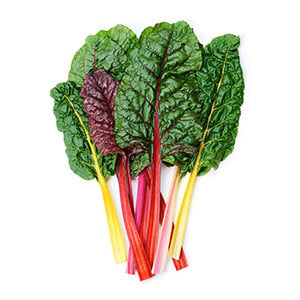
Chard
Beta vulgaris subsp. vulgaris
Plant family
Amaranth family (Amaranthaceae)
Also known as
Swiss Chard
Cultivation Break
3 Years
Season Overview
Propagating
Planting
Harvest
Harvest
J
F
M
A
M
J
J
A
S
O
N
D
1ST YEAR
2ND YEAR
Details


Light requirement
Semi-shaded

Water requirement
Moist

Soil
Medium (loamy)
Nutrient requirement
Medium

Dark germinator

Germination temperature
15 - 20 °C (Degrees Celsius)

Plant distance
30 cm

Row spacing
40 cm

Seeding depth
1 cm
Instructions
The season for this plant is over. The following instructions are for the next season.
Mid of February

Propagating
Beginning of March

Transplanting
Mid of March

Planting
Description
Biennial goosefoot with two groups of varieties: stem or ribbed chard and leaf or cut chard. Stem chard forms a very large leaf vein that can be prepared like asparagus. Leafy chard forms a much smaller leaf vein, but large leaves that can be used like spinach or raw as a salad ingredient when young.
Origin:
Coastal regions of the Mediterranean
Growing tips
When sowing chard is happy humus and nutrient-rich soil, and then should be kept moist. After germination, it is recommended to remove seedlings that grow too densely. Chard tolerates light frost and can remain outdoors in regions with mild winters. Leafy chard can be harvested continuously from about 2 months after sowing, stem chard after about 3 months. If only the outer leaves are removed and the plant is watered, the chard will grow again. A cultivation interval of 3-4 years to other goosefoot should be observed.

Companion Plants
Abyssinian cabbage / Ethiopian mustard
Apple
Apricot
Aubergine / Eggplant
Basil
Bean ((Scarlet) runner bean)
Bean (Broad bean / Faba bean / Field bean)
Bean (Dwarf bean)
Bean (Hyacinth bean / Lablab-bean)
Bean (Lima Bean)
Bean (Runner bean)
Borage
Broccoli
Broccoli raab / Stem cabbage / Cima di rapa
Brussels sprouts
Brussels sprouts
Cabbage (Cabbage)
Cabbage (Pointed cabbage)
Cabbage (red cabbage)
Cabbage (Savoy cabbage)
Carrots
Cauliflower
Celery (Celeriac / Celery root)
Celery (Celery)
Celery (Leaf celery / Chinese celery)
Chili
Chinese kale - Kai-lan / Chinese broccoli
Chives
Collard greens
Collard greens (Kale)
Collard greens (Tuscan kale / Dinosaur kale / Palm tree kale)
Common marigold
Courgette / Zucchini
Cucumber (African horned cucumber / Kiwano)
Cucumber (Caigua)
Cucumber (Melothria)
Cucumber / Gherkin
Currant
Dill
Funk
Garden squash - Patisson / UFO squash
Garlic
Garlic chives
Gooseberry
Hair cucumbers / snake gourds
Hazelnut
Kohlrabi / German turnip / Turnip cabbage
Leeks
Lettuce (Common chicory)
Lettuce (Endive / Escarole / Erisée)
Lettuce (Lamb's lettuce)
Lettuce (Lettuce)
Lettuce (Oriental greens / Brown mustard)
Lettuce (Puntarelle / Cicoria di catalogna / Cicoria asparago)
Lettuce (Radicchio / Italian chicory)
Lettuce (Sugar loaf)
Melon (Sugar melon)
Melon (Watermelon)
Mizuna / Japanese mustard greens
Napa cabbage / Chinese cabbage
Nasturtium
Nightshades (Other)
Okra
Onion
Onion (Spring onion)
Ornamental pumpkin
Pak Choi
Parsley
Parsnip
Pea
Peach
Pear
Pepper / Paprika
Plum
Pomegranate
Pumpkin / Squash
Radish
Radishes
Rapeseed
Rapeseed - Sheer cabbage / Siberian cabbage
Rapini / Broccoli rabe
Raspberry
Root parsley
Rutabaga / Swedish turnip
Savory
Sea buckthorn
Sour cherry / Tart cherry
Soybean
Sponge gourd / Egyptian cucumber / Vietnamese luffa
Sunflower
Tagetes / Marigolds
Tomato (Bush tomato)
Tomato (Cocktail bush tomato)
Tomato (Cocktail Stake Tomato)
Tomato (Stake tomato)
Turnip
Turnip greens - Choy Sum / Chinese flowering cabbage
Turnip greens - Mizuna
Turnip greens - Tatsoi
Turnips - Oilseed turnips
Turnips - Wild turnips
Vegetable cabbage - Forage cabbage
Vegetable cabbage - Ribbed cabbage / Portuguese cabbage
Vegetable cabbage - wild cabbage / ancient cabbage
Wild Cherry / Bird Cherry / Sweet Cherry
Wild garlic
Yalta tomatoes

Antagonistic Plants
Beetroot
Blackberry / Brambles
Chard
Coneflower (Echinacea)
Elderberry
Green lavender cotton
Jerusalem artichoke / Topinambur
Larkspur
Lavender
Lovage
Maples
Mint
Oregano
Phlox, flame flower
Potato
Rosemary
Rudbeckia (Coneflower / Black-eyed-susans)
Sage
Spinach (Summer)
Spinach (Winter)
Spruce trees
Stem herbs
Thyme
Walnut family
Diseases
Root Rot
Septoria
Angular leaf spot of cucumber
Powdery mildews
Downy mildew
Pests
Land snails
Thrips
Flea beetles
Beet fly
Aphids
Wireworms