Gewöhnliche Vogelmiere

Variety
Gewöhnliche Vogelmiere
Approved Data
created by MarieLu at 19.01.2026
Season Overview
Sowing
Harvest
J
F
M
A
M
J
J
A
S
O
N
D
Description
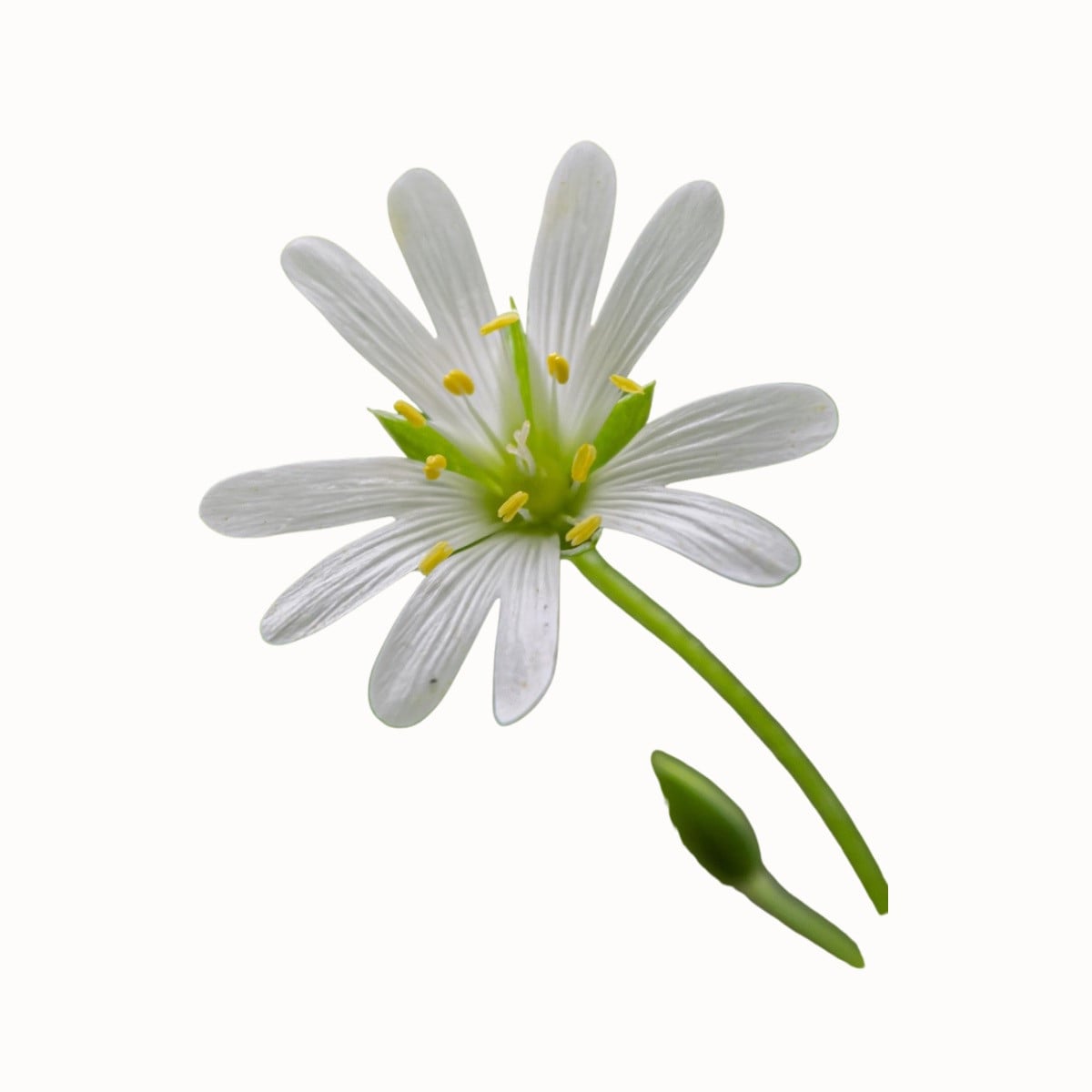
Taxonomy & classification Common chickweed belongs to the Caryophyllaceae family within the Caryophyllales order. Its scientific name is Stellaria media (L.) Vill. It is the eponymous species of a group of species that includes close relatives such as greater stitchwort (Stellaria neglecta) and white stitchwort (Stellaria apetala). There are several subspecies within the species, which can differ in details of hairiness and distribution. Growth form & appearance Chickweed is an annual, herbaceous plant that usually grows flat on the ground and forms dense carpets. The stems are soft, mostly prostrate, and usually reach a length of 3 to 40 cm, rarely slightly more. They are round in cross-section and bear a single line of fine hairs. The leaves are green, oval to slightly lanceolate, and opposite the stem. The plant produces small, white flowers that can appear almost all year round in mild weather. Each flower has five deeply forked petals, making it look like ten small petals. After flowering, capsule fruits develop with numerous seeds that can spread independently. Benefits in the garden Although chickweed is often considered a weed, it has several positive aspects. As a dense, flat-growing plant, it protects the soil from drying out in summer and from severe cold in winter, thus reducing erosion and contributing to soil moisture. It is also useful for animals: many bird species eat the seeds and insects also use the flowers as food, albeit to a lesser extent. Its common name "chickweed" comes not least from the fact that it has long been used as a feed plant for poultry and ornamental birds. In the garden ecosystem, chickweed contributes as an early-flowering species, helping to provide nectar for insects. At the same time, especially in nutrient-rich soils, it can grow quickly and compete with cultivated plants, which sometimes makes it seem disruptive. Chickweed is edible and nutritious for humans. Young leaves and shoots can be eaten raw in salads or cooked as wild vegetables. It contains vitamins, minerals, and trace elements and has found various uses in folk medicine. It is traditionally used for mild inflammation, skin problems, or as a tea. However, due to its saponin content, it should be consumed in moderation.
Non hybrid
Growing tips
Chickweed is usually sown directly. Pre-cultivation is neither necessary nor advisable, as the plant germinates very quickly and self-seeds without any problems. Direct sowing is possible all year round as long as the soil is frost-free. The seeds are only covered very thinly with soil or lightly pressed down, as they are light germinators. Chickweed likes evenly moist soil. Additional fertilizer is not usually necessary. Chickweed tolerates frequent harvesting very well and sprouts again quickly.
Details


Light requirement
Semi-shaded

Water requirement
Moist

Soil
Medium (loamy)

Nutrient requirement
Low

Plant distance
30 cm

Row spacing
30 cm

Seeding depth
0.5 cm

Companion Plants
No companion plants

Antagonistic Plants
No antagonistic plants

Diseases
No diseases

Pests
No pests