Papaya

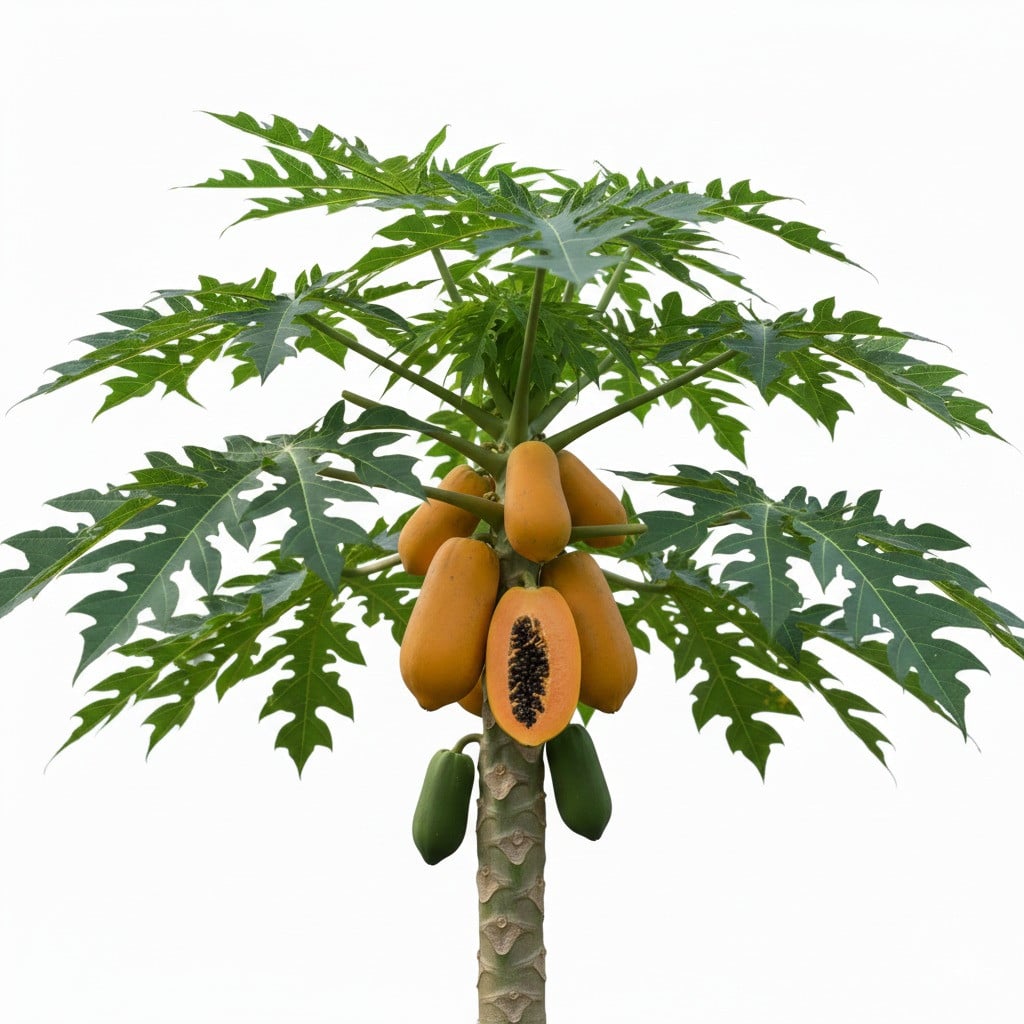
Papaya
Carica papaya
Plant family
Papaya family (Caricaceae)
Season Overview
Propagating
Planting
Harvest
Harvest
J
F
M
A
M
J
J
A
S
O
N
D
1ST YEAR
FOLLOWING YEARS
Details


Light requirement
Sunny

Water requirement
Dry

Soil
Light (sandy)

Nutrient requirement
Medium

Light germinator

Germination temperature
18 - 25 °C (Degrees Celsius)

Plant distance
200 cm

Row spacing
300 cm

Seeding depth
0.5 cm
Instructions
Description
Papaya (Carica papaya), also called the melon tree or papaya tree, is the only species of the plant genus Carica within the family Caricaceae. Growth The papaya plant grows into a six-meter-tall shrub with a bushy crown, resembling a palm tree in appearance. The stem is hollow and does not harden into wood: As with the banana, it consists of parallel fibers without woody tissue. Branching occurs only rarely. All parts of the true papaya plant contain latex. The roots run relatively close to the ground's surface. Leaves The long-stemmed, evergreen leaves of the true papaya are deeply lobed, about a half a meter long, and palmately shaped. The undersides are hairy. They are only found at the top of the stem, as the leaves growing lower continuously die off. Only triangular, broad leaf scars remain as a reminder. In Asia, the leaves are eaten like spinach. If you want to plant a papaya, choose a sunny to partially shaded location. In the summer, they do just as well on a balcony or terrace as they do in a garden bed. Potted plants are happy to spend the winter in a sunroom at temperatures of 65-77°F (18-25°C). The papaya should then be in a bright spot and can even tolerate direct sun. In a darker location, temperatures of 50-54°F (10-12°C) are well-tolerated, but growth will be slower. Temperatures above 60°F (15°C) are much better for the heat-loving papaya. The cream-yellow flowers of the papaya plant appear at the earliest after six months; you have to wait longer with potted plants. Male, female, and hermaphroditic flowers are produced—botanists have a field day with the papaya flower, as up to 13 forms have been described. Even a change of sex, caused by cool nighttime temperatures and changes in day length, is possible! Flowering Male flowers, which are recognizable by their up to four-centimeter-long, fused flower coronas, appear in racemes. Female flowers are shorter, with their petals fused only at the base. They usually appear singly or in small clusters on short stems that grow in the leaf axils. To ensure pollination, it is advisable to have several papaya plants. Fruits The exotic fruits that come from the hermaphroditic flowers of the true papaya are elongated and can weigh from one pound to about nine kilograms. Fruits from female flowers are round or oval. The rind, which is peeled before eating, is green at first and later turns yellow to orange-red. Inside the fruit is a cavity containing numerous black seeds. They are about the size of peppercorns and are usually not eaten. In some countries, they are used as a substitute for pepper. The fruit flesh is first white, later turning yellow, orange, or red. The fruit is ripe when it gives slightly to pressure. Unripe fruits can be ripened at room temperature for a few days. The vitamin A and C-rich fruit flesh is cooked like a vegetable or eaten raw, scooped out with a spoon from a papaya cut lengthwise. It tastes good in fruit salad, but also in ice cream, as jam, and as juice. A few drops of lemon juice on the fruit flesh improves its taste. The dried juice contains the enzyme papain, which aids in the digestion of meat. The juice of green papayas promotes wound healing and relieves skin diseases. In medicine, papain is used as an anthelmintic.
Origin:
tropical and subtropical regions, Malaysia, Australia, southern United States, Central America
Growing tips
Location A heated conservatory is the ideal location for the papaya plant. In summer, temperatures above 20 degrees Celsius are perfect, in winter it can be a little cooler at 13 to 18 degrees Celsius. In the summer months, the real papaya and its container can be moved outside to a sheltered, sunny spot. Substrate Carica papaya is at its best in structurally stable, nutrient-rich potting soil. Alternatively, humus-rich potting soil with a little sand is suitable. The pH value should not be too low, but it should not be above seven either. Watering Regular watering is essential for the papaya plant. However, you should significantly reduce the watering during the dormant phase, as the roots will rot if there is too much moisture. Fertilizing Fertilize the papaya generously every two to four weeks. Repotting When repotting, which is done annually, the root ball should remain intact. The plant should also not be higher or lower than before. Overwintering To overwinter the papaya plant, temperatures of at least ten degrees Celsius are required. Don't worry if almost all the leaves fall off: Just continue to keep the plant relatively dry, it will quite certainly sprout again. Propagation The black seeds of ripe fruit are used to grow real papaya, from which the gelatinous substance is first removed by rubbing with kitchen paper - it contains germination-inhibiting substances. Then sow immediately, as the seeds quickly lose their germination capacity, and cover the seeds thinly with soil. As the seedling roots are very sensitive to pricking out, it is best to plant the seeds in peat pots with nutrient-poor potting compost. A temperature of 27 degrees Celsius is ideal, germination then takes place after about two weeks. When the first real leaves appear, the seedling and the well pot should be transplanted into good potting soil - this should be well drained. The young papaya plant thrives best in a bright, warm place with high humidity. From a height of 15 centimetres, it can be placed in a sunny spot. Diseases and pests Fungal diseases such as mildew can cause problems for the papaya plant. A virus in the 1970s was devastating in Taiwan, causing the plants to die.

Companion Plants
No companion plants

Antagonistic Plants
No antagonistic plants

Diseases
No diseases
Pests
No pests