Nightshades (Other)

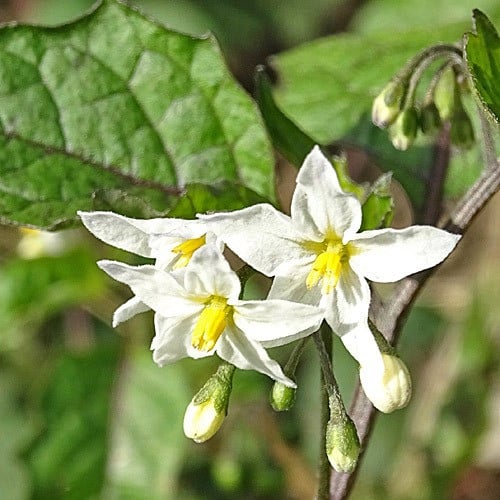
Nightshades (Other)
Solanum spec.
Plant family
Solanums (Solanaceae)
Cultivation Break
4 Years
Season Overview
Propagating
Planting
Harvest
Harvest
J
F
M
A
M
J
J
A
S
O
N
D
1ST YEAR
FOLLOWING YEARS
Details


Light requirement
Sunny

Water requirement
Moist

Soil
Medium (loamy)

Nutrient requirement
High

Light germinator

Germination temperature
20 - 25 °C (Degrees Celsius)

Plant distance
100 cm

Row spacing
100 cm

Seeding depth
0.5 cm
Instructions
Description
Nightshade (bot. Solanum) is a genus that belongs to the nightshade family (Solanaceae). It comprises around 1400 species. Nightshades are found all over the world, with the exception of areas near the North Pole. They are mostly herbaceous plants that grow upright to creeping, sometimes climbing. In the tropics, woody species are also found as shrubs and trees that can reach up to 20 meters in height. Numerous Solanum species are important as food or in medicine. Others are used as ornamental plants. Some nightshades are poisonous to humans due to various alkaloids. The shoot axis of the plants continuously divides into side shoots as it grows. This is known as the sympodial branching pattern. Some of the shoots have spines or are hairy. The spines can be seen on the shoots, on the leaves or on the calyx. They appear straight or bent back, thin and needle-like or with a broadened base. Depending on the species, the trichomes appear simple, glandular, star-shaped, tree-like or branched like sea urchins. Leaf The leaves of Solanum species are simple or compound, more often petiolate, more rarely sessile. They have a whole-margined, toothed, lobed or bent margin. All nightshades have alternate leaves. However, the leaf stalks are more often opposite or paired. This is due to complex growth patterns. Flower The inflorescences of nightshades are terminal, opposite the leaves, in the branching axils or outside the branching axils. Solanum plants form uniaxially or dichotomously branching, sometimes spiral umbels. The latter usually consist of two to ten, sometimes up to 20 or even 300 flowers, which are arranged in racemes or umbels. In some species, the inflorescences are reduced to simple, forked, racemose structures. The flowers are usually small and almost sessile or short-stalked. They are rarely solitary. The perianth is generally five-petaled, occasionally four-, six- or ten-petaled. The bell-shaped calyx, which consists of five calyx lobes or segments, is striking. Some of the latter enlarge after the flowering phase. The attractive wheel-, bell- or star-shaped corolla appears in white, green, yellow, pink or purple. The flowers are mainly fertilized by pollen-collecting bees. The five stamens are usually the same length. In rare cases, one stamen within a flower is longer than the other four. The stamens are generally much shorter than the anthers. They are rarely the same length or longer. The pollen grains, which are often small, occasionally medium-sized or large, are usually three-folded, occasionally four-folded and have walls with a granular outer layer. The female parts of nightshade flowers consist of two carpels with a two-chambered ovary, without nectaries. They have a hairy or hairless style, the stigma of which is saddle-shaped, spherical or disc-shaped. Fruit Nightshades develop juicy, slimy or fleshy berries. Sometimes they form woody or dry, bursting and capsular fruits instead. The berries tend to be spherical and have an average radius of nine to 20 millimetres. The calyx, which remains on the fruit, often bends back or enlarges. One fruit generally contains 20 to 80 disc-shaped or kidney-shaped and strongly depressed seeds. Some Solanum species surprise with 1600 to 1800 seeds per fruit. Growth Species of the nightshade genus are annual or perennial herbaceous plants, some of which are woody. They grow as shrubs, lianas or trees and reach heights of up to 20 meters. Some species are prostrate or climbing.
Origin:
Worldwide except polar region
Growing tips
Location Solanum plants prefer a sunny and sheltered location. The plants prefer humus-rich, nutrient-rich soil with as little lime as possible and moisture-retaining yet permeable properties. Utilization The genus Solanum includes many species that are important as food, in medicine or as ornamental plants. Caution is advised with nightshades containing alkaloids - they are poisonous to humans. Care/pruning Solanum plants are relatively demanding when it comes to care. The watering water must not be too cold or calcareous. Filtered tap water or rainwater from the barrel is perfect. The gardener makes sure that the roots do not dry out and yet are not waterlogged. Only water again when the top layer of soil has dried out slightly. The plant lover does everything right with standard tub or garden soil. We recommend adding compost or coconut fibers before planting. Due to its limited to non-existent winter hardiness, the gardener cultivates nightshade in containers that can be moved regularly. In summer, a south-facing corner against a house wall is ideal. Nightshades need lots of nutrients to develop their lush flowers. A complete liquid fertilizer is ideal for flowering plants. Gardeners should fertilize their Solanum plants once or twice a week from spring to autumn, ensuring a low to medium concentration. Regular thinning out is also important for dense growth and magnificent flowering. Gardeners prune their plants in spring before budding. Radical pruning is not suitable. Otherwise nightshades will not produce flowers. If necessary, the plant lover uses shears in summer and fall to remove dead and troublesome shoots. Solanum plants can be propagated by cuttings. Most species are not hardy. Before the first frost, the gardener should move them to suitable winter quarters with temperatures of at least seven degrees Celsius. A garage, conservatory or unheated cellar room are ideal. Moderate watering is still necessary, fertilizing is not. Diseases/pests If nightshades receive too little fertilizer, they often lose their lower leaves. It is essential to provide sufficient nutrients. If symptoms occur, concentrated fertilizer is required for a short time. During dormancy, spider mites, aphids and whiteflies can infest the plants. These pests can be easily removed using suitable household remedies.

Companion Plants

Antagonistic Plants
Beetroot
Celery (Celeriac / Celery root)
Celery (Celery)
Celery (Leaf celery / Chinese celery)
Courgette / Zucchini
Fennel
Florence fennel / Finocchio
Ornamental pumpkin
Pea
Pepper / Paprika
Potato
Pumpkin / Squash
Tomato (Bush tomato)
Tomato (Cocktail bush tomato)
Tomato (Cocktail Stake Tomato)
Tomato (Stake tomato)

Diseases
Grey mold
Downy mildew
Brown rot
Powdery mildews
Pests
Thrips
Land snails
Aphids
Spider mites
White fly