Geflecktes Knabenkraut / Flecken-Fingerwurz (Wildform)

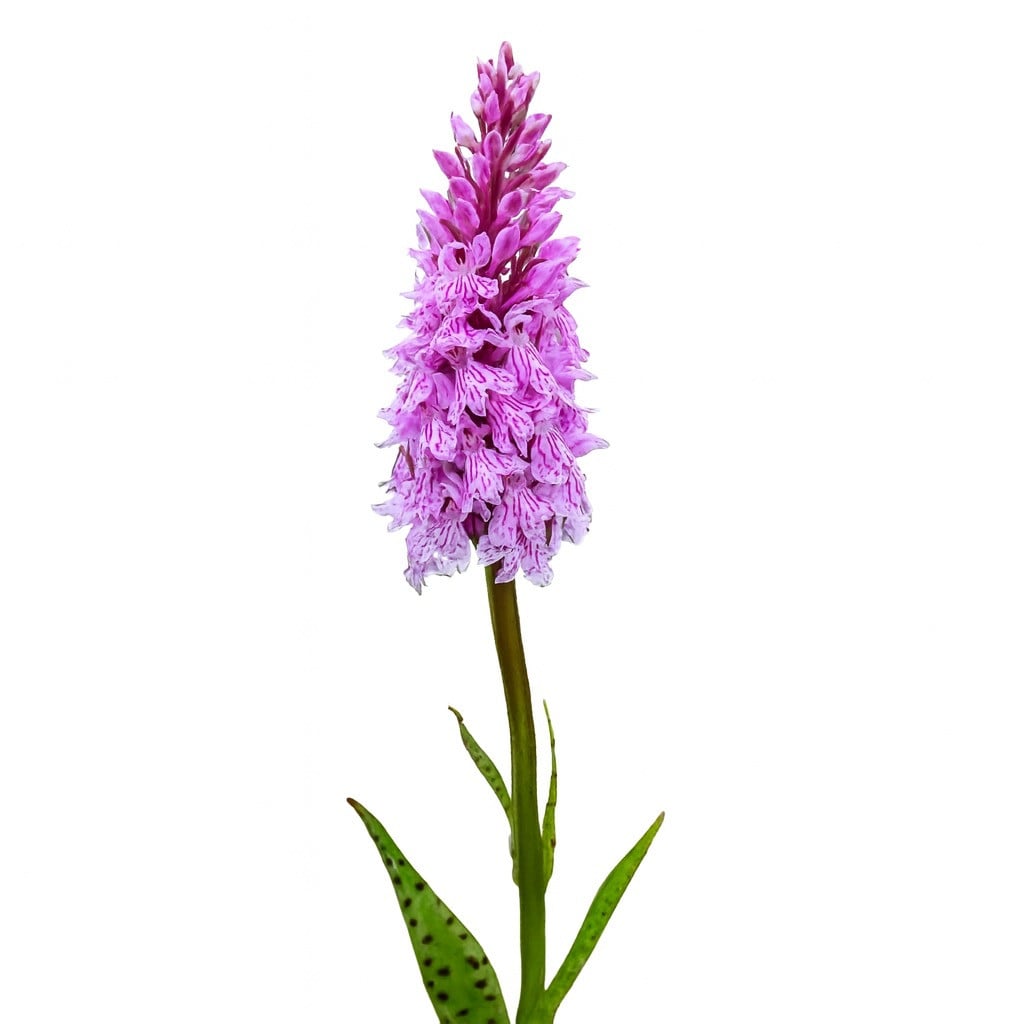
Variety
Geflecktes Knabenkraut / Flecken-Fingerwurz (Wildform)
Approved Data
created by Alex&Sempi at 03.12.2025
Features
Color
green
striped
brown
light green / pale green
speckled
glossy
Flower: white
Flower: crimson
lavender
Flower: pink
Oberfläche: wachsig
Wurzel: weiß
Wurzel: gelb
Blattrippen: grün
Wurzel: beige
Musterung: gepunktet
Stamm, Stiel: hellgrün
Resistances
resistant
Little susceptible
robust
fully hardy
hardy down to -30°C
Location
biotope: mountain area
biotope: forest
biotope: swamp / moor
planting: bed
planting: outdoor
sheltered from the wind
Soil: permeable soil
soil moisture: no waterlogging
Fertilization: nutrient-poor
fertilization: humus-enriched
light: light shade.
Light: Semi-Shade
soil moisture: well-drained
Soil moisture: dry to moderately moist
Water: regularly
Soil: light to medium-heavy
Soil: sandy to loamy
fertilization: lime-free
Soil: loosened
Water: Adequate
water: no tap water
Planting: edge of wooded areas or beneath trees
pH value: neutral (7)
Planting: pond / pond's edge
biotope: stream / pond / shoreline
Heat requirement: cool
Licht: vor Mittagssonne geschützt
Good companions: moisture-loving
Nachbarn schlecht: trockenheitsliebend
Good companions: shade tolerant
Nachbarn schlechte: kalkliebend
Nachbarn schlechte: sonnenliebend
Nachbarn schlechte: stark wuchernd
Nachbarn schlechte: hoher nährstoffbedarf
Nachbarn gute: mit niedrigen Nährstoffbedarf
Nachbarn schlechte: hochwachsend
Nachbarn gute: niedrigwachsend
Gartenstil: Naturgarten
Pflanzung: Rabatte
Gartenstil: Heidegarten
Gießen: Olla
Herkunft: einheimisch, indigen
Boden: flachgründig (0-30)
Boden: karg
Pflanzung: Moorbeet
Pflanzung: Waldbeet
Biotop: Feuchtwiese
Düngung: nicht erforderlich
Gartenstil: Waldgarten
Taste
not edible
Toxizität: ungiftig
Growth habit
cross-pollination
insect pollination
lifespan: perennial
Game Variety
growth habit: horst-forming
leaves: loosely leafed
flower: flowering
leaves: Deciduous
Cold germination
normal growth
growth habit: upright slender
ornamental plant
growth habit: Trailing
height: 50 - 60 cm
wide: 30 - 40 cm
height: 40 - 50 cm
hermaphroditic
growth habit: upright flower stems
root type: bulb, tuber
entire leaves
simple flower
small flowers
spicate flowers
non-woody
no lateral shoot development
Spear shaped leaves
propagation by seeds
propagation by offsets
perennial
Blätter: zugespitzt
Blätter: mittelgroß
Geschlechtertyp: einhäusig
Keimung: Lichtkeimer
Blätter: weich/zart
Wuchsform: krautig
Blätter: einfach
Blätter: oval
Blätter: länglich
Wuchs: mittel
Blütenform: zygomorph (spiegelbildlich)
Lebenszyklus: zieht im Herbst ein
Wuchsform: terrestrisch
Life cycle: sprouts in spring
Vermehrung: samenfest
Stamm, Stiel: rund
Stamm, Stiel: fleischig
Blätter: gefaltet
Fruit shape
capsule
elongated
smooth, sleek
egg-shaped
small
Oberfläche: trocken
Season Overview
Propagating
Planting
Harvest
J
F
M
A
M
J
J
A
S
O
N
D
1ST YEAR
FOLLOWING YEARS
Description
The orchid genus (bot. Dactylorhiza) belongs to the orchid family (Orchidaecea). Around 40 to 75 species belong to this genus. Botanists have recently begun to distinguish the genus Dactylorhiza from the genus Orchis, which is also known as orchids. Other names are foxglove and cuckoo flower. Orchids enchant every plant lover. Orchids have the typical orchid flowers, which take on beautiful shapes. Once you have admired the fascinating beauty of these plants in nature, you will never forget their elegance. In the wild, these rare creatures are protected by law. Anyone who brings these species into their garden is supporting nature conservation. The eye-catching plants impress with their breathtaking inflorescences. Some species develop spotted foliage that forms a perfect contrast to the flowers. Leaves Orchids form a loose rosette of leaves directly above the ground. Species in colder regions reduce the number of leaves. The base of the leaves is stem-encompassing. The leaves strive upwards and are colored differently depending on the species. The color spectrum ranges from pure green to a beautiful dark green. Some species have a dark to reddish pattern of spots on the leaf blades. The end of the leaf is either pointed or fused into a small hood. The leaf blades are broad to oval in most species. Species that grow at higher altitudes or in more northerly regions have narrow leaves. They are spread out flat or folded along the midrib. The leaf edges appear smooth to the naked eye. A finely toothed structure can be seen under the microscope. Below the inflorescence, bracts are formed which protrude above the inflorescence. Flower The shoot axis forms the inflorescence above the leaves. The individual flowers sit together in a racemose form. They are hermaphrodite and follow a trifoliate structure. This results in a mirror symmetry. The flowers have pink or purple, yellow or white hues. Orchids develop the flower shapes typical of orchids, which consist of a sepal pointing upwards, two lateral petals and a lower lip. The petals and sepals are fused together. They tower over the flower like a hood. The conspicuous markings on the lower lip are typical of the plants. It takes the form of spots or curved lines. There is a spur at the base of the flower. Flowering begins between May and June. Fruit The capsule fruits develop after the flowering period. Each capsule fruit contains between 2,000 and 5,000 seeds. These rates of formation are possible because the seeds contain no nutritive tissue. The plants use the energy to produce large quantities of seeds. The shape of the fruit is reminiscent of a spindle. The surface of the seeds has a pattern specific to each species. They retain their germination capacity for several years. This makes orchids special among orchids, which otherwise have a short germination period. In order for the seeds to germinate, they need nutrients from certain fungi. The fungus penetrates the seed so that it can grow. It forms a cell tissue known as a protocorm. Growth Orchids grow as perennial and herbaceous plants. They survive the cold season with underground tubers. The shape of the tubers differs depending on the species. Some representatives develop a five-part fingered rhizome. Other species have a roundish tuber with few divisions. The plants form a new tuber every year. Germination begins in April. The old rhizome dies off. The roots develop above the rhizome. The species reach growth heights of between five and 90 centimeters. Distribution The main distribution area of orchids extends from the temperate zones of Europe to Iceland. They occur in the Mediterranean region and are native to parts of North Africa and Asia Minor. Dactylorhiza hatagirea is a species that is native to the southern slopes of the Himalayas. It is considered the most south-easterly species within the genus. Dactylorhiza aristata extends from eastern Russia to the Aleutian Islands. The Madeira orchid (Dactylorhiza foliosa) represents the distribution limit in the southwest. They reach altitudes of up to 2,500 meters. Utilization Due to their different habitat requirements, orchids are suitable for a wide range of plantings. They embellish the edges of banks and provide colorful accents along bodies of water. In meadows that are only mowed once or twice a year, orchids make a valuable contribution to nature conservation. They are a must in any near-natural garden. They are ideal when planted individually or in small groups. In wet meadows, the purple-flowering plants harmonize perfectly with cinquefoil (Potentilla) and creeping buttercup (Ranunculus repens). In bog beds, the moisture-loving species cut a fine figure alongside checkerboard flowers (Fritillaria meleagris) and sundew (Drosera).
Non hybrid
Frostproof
Growing tips
cvs
Details


Light requirement
Semi-shaded

Water requirement
Moist

Soil
Medium (loamy)
Nutrient requirement
Low

Light germinator

Germination temperature
15 - 20 °C (Degrees Celsius)

Plant distance
30 cm

Row spacing
40 cm

Seeding depth
0.1 cm


Antagonistic Plants
Courgette / Zucchini
Cucumber / Gherkin
Grasses - Feather grasses
Grasses - feather-bristled grasses, lamp-cleaning grasses
Grasses - Fescue
Grasses - Pampas grass
Kohlrabi / German turnip / Turnip cabbage
Lavender
Okra
Pepper / Paprika
Pumpkin / Squash
Rapeseed
Rosemary
Sage
Succulents
Succulents - Cacti
Thyme
Tomato (Stake tomato)
Turnips - Wild turnips
Diseases
Root Rot
Pests
Larvae
Land snails
Aphids