Arrak roots / Arakachas

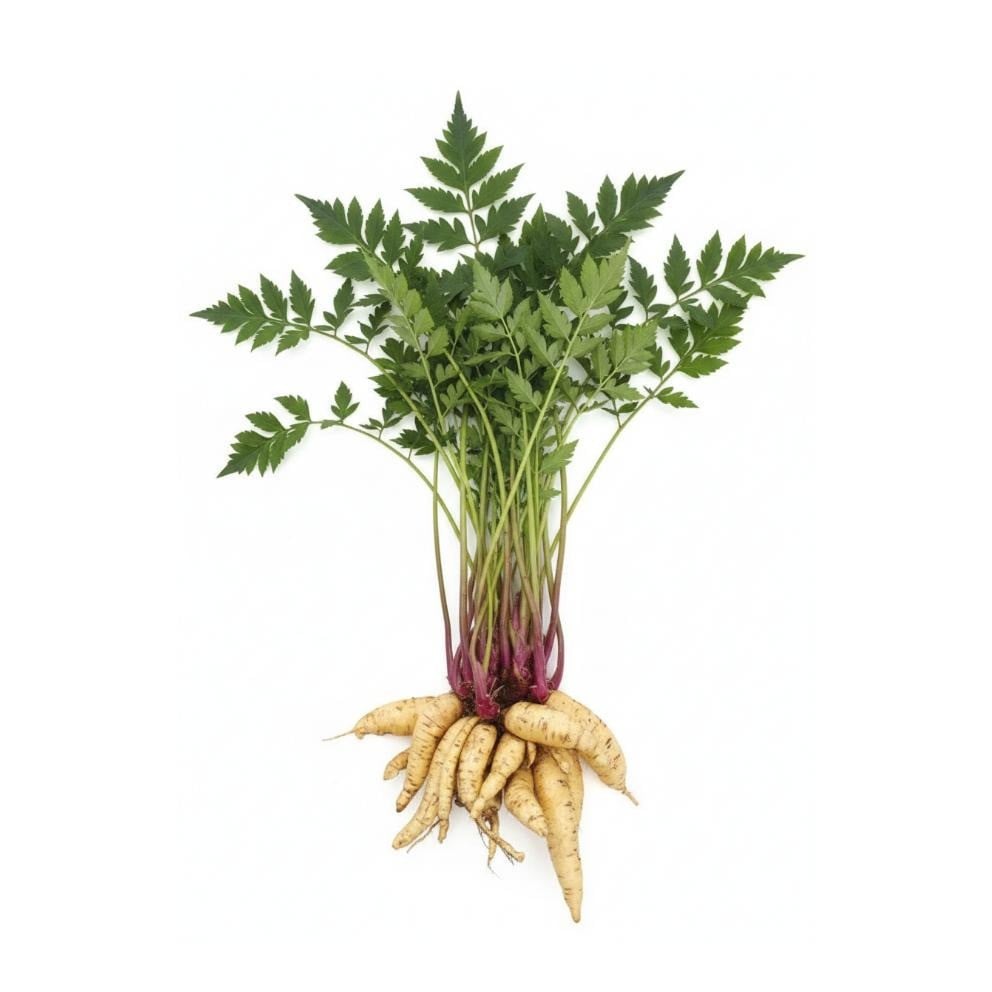
Arrak roots / Arakachas
Arracacia
Plant family
Umbellifers (Apiaceae)
Cultivation Break
4 Years
Season Overview
Propagating
Planting
Harvest
J
F
M
A
M
J
J
A
S
O
N
D
1ST YEAR
FOLLOWING YEARS
Details


Germination temperature
18 – 22 °C (Degrees Celsius)

Plant distance
50 cm

Row spacing
60 cm

Seeding depth
1 cm
Instructions
Description
Arracacia is a genus of flowering plants in the umbellifer family (Apiaceae). It is native to America, from Mexico to Bolivia. The economically most important species of the genus is the Arracacha (Arracacia xanthorrhiza). The genus comprises around 41 species. The perennial herbaceous plant, which resembles our celery, grows to a height of 1.0 to 1.5 meters. The feathery leaves with pinnate leaflets sit on long, reddish stems. The stems arise from the rosette-like above-ground root outgrowths (cormels, stems). The double umbels sit on the generative shoots. The umbels bear male and hermaphrodite, mostly self-sterile, i.e. intraflorally dichogamous flowers; they are pollinated by insects. The species is only self-fertile to a limited extent, i.e. self-pollination can occur.[1] Sepals may be present. The five petals are yellow or purple-brown. There are five stamens each. The species forms several cylindrical beet-like tubers (corms, storage roots) with fine lateral roots on the side of a "rhizome". In 8 to 12 months, the carrot-like and potato-colored tubers each grow up to 30 cm long and 3 to 8 cm thick. The "flesh" is whitish, yellowish, whitish to yellowish-purple. As the plants hardly ever set fruit, the crop plants are propagated vegetatively via root cuttings.
Origin:
America (Mexico to Bolivia)
Growing tips
The "turbo start" in February Plant the shoots (sprouts) in pots on the windowsill at the beginning of February. Tip: Use a heating mat under the pots. Warm feet (approx. 22°C) accelerate rooting enormously. As soon as they sprout green, they need as much light as possible. Alternatively, start sowing in January. Cleaning" the seedlings Before you plant the side shoots (colinos), prepare them: Cut back the old leaves at the top almost completely (leave only the heart leaves). Trim the base of the shoot smoothly with a sharp, clean knife. Allow the cut to air dry for 24 hours before planting it in the soil. This prevents rotting in the soil. Location tricks for cool nights Arracacha hates strong temperature fluctuations. Black fleece: Cover the ground around the plants with black mulch fleece or dark stones. These store the sun's heat during the day and release it into the soil at night. Raised bed advantage: In a raised bed, the soil warms up faster in spring and the drainage is better - ideal for arracacha! Mounding" (as with potatoes) As soon as the plant is about 20 to 30 cm high, you should lightly mound it up. Gently pull soil together around the stem close to the base. Effect: This promotes the formation of more side tubers and protects the sensitive "mother tuber" from light and dehydration. Water correctly: The "sponge method" Arracacha must never be allowed to dry out completely, otherwise the tubers will become woody. Watering rule: It is better to water small amounts more frequently than a deluge once a week. Water quality: If possible, use rainwater. Tap water is often too calcareous (increases the pH value), which stresses the plant. The trick for November When the first frost is reported but the leaves are still green: Build a small "tent" of double garden fleece over the plants. This can often extend the growing season by 2 to 4 crucial weeks. Every leaf that is still photosynthesizing in November will make your tubers thicker and sweeter.

Companion Plants

Antagonistic Plants

Diseases
Angular leaf spot of cucumber
Septoria
Powdery mildews
Root Rot
Pests
Nematodes
Aphids
Carrot fly
Voles