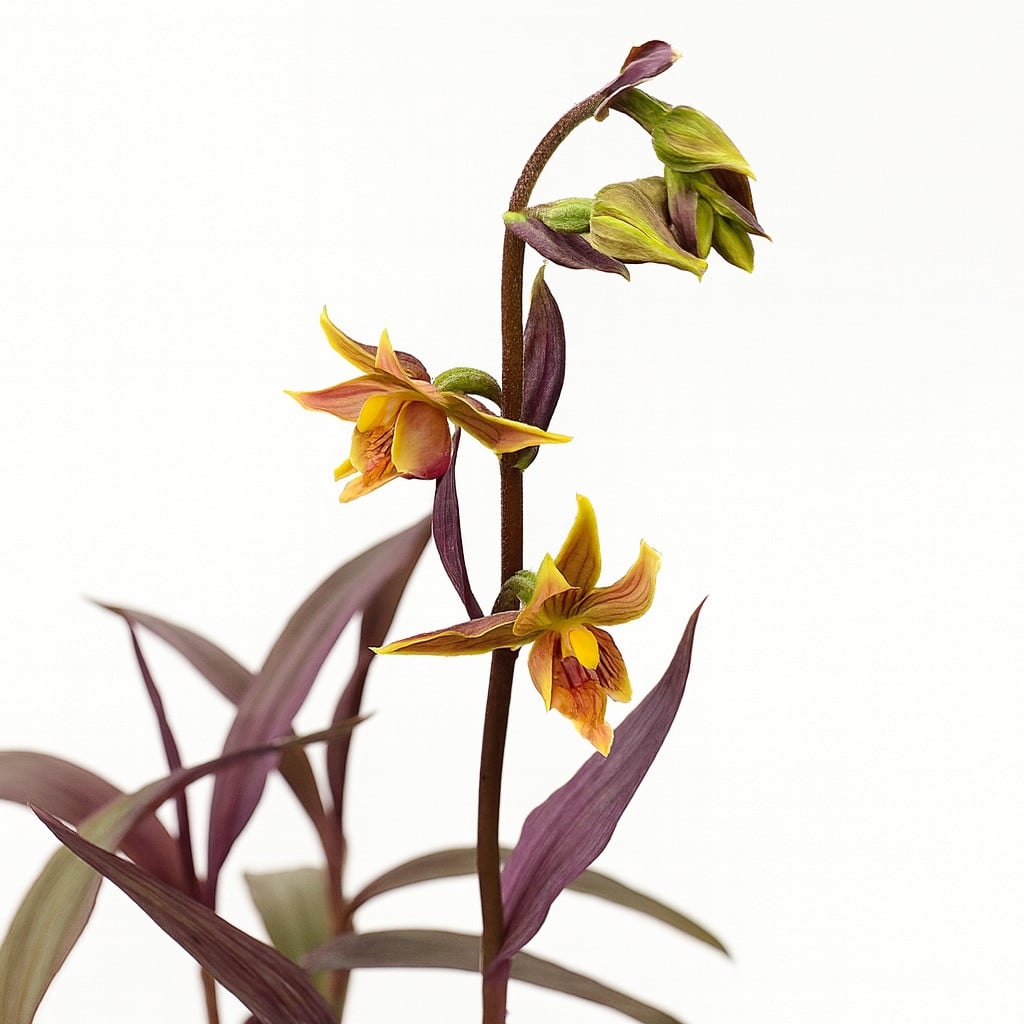
Riesen-Stendelwurz 'Serpentine Night'

Variety
Riesen-Stendelwurz 'Serpentine Night'
Approved Data
created by Alex&Sempi at 29.11.2025
Features
Location
biotope: forest
biotope: swamp / moor
biotope: stream / pond / shoreline
planting: bed
planting: outdoor
sheltered from the wind
light: sunny to semi-shady
Soil: permeable soil
Soil moisture: water-retentive
Hydroponics
fertilization: minimal
soil moisture: fresh to moist
soil moisture: moist
soil moisture: well-drained
Soil: medium-heavy
Water: regularly
planting: heat protected
soil moisture: not too dry
soil moisture: consistently moist
Soil: sandy to loamy
fertilization: low-nitrogen
pH value: acidic to neutral (5,5-7)
fertilization: lime-free
Soil: loosened
water: no tap water
Planting: pots, tubs, or boxes
Water: generously
Water: deeply
Soil moisture: moist to wet
Fertilization: low in potassium
Fertilization: low in phosphate
Planting: pond / pond's edge
Heat requirement: moderate
Licht: vor Mittagssonne geschützt
Good companions: moisture-loving
Nachbarn schlecht: trockenheitsliebend
Good companions: shade tolerant
Nachbarn schlechte: kalkliebend
Nachbarn schlechte: sonnenliebend
Nachbarn schlechte: stark wuchernd
Nachbarn schlechte: hoher nährstoffbedarf
Nachbarn gute: mit niedrigen Nährstoffbedarf
Nachbarn schlechte: hochwachsend
Nachbarn gute: niedrigwachsend
Gartenstil: Naturgarten
Gartenstil: Heidegarten
Herkunft: Neophyt
Herkunft: einheimisch, indigen
Boden: flachgründig (0-30)
Pflanzung: Moorbeet
Pflanzung: Waldbeet
Fertilization: nutrient-poor
fertilization: low-humus
Düngung: nicht erforderlich
Color
green
striped
multicolor
brown
glossy
medium green
yellow-green
Flower yellow
Fruit: yellow-green
crimson
Stamm, Stiel: purpur
Blätter: dunkelgrün
Oberfläche: matt
Blüte: grün
Frucht: grün
Musterung: verlaufend
Stamm, Stiel: grün
Stamm, Stiel: silbrig
Herbstfärbung: gelb
Wurzel: weiß
Wurzel: cremeweiß
Wurzel: gelb
Wurzel: braun
Blattrippen: grün
Samen: braun
Seeds: white/cream
Samen: grünlich
Behaarung: silbergrau
Samen: beige
purple
leaves: budding coloration
Blüte: braunrot/rotbraun
Blüte: hellbraun
Blätter: Austrieb violett
Blätter: Austrieb dunkelrot/schwarzrot
Growth habit
lifespan: perennial
growth habit: compact
growth habit: upright leaf position
growth habit: horst-forming
root type: shallow-rooted
leaves: Deciduous
strong leaves
normal growth
warm germination
cross-pollination
growth habit: upright slender
ornamental plant
root type: rhizome
Fragrant flowers
wide: 30 - 40 cm
height: 60 - 80 cm
hermaphroditic
growth habit: upright flower stems
entire leaves
simple flower
small flowers
non-woody
slow growth
no lateral shoot development
Spear shaped leaves
propagation by seeds
propagation by division
leaves slim
perennial
insect pollination
hand pollination
leaves: slightly wavy
Blütenstand: traubenförmig
Blüte: mittelgroß
Blätter: zugespitzt
Blätter: gerillt
Blätter: mittelgroß
Geschlechtertyp: einhäusig
Keimung: Lichtkeimer
Wuchsform: krautig
Wuchs: nicht invasiv
Blätter: einfach
Schnitt: nicht erforderlich
Blätter: oval
Blätter: länglich
Leaves: slightly hairy
Blütenform: lippenförmig
Blüte: kurzlebig
Blütenstand: einzeln, kleine Gruppen
Blütenform: zygomorph (spiegelbildlich)
Lebenszyklus: zieht im Herbst ein
Wuchsform: terrestrisch
Fruit shape
elongated
triangular
slightly ribbed
capsule
medium-sized
smooth, sleek
Resistances
resistant
fungus resistant
robust
disease resistant
moisture tolerant
Little susceptible
hardy with protection
hardy down to -20°C
Taste
not edible
mildly toxic
Toxizität: ungiftig
Season Overview
Propagating
Planting
Harvest
Harvest
J
F
M
A
M
J
J
A
S
O
N
D
1ST YEAR
FOLLOWING YEARS
Description
Epipactis (bot. Epipactis) is a plant genus within the orchid family (Orchidaceae). The number of species belonging to this genus varies from 25 to 90. Their inconspicuous, small flowers only attract attention on closer inspection. As orchids, all wild species are protected. These beauties follow special life strategies. They live in constant symbiosis with a fungal network that spreads through the substrate. Without this symbiosis, Stendel roots have no chance of survival, as they obtain important nutrients from the fungus. The reproductive strategy of these plants is no less impressive. Their flower shape mimics the appearance of bees and bumblebees, which are attracted by the colorful flowers. If you manage to establish these beautiful plants in your garden, you will have a real natural paradise. Leaf As Stendelworts are monocotyledonous plants, they develop leaves with parallel veins. The veins are visible on the upper side. They are clearly visible on the underside of the leaf. The leaves do not have a petiole. The leaf blade is located on the stem axis, while the leaf base surrounds the stem. The leaf blade is elongated lanceolate or somewhat broader. They follow an alternate or spiral arrangement. Flower Stendelworts bear typical orchid flowers. They are developed in a wide variety of colors. The three-petaled flowers are hermaphrodite. The flower consists of an outer and an inner bract circle. The outer circle represents the three sepals, which botanists call sepals. The inner circle of bracts is made up of three petals. The sepals are fused together in the lower part. The petals are largely free, with the lower petal forming a lip. The lip is shaped differently depending on the species. Some Stendelwurzen have small bump-like outgrowths on the lip. There are species that form a pattern on the labellum or whose labellum is colored differently from the other petals. The flowers are lateral on the stem. Some species develop flower axes with single flowers on one side. Other species have all-round flowers that are distributed around the flower axis. The color spectrum ranges from whitish-green to yellow, purple and brownish. The flowers are not monotonously colored. They have several colors and color gradients. The flowering period extends from June to August. Fruit The species develop capsule fruits in the fall, which contain numerous seeds. One fruit bears up to 10,000 seeds. The tiny seeds are light in weight. This feature is used for dispersal by the wind. The capsules open in dry weather so that they do not fall to the ground but fly away with the wind. They contain no nutritive tissue, as the plant invests its energy in developing large quantities of seeds. To germinate, the seeds need a fungus to supply them with nutrients. The high seed production ensures that the plants can reproduce. This increases the chance that some seeds will find the required fungus. Growth The plants grow as perennial herbaceous plants. They form an underground rhizome, which serves to survive. In the fall, the above-ground parts of the plant die off. The plant withdraws into the tuber and overwinters protected in the substrate. The next spring, the rhizome sprouts again and develops an upright shoot. The stem is hairy or bare. Many species form long stolons in the substrate, which they use to spread underground. In nature, the species tend to interbreed. Location Each species is a specialist when it comes to its location. This genus is characterized by species with different requirements in terms of temperature and soil. The majority of species prefer a semi-shady or shady location. They love moist, humus-rich or poor soil. In the garden, they grow on a fen substrate. Other species have specialized in dry locations. They grow in sunny locations with a stony substrate and thrive in calcareous conditions. Distribution Stendel roots occur from central Siberia via Iran to western Russia. Their distribution area extends from the Near East to Central Europe. Some species have established themselves in southern Scandinavia and spread to the northern Mediterranean region. Another area is in North America. They colonize bogs and swamps as well as forests and bushes. Stendelwort can be found in parks and extensively used wet meadows. Some species thrive on gravel slopes. Utilization The species of the genus Epipactis are ideal companions for the near-natural garden. If you have a large garden with damp and shady areas, you can offer the plants optimal conditions. They develop splendidly in wet meadows that are mown once or twice a year at most. Stendel roots are ideal for woodland beds. They cut a fine figure in arrangements with other bog plants. Riparian strips and damp water edges are visually enhanced with these species. Numerous cultivated forms and mixtures combine the characteristics of different species in terms of growth height, site requirements and flower coloration.
Non hybrid
Frostproof
Growing tips
vv
Details


Light requirement
Semi-shaded

Water requirement
Wet

Soil
Medium (loamy)

Nutrient requirement
Low

Light germinator

Germination temperature
20 - 25 °C (Degrees Celsius)

Plant distance
30 cm

Row spacing
40 cm

Seeding depth
0.2 cm


Antagonistic Plants
Bean (Dwarf bean)
Cucumber / Gherkin
Dahlia
Grasses - Bamboos
Grasses - feather-bristled grasses, lamp-cleaning grasses
Grasses - Pampas grass
Ivy
Kohlrabi / German turnip / Turnip cabbage
Larkspur
Lavender
Maples
Pepper / Paprika
Sage
Succulents
Succulents - Agave family
Succulents - Cacti
Sunflower
Thyme
Tomato (Bush tomato)
Diseases
Grey mold
Powdery mildews
Pests
Thrips
Spider mites
Land snails
Nematodes
Aphids