Buttonholes

Buttonholes
Cephalanthus
Plant family
Madder or Coffee family (Rubiaceae)
Season Overview
Propagating
Planting
Harvest
J
F
M
A
M
J
J
A
S
O
N
D
1ST YEAR
FOLLOWING YEARS
Details


Light requirement
Sunny

Water requirement
Moist

Soil
Medium (loamy)
Nutrient requirement
Medium

Light germinator

Germination temperature
20 – 25 °C (Degrees Celsius)

Plant distance
120 cm

Row spacing
120 cm

Seeding depth
0.5 cm
Instructions
Description
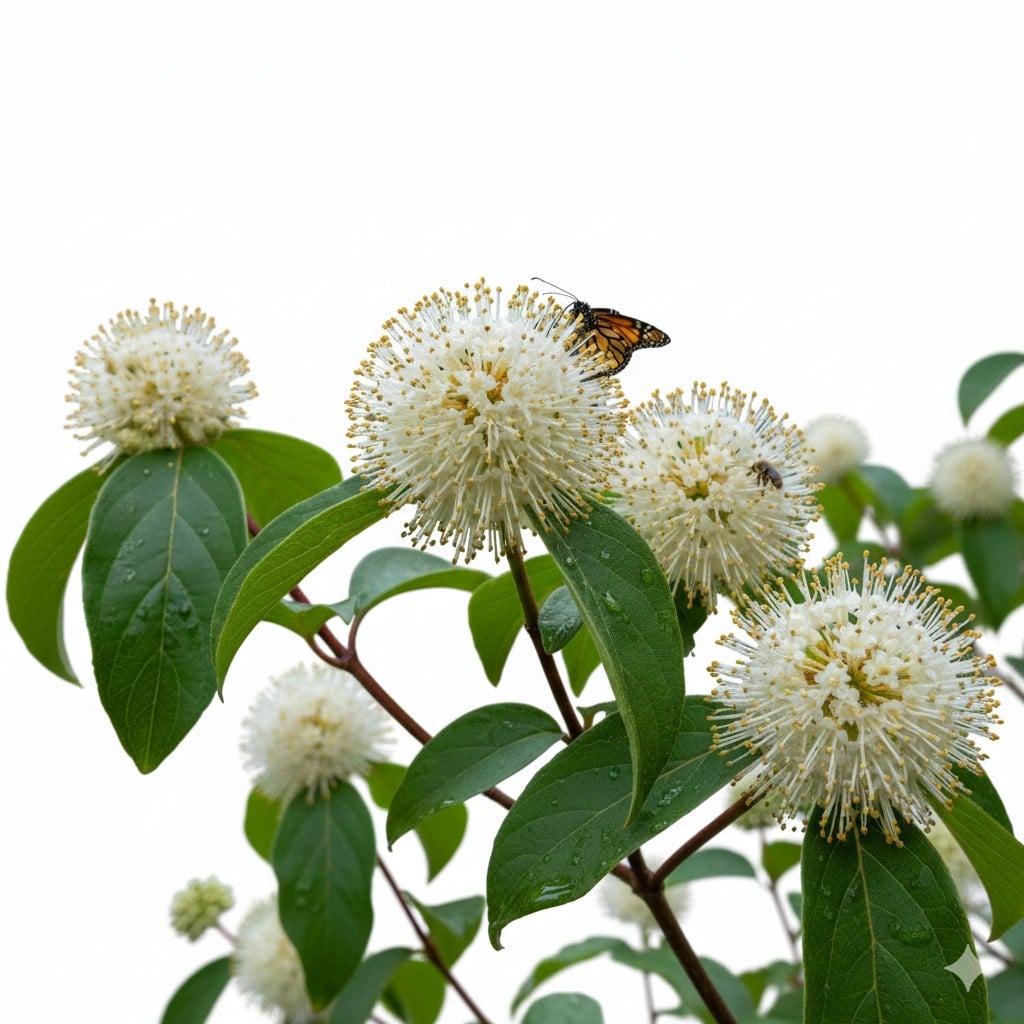
The buttonbush adorns itself with beautiful and unusual flower balls. They are up to three centimetres in size, spherical, white-yellow, with widely protruding stamens. They are reminiscent of globe thistles and adorn the buttonbush from July to August. Their intense fragrance earned the ornamental shrub the name honeyball. The spherical flowers of (bot.) Cephalanthus occidentalis attract numerous beneficial insects to the garden. It has a magical attraction for butterflies. Originally from the wetlands of North and Central America, this shrub is known as the western buttonbush and is a real rarity in this country. It can be planted in the garden or cultivated as a container plant. In containers, it is a beautiful eye-catcher on balconies and terraces. In the garden, it works equally well as a solitary plant or in a group. It combines wonderfully with perennials in borders and mixed beds. It also blends harmoniously into water gardens at the edge of ponds. Cephalanthus occidentalis is known to many gardeners as the button flower. This deciduous shrub grows well-branched, broadly upright and later bushy. It rarely grows into a tree shape. The buttonbush takes its time to grow. Over the years, it reaches a height of 150 to 200 centimetres with a diameter of up to 130 centimetres. The leaves are a glossy medium green and turn a bright orange to yellow color in autumn. But their radiance does not steal the show from the fantastically shaped flower balls! Filigree and unusual, they present themselves to the viewer who takes the time to admire them.
Origin:
North and Central America (Everglades, USA, Mexico, SE Canada)
Growing tips
In its native habitat, the buttonbush grows in fens, temporarily flooded marshes, river marshes and sparse alluvial forests. Accordingly, it should be planted in similar locations in the home garden. Ideally, the soil should be moist to wet. Western buttonbush even thrives in boggy ground! Cephalanthus occidentalis finds an ideal environment on the banks of a garden pond. Sunny to light or semi-shady spots in the garden are perfect. Wet feet do not harm the buttonbush. It only does not tolerate dry soil. The root area must never be allowed to dry out. Well-drained, nutrient-rich, sandy-loamy soil is ideal. In the right location, no additional watering is necessary, except for specimens in containers. A buttonbush kept in a tub requires a constant and plentiful supply of water. One or two annual applications of compost provide the ornamental plant with sufficient nutrients. The gardener should provide this in March and June. For potted plants, a fortnightly application of a liquid fertilizer or a single application of a slow-release fertilizer is recommended. During the winter, the gardener does not apply any additional fertilizer. The best planting time is from March to October. For potted plants, a pot volume of 7.5 liters or more is advisable, depending on the size of the plant. If necessary, pruning can be carried out in March, which is often more severe. Specimens planted out in the garden are hardy and can survive without winter protection. To protect the root area of potted plants, it makes sense to wrap them in fleece, straw mats or bubble wrap. The buttonbush Cephalanthus occidentalis will reward you with an abundance of spectacular, fragrant flower balls.

Companion Plants

Antagonistic Plants
Diseases
Powdery mildews
Root Rot
Pests
Spider mites
Aphids