Caucasian forget-me-not

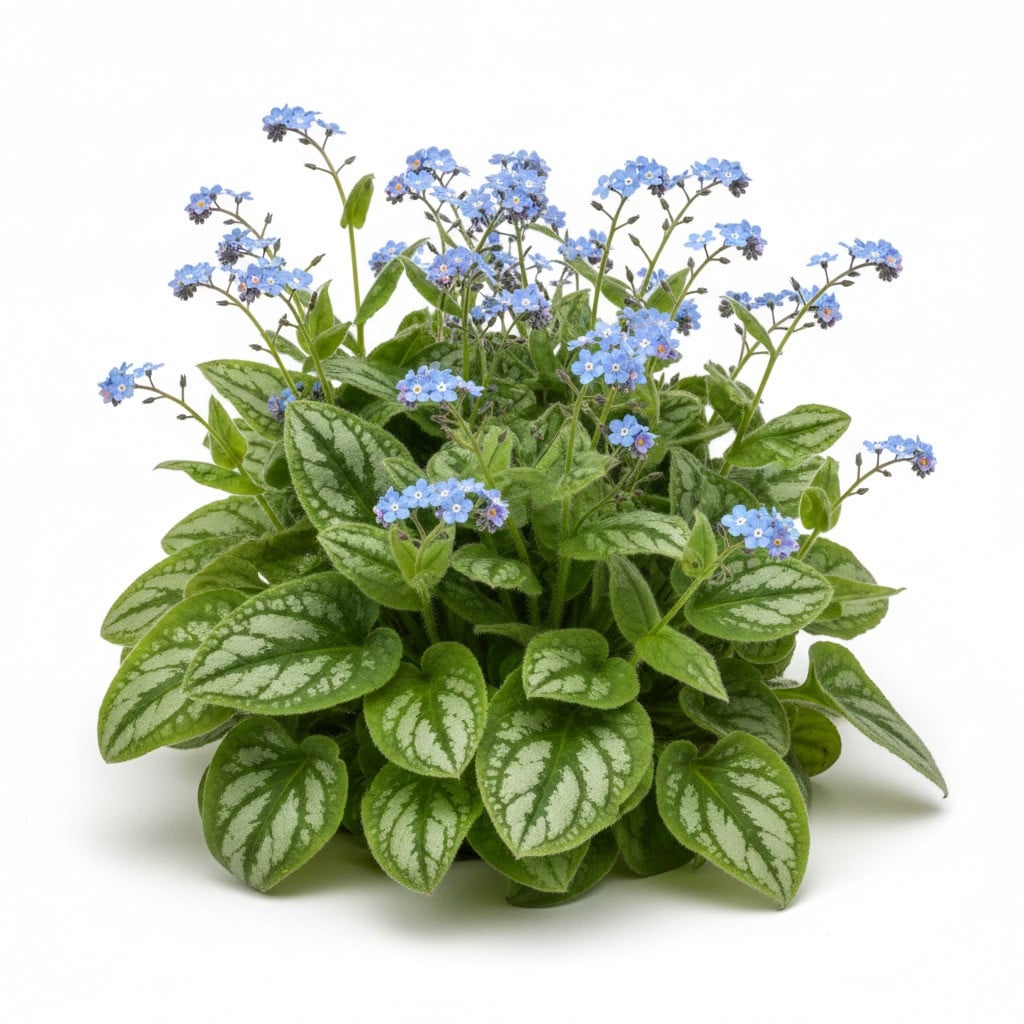
Caucasian forget-me-not
Brunnera macrophylla
Plant family
Borage family (Boraginaceae)
Season Overview
Sowing
Harvest
Harvest
J
F
M
A
M
J
J
A
S
O
N
D
1ST YEAR
FOLLOWING YEARS
Details


Light requirement
Semi-shaded

Water requirement
Moist

Soil
Medium (loamy)

Nutrient requirement
Medium

Plant distance
40 cm

Row spacing
40 cm

Seeding depth
0.5 cm
Instructions
Description
The Caucasian forget-me-not (Brunnera macrophylla) is a member of the borage family (Boraginaceae). The perennial originally occurs in the forests of Eastern Europe and Northwest Asia. Its flower shape shows that it is related to the forget-me-not (Myosotis), which spreads widely in the garden by seed, and the spring forget-me-not (Omphalodes verna), whose leaves are somewhat more inconspicuous. The wild species found its way from the subalpine forests of the Caucasus to Central European gardens as early as the beginning of the 19th century. The first cultivars of the perennial were soon available, but it was not until the turn of the millennium that varieties with striking silvery-white leaves were bred that they attracted greater attention. Incidentally, the Bund Deutscher Staudengärtner has named the Caucasian forget-me-not perennial of the year 2025. The Caucasian forget-me-not is a spreading to bushy perennial from the Caucasus that grows to a height of between 30 and 50 centimetres. It forms a short rhizome as a survival organ. The leaves of Brunnera macrophylla are softly hairy, medium to dark green and usually heart-shaped. They are between 5 and 20 centimeters long and have long leaf stalks. Dainty, panicle-shaped flowers in a bright blue appear from April to May. They are very similar to the flowers of the forget-me-not - hence the German name. After flowering, the Caucasian forget-me-not forms inconspicuous little nuts which contain a large number of seeds.
Growing tips
The Caucasian forget-me-not thrives best in the light shade of woody plants. If the soil is sufficiently moist, it can also be planted in a sunny spot. However, avoid locations in full midday sun. The perennial should be watered if it is persistently dry.

Companion Plants

Antagonistic Plants

Diseases
Root Rot
Powdery mildews
Pests
Land snails
Aphids