Grasses - feather-bristled grasses, lamp-cleaning grasses

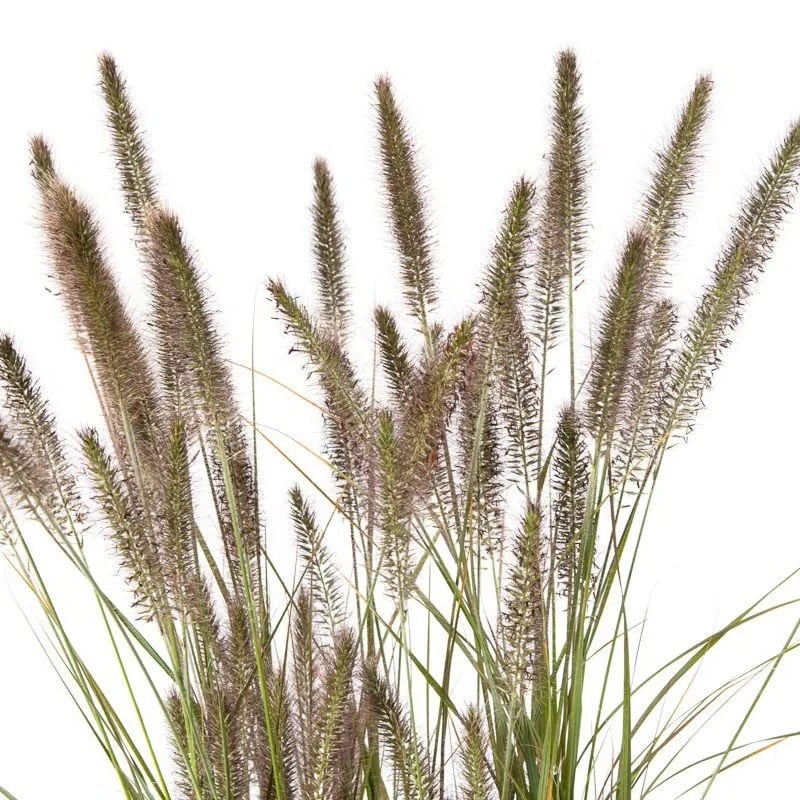
Grasses - feather-bristled grasses, lamp-cleaning grasses
Pennisetum
Plant family
Grass family (Poaceae)
Season Overview
Propagating
Planting
Harvest
Harvest
J
F
M
A
M
J
J
A
S
O
N
D
1ST YEAR
FOLLOWING YEARS
Details


Light requirement
Sunny

Water requirement
Dry

Soil
Medium (loamy)

Nutrient requirement
High

Plant distance
100 cm

Row spacing
100 cm

Seeding depth
0.2 cm
Instructions
Description
A member of the sweet grass family (Poaceae), Pennisetum alopecuroides originally comes from Japan, Korea, China and Australia, where it grows naturally on sunny plains. It was introduced to Europe in the second half of the 20th century, where it is very popular due to its high ornamental value and frost tolerance. There are around 80 other, predominantly perennial species in the genus of the lamp-cleaning grasses. However, Pennisetum alopecuroides and its varieties are the most widespread of all species in our gardens. The botanical name Pennisetum is due to the brush-like inflorescences of the ornamental grass - it is derived from the Latin words "penna" for "feather" and "seta" for "bristle". For this reason, lamp-cleaning grasses are also often called feather-bristle grasses. This perennial lampbrush grass forms a magnificent leaf clump with arching overhanging foliage, above which the filigree flower spikes appear in late summer. The leaf clump itself looks a bit like a small bush, as the leaves form an almost perfect hemisphere, and is about as wide as it is tall, sometimes even wider. While the species only grows to a height of around 60 to 90 centimetres, some varieties, such as 'Paul's Giant', can reach heights of up to 150 centimetres. The height of the inflorescences is measured here, the leaf stalk is around 20 centimetres lower. However, there are also dwarfs among the lamp-cleaning grasses, such as 'Little Honey' or 'Little Bunny' with a height of 30 centimetres. The leaves of the lamp-cleaner grass are very narrow and reach a maximum width of 12 millimeters. In summer, the leaf clusters of the species and varieties are gray-green, turning golden yellow in autumn. However, there are also varieties with unusual autumn coloration, for example 'Cassian', whose foliage has a reddish tinge, or 'Hameln', whose foliage very reliably turns a strong amber color. As a so-called "warm-season grass", the lamp grass sprouts late, but the ornamental grass is still very attractive in winter. The lamp-cleaner grass only displays its magnificent flower spikes, which are visually reminiscent of small bottle brushes or foxtails, in late summer, but the flowers then form an eye-catcher in the bed or pot from August to October. Even after the flowering period, the flowers do not disintegrate immediately, so you can still enjoy them in winter. The flower color varies from variety to variety. While the spikelets of the species are brownish and pinkish-red, the 'Cassian' variety blooms in ivory, while the flowers of 'Moudry' are dark purple. If the summer is short and rainy, or if you live in areas with a harsh climate, it may be the case that the lamp cleaners grass does not fully develop its characteristic flowers.
Growing tips
The lamp-cleaner grass thrives best in nutrient-rich, fresh soil with good drainage. It also likes a warm spot in full sun. If planted in full sun, however, you should make sure that the soil remains evenly moist; only well-established specimens can tolerate drought. Compacted, heavy soil is not suitable, as the ornamental grass has problems with waterlogging.

Companion Plants

Antagonistic Plants

Diseases
Root Rot
Septoria
Angular leaf spot of cucumber
Pests
Thrips
Spider mites
Aphids